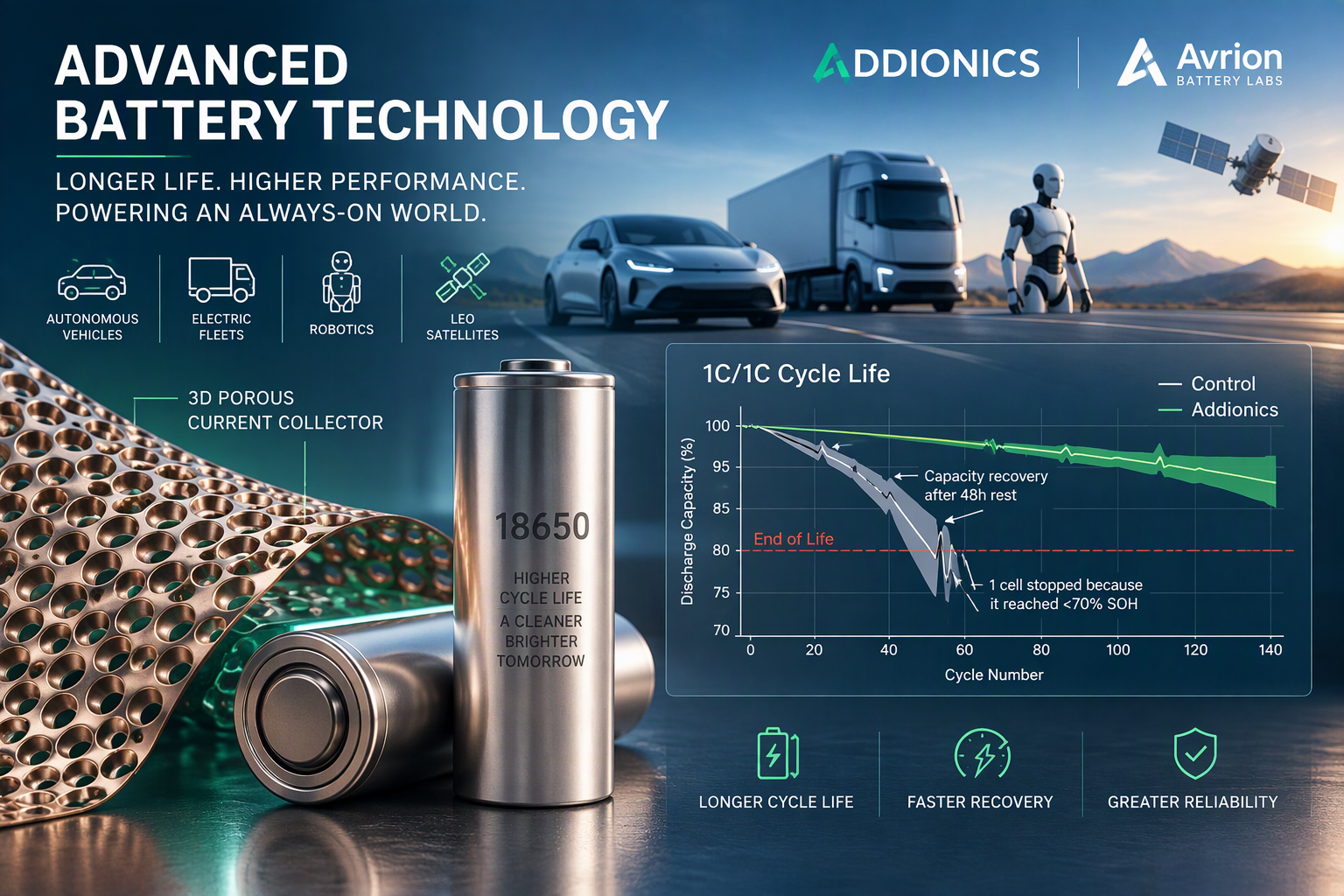
A case study at Avrion Battery Labs found that graphite/NMC811 cells using Addionics’ 3D porous current collectors completed approximately 3.5 times as many cycles as reference cells before reaching 80% state of health.
Addionics has reported longer cycle life and faster resistance stabilization during rest in lithium-ion cells incorporating its 3D porous current collectors.
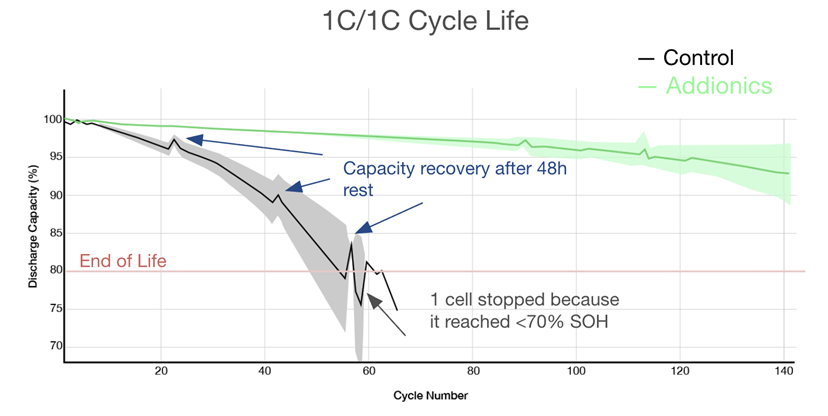
In a case study conducted at Avrion Battery Labs, 18650 cylindrical cells using the architecture completed approximately 3.5 times as many cycles as reference cells before reaching the study’s end-of-life threshold, defined as 80% state of health.
Testing used 1C charge and 1C discharge at 25 °C, with a scheduled 48-hour rest after every 20 cycles.
Addionics attributes the results to improved electrolyte and salt mobility inside the cells. However, salt distribution was not measured directly in the reported study.
Addionics and Avrion plan follow-up measurements to investigate that explanation.
Porous current collectors extend cycle life in reported tests
Avrion Battery Labs fabricated two groups of 2.7 Ah 18650 cylindrical cells using NMC811 cathodes and graphite anodes.
One group used conventional current collectors. The other incorporated Addionics’ 3D porous current collectors.
According to Addionics, cells using its collectors retained capacity over more cycles and showed smaller capacity-recovery steps following scheduled rests than the reference cells.
Addionics reports that the cells completed approximately 3.5 times as many cycles as the reference cells before reaching the study’s 80% state-of-health threshold.
The comparison applies to the cells and laboratory conditions described in the case study. It does not establish the same improvement across other battery chemistries, cell formats or operating conditions.
The release does not state how many cells were tested in each group or provide statistical uncertainty for the reported comparison.
Addionics reports faster resistance stabilization during rest
The case study also examined how the cells behaved during scheduled 48-hour rest periods.
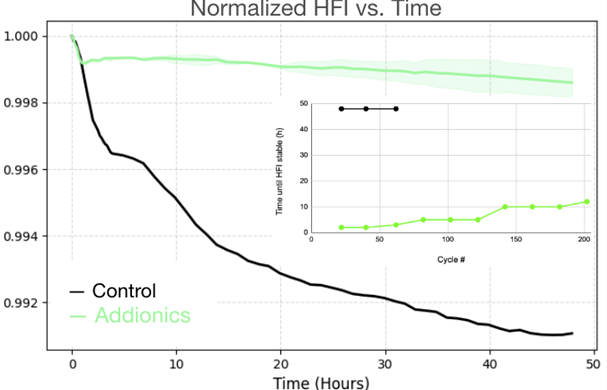
Periodic electrochemical impedance spectroscopy tracked the high-frequency intercept, or HFI, which the release describes as a measure of cell ohmic resistance.
Addionics reports that resistance stabilization occurred in less than two hours initially and in less than 12 hours by cycle 200.
The reference cells required more than 48 hours after the first 20 cycles, according to the company.
The accompanying resistance-relaxation figure uses HFI stabilization to characterize changes over time. Addionics says its cells showed a smaller resistance change and stabilized sooner, while the reference cells showed a larger and more prolonged decrease.
The release separately reports smaller discharge-capacity recovery steps in the Addionics cells after scheduled rests.
HFI stabilization and restored discharge capacity are related observations in the case study, but they are not interchangeable measurements. Addionics interprets the combined responses as consistent with faster relaxation of electrolyte salt-concentration gradients.
How Addionics says porous collectors could improve electrolyte transport
The proposed mechanism concerns how electrolyte and dissolved salt redistribute inside a battery during repeated charging and discharging.
According to Addionics, sustained cycling can produce uneven salt concentrations when electrolyte transport and salt redistribution cannot keep pace with operation.
In thick, high-loading electrodes, these concentration gradients can reduce accessible capacity, increase resistance and contribute to lithium plating on the anode.
The release also discusses electrolyte motion-induced salt inhomogeneity, or EMSI. Electrode expansion and contraction can move electrolyte and worsen uneven salt concentrations when redistribution is restricted.
Conventional solid metal-foil current collectors block direct electrolyte transport through the collector. Addionics says its porous structure introduces through-plane pathways, allowing electrolyte and salt to move more directly across electrode layers within the wound cell.
The engineering objective is to shorten the distance over which concentration gradients must relax.
Shorter pathways underpin the proposed mechanism
Addionics uses a simplified diffusion model to explain why shorter transport pathways could have a substantial effect.
In the simplified model cited by Addionics, characteristic relaxation time scales with the square of diffusion length and inversely with the effective salt-diffusion coefficient.
Shortening the pathway could therefore produce a proportionally larger reduction in the time required for redistribution.
The company says its architecture could reduce diffusion-relaxation times by hundreds to thousands of times by shortening diffusion distances.
That is a model-based claim, not a directly measured improvement in the overall charging time or cycle life reported in the case study.
Addionics expects the effect to become more significant in larger-format cells. The reported cycle-life comparison, however, used 18650 cylindrical cells.
Direct salt-distribution measurements are planned to test whether the proposed mechanism explains the observed results.
Cell design and test conditions
The case study compared two groups with the same stated chemistry and test conditions: one using conventional current collectors and the other incorporating Addionics’ porous architecture.
| Property | Test specification |
|---|---|
| Cell format | 18650 cylindrical |
| Capacity measured at C/3 | 2.7 Ah |
| Cathode | NMC811 |
| Anode | Graphite |
| Cathode single-side reversible areal capacity | 4.5 mAh/cm² |
| N/P ratio | 1.1 |
| Voltage window | 2.8–4.2 V |
| Charge rate | 1C |
| Discharge rate | 1C |
| Test temperature | 25 °C |
| Electrolyte | 1.2 M LiPF₆ in EC:EMC:DMC |
| Solvent ratio | 25:5:70 by weight |
| Additive | 2% VC |
| Electrolyte fill factor | 1.3 × total pore volume |
| Rest procedure | 48 hours after every 20 cycles |
| End-of-life threshold | 80% state of health |
Avrion’s work included:
- Roll-to-roll electrode coating
- Electrode fabrication
- Assembly of graphite/NMC811 18650 cells
- Ultra-high precision coulometry
- Electrochemical impedance measurements
- Cycling-performance tracking
This allowed the current-collector architecture to be evaluated in a practical wound-cell format rather than only through component-level testing.
The release also states that Avrion tested 18650-cell performance down to −10 °C and observed improved performance at high rates and low temperatures.
Detailed results from that low-temperature testing were not included in the supplied case-study summary.
Potential applications include autonomous fleets and robotics
Addionics identifies autonomous vehicles, electric fleets, humanoid robots and low Earth orbit satellites as potential applications for batteries that can sustain repeated operation with limited opportunities for rest.
The company argues that longer cycle life and shorter resistance-stabilization periods could improve availability in systems where downtime carries a significant operational cost.
Addionics says its porous current collectors could help by:
- Extending cycle life
- Reducing resistance-stabilization time during rest
- Improving electrolyte and salt mobility
- Limiting reversible salt-concentration gradients
- Supporting sustained high-rate cycling
The case study reports improved cycling performance under its specified laboratory conditions.
Improved salt mobility and reduced concentration gradients remain proposed explanations that require direct measurement.
The release does not provide field results from autonomous vehicles, robots or satellites using the technology.
Fleet savings model remains illustrative
Addionics also presents an illustrative business case for autonomous taxis.
The model assumes that expanding the usable battery window from 60% to 80% could provide one-third more usable energy or meet the same energy requirement with approximately 25% less battery capacity.
Assuming a $50,000 vehicle with a battery representing 35% of its cost, the company estimates potential savings of approximately $4.4 million across 1,000 autonomous taxis.
Those assumptions were not demonstrated by the Avrion cell test.
The release does not establish a validated pack-level operating window, a commercial battery-pack cost reduction or customer savings.
Actual outcomes would depend on pack design, battery pricing, operating requirements and the usable state-of-charge limits validated for a particular application.
Addionics also outlines a satellite use case
Addionics presents a separate illustrative example involving a $5 million satellite.
The company says extending the satellite’s operating life from five to six years could add one productive year without requiring another build or launch.
As with the autonomous-taxi calculation, this is an illustrative business case rather than a result demonstrated by the Avrion cell study.
The example is intended to show the potential value of longer battery life in an application where replacing or servicing the battery would be difficult.
Follow-up work will test the salt-mobility explanation
Addionics and Avrion plan direct salt-distribution measurements, with findings on the proposed mechanism expected in a future technical note.
The release also identifies larger cell formats, thicker electrodes, low-temperature operation and other transport-limited conditions as areas for further testing.
For now, the case study reports stronger cycling performance and faster resistance stabilization under a defined 18650-cell laboratory protocol.
Direct measurements will be needed to test the proposed salt-mobility mechanism. Larger-format and application-level testing will determine how consistently the reported benefits extend to commercial duty cycles.
FAQ: Addionics 3D Porous Current Collector Study
What did the Addionics and Avrion case study report?
Addionics reports that 18650 cells using its 3D porous current collectors completed approximately 3.5 times as many cycles as reference cells before reaching 80% state of health.
The study also reported faster resistance stabilization during scheduled rest periods.
What cells and test conditions were used?
Avrion fabricated 2.7 Ah 18650 cylindrical cells with NMC811 cathodes and graphite anodes.
Testing used 1C charge and 1C discharge at 25 °C within a 2.8–4.2 V window. The cells rested for 48 hours after every 20 cycles.
What is the end-of-life threshold in the study?
End of life was defined as 80% state of health.
The approximately 3.5× comparison refers to the number of cycles completed before reaching that threshold.
Was improved salt mobility measured directly?
No. Addionics says the capacity and resistance responses are consistent with faster salt-concentration relaxation.
Direct salt-distribution measurements are planned to investigate that explanation.
What is HFI?
HFI stands for high-frequency intercept.
The release describes HFI as a measure of cell ohmic resistance. Periodic electrochemical impedance spectroscopy was used to track HFI during the scheduled 48-hour rest periods.
Does the result establish the same improvement in EV battery packs?
No. The reported comparison concerns 18650 cells under specified laboratory conditions.
The release does not provide pack-level validation or field results establishing the same improvement in electric vehicles or other commercial applications.
Which applications could benefit from the technology?
Addionics identifies autonomous vehicles, electric fleets, humanoid robots and low Earth orbit satellites as potential applications requiring sustained operation with limited opportunities for rest.
The release does not report commercial deployments in those applications as part of this study.
What remains to be tested?
Addionics and Avrion plan direct salt-distribution measurements to investigate the proposed mechanism.
The release also identifies larger cells, thicker electrodes, low-temperature operation and other transport-limited conditions as areas for further testing.