A USCALE survey of more than 4,500 drivers in Germany found broad satisfaction with driver assistance systems, while warning sounds and unexplained interventions continued to limit acceptance.
Most drivers surveyed by USCALE are satisfied with the assistance systems in their vehicles, but intrusive warnings and interventions without an apparent reason continue to undermine trust.
The USCALE ADAS Satisfaction Study 2026 found that 81% of respondents were satisfied overall with their vehicle’s advanced driver assistance systems, or ADAS. However, only 35% were very satisfied.
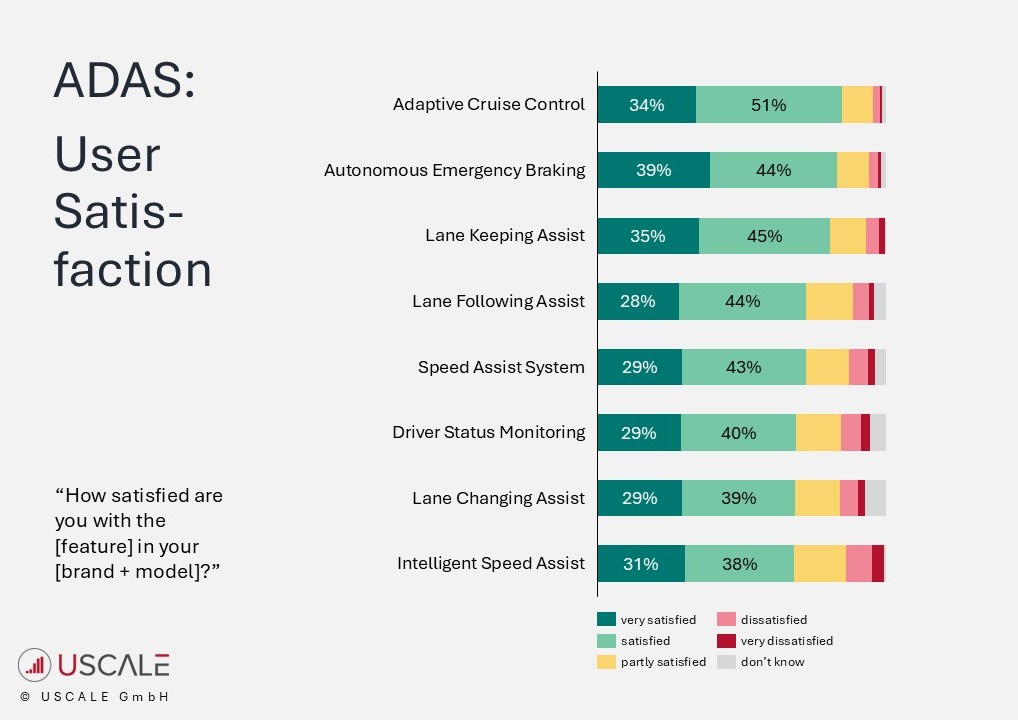
Adaptive Cruise Control achieved the highest satisfaction rating at 85%. Lane Change Assist and Intelligent Speed Assistance were among the lowest-rated features.
The study also found that factory settings strongly influence whether drivers leave optional systems enabled. Experienced electric vehicle drivers, meanwhile, were less likely to report being very satisfied than respondents in the broader survey panel.
Adaptive Cruise Control tops the satisfaction ranking
Adaptive Cruise Control was the best-rated individual feature, with 34% of respondents very satisfied and 51% satisfied.
Autonomous Emergency Braking followed with a combined satisfaction rate of 83%, ahead of Lane Keeping Assist at 80%.
| Driver assistance system | Very satisfied | Satisfied | Combined satisfaction |
|---|---|---|---|
| Adaptive Cruise Control | 34% | 51% | 85% |
| Autonomous Emergency Braking | 39% | 44% | 83% |
| Lane Keeping Assist | 35% | 45% | 80% |
| Lane Following Assist | 28% | 44% | 72% |
| Speed Assist System | 29% | 43% | 72% |
| Driver Status Monitoring | 29% | 40% | 69% |
| Lane Changing Assist | 29% | 39% | 68% |
| Intelligent Speed Assist | 31% | 38% | 69% |
Source: USCALE ADAS Satisfaction Study 2026 chart. System names follow the terminology used in the supplied graphic. Combined satisfaction is the sum of the displayed “very satisfied” and “satisfied” percentages.
Study compares mandatory and optional assistance systems
USCALE structured the study around mandatory and optional assistance systems, using the EU General Safety Regulation as its reference framework.
The study grouped the following as mandatory systems:
- Lane Keeping Assist
- Driver Drowsiness and Attention Warning
- Autonomous Emergency Braking
- Intelligent Speed Assistance
The optional systems examined were:
- Adaptive Cruise Control
- Speed Limit Assist
- Lane Following Assist
- Lane Change Assist
The combined Driving Assist function was also included.
USCALE examined whether respondents knew the systems were present, deliberately used them or switched them off. The research also considered default settings and satisfaction with warning sounds, steering interventions and controls.
Respondents’ open-ended suggestions for improvement were evaluated using AI-assisted analysis.
High awareness does not guarantee acceptance
Awareness of mandatory assistance systems was high. Depending on the system, between 88% and 97% of respondents knew that it became active whenever the vehicle was started.
However, fewer drivers deliberately left every system enabled because they wanted to use it.
For Autonomous Emergency Braking, 86% consciously left the system switched on. The figure fell to 71% for Lane Keeping Assist.
Intelligent Speed Assistance, which warns when the speed limit is exceeded, received a more critical response:
- 56% deliberately left it switched on.
- 23% usually switched it off.
- Among those who switched it off, 79% cited warning sounds as the main reason.
For Driver Drowsiness and Attention Warning, almost one in five respondents left the system active only because they did not know how to disable it.
The findings highlight an important distinction between a system being enabled and a driver actively choosing to use it.
Unexplained braking and warnings weaken confidence
Interventions without an apparent reason were a prominent source of dissatisfaction.
Among respondents dissatisfied with Autonomous Emergency Braking, 51% reported braking without an apparent reason.
For Driver Drowsiness and Attention Warning, 43% of dissatisfied users reported warnings without an apparent cause. USCALE also reported that only 31% considered the system very well developed.
Speed Limit Assist generated criticism over traffic-sign recognition. Half of dissatisfied users identified incorrectly recognized signs as a problem.
These findings describe respondents’ experiences and perceptions rather than independently verified technical faults.
“Assistance systems have arrived in cars, but not yet in drivers’ minds,” said Dr. Axel Sprenger, founder and managing director of USCALE GmbH.
“When systems are switched off because they are annoying or intervene for no reason, that is not only a technology problem but also a trust problem. One thing is clear: there is still a lot to do.”
Default settings strongly influence ADAS use
The study found a substantial difference in reported use depending on how optional systems were configured at the factory.
Among respondents whose vehicles had Adaptive Cruise Control enabled by default, 69% said they left the feature switched on. Where the system was disabled by default, only 7% said they routinely activated it.
USCALE reported the same general pattern across all optional systems, alongside considerable differences between manufacturers’ default settings.
The findings show that activation rates do not necessarily reflect an active preference for a feature, particularly when that feature is enabled at the factory. They do not establish how much driving was performed with the system actively controlling the vehicle.
Experienced EV drivers report lower satisfaction
USCALE compared respondents recruited through a broad access panel with experienced electric vehicle drivers from its BEV panel.
In the broader access panel, 48% were very satisfied with their assistance systems overall. Among experienced EV drivers, the figure was 23%.
The difference appeared across every individual system examined.
USCALE interprets the gap as a sign that experienced EV drivers have higher expectations of vehicle technology. The survey comparison does not establish whether expectations, vehicle mix or other differences between the panels caused the result.
The findings should therefore be treated as a comparison between the two survey groups rather than a conclusion about all EV drivers.
Driver assessments vary between brands
The study compared driver assessments of assistance systems across 12 vehicle brands.
According to USCALE, German premium manufacturers generally received above-average ratings for system maturity and overall satisfaction.
Korean brands and Volkswagen Group volume brands were mostly in the middle of the ranking or slightly below.
Tesla presented a mixed picture, with positive results for mandatory systems but below-average ratings for comfort features such as Adaptive Cruise Control.
The supplied release does not provide complete brand-by-brand scores or model-level results.
These are customer assessments rather than a controlled technical ranking of system performance. Nevertheless, the findings indicate that acceptance depends on how effectively each feature is implemented, not simply whether it is fitted.
Predictability remains central to driver acceptance
The study presents a more nuanced picture than either broad rejection or universal enthusiasm for ADAS. Overall satisfaction was high, although only 35% of respondents were very satisfied.
Warning sounds, incorrectly recognized traffic signs and interventions without an apparent reason remained important sources of frustration. Default settings also had a substantial influence on whether optional systems were used.
For manufacturers, the challenge is not simply adding more assistance features. Those systems must behave predictably enough that drivers actively choose to keep them enabled.
FAQ: USCALE ADAS Satisfaction Study 2026
How many drivers participated in the study?
The USCALE ADAS Satisfaction Study 2026 surveyed more than 4,500 drivers in Germany. The research compared a broad access-panel sample with experienced electric vehicle drivers from USCALE’s BEV panel.
How satisfied are drivers with ADAS overall?
USCALE found that 81% of respondents were satisfied overall with the assistance systems in their vehicles. However, only 35% were very satisfied.
Which driver assistance system received the highest satisfaction rating?
Adaptive Cruise Control ranked highest, with 85% combined satisfaction. The supplied chart shows that 34% were very satisfied and 51% were satisfied.
Why do drivers switch off Intelligent Speed Assistance?
Among respondents who usually switched off Intelligent Speed Assistance, 79% cited warning sounds as the main reason. Overall, 23% usually disabled the feature, while 56% deliberately left it enabled.
How did experienced EV drivers rate the systems?
Among experienced EV drivers in USCALE’s BEV panel, 23% were very satisfied overall, compared with 48% in the broader access panel. The study does not establish the cause of the difference between the two groups.