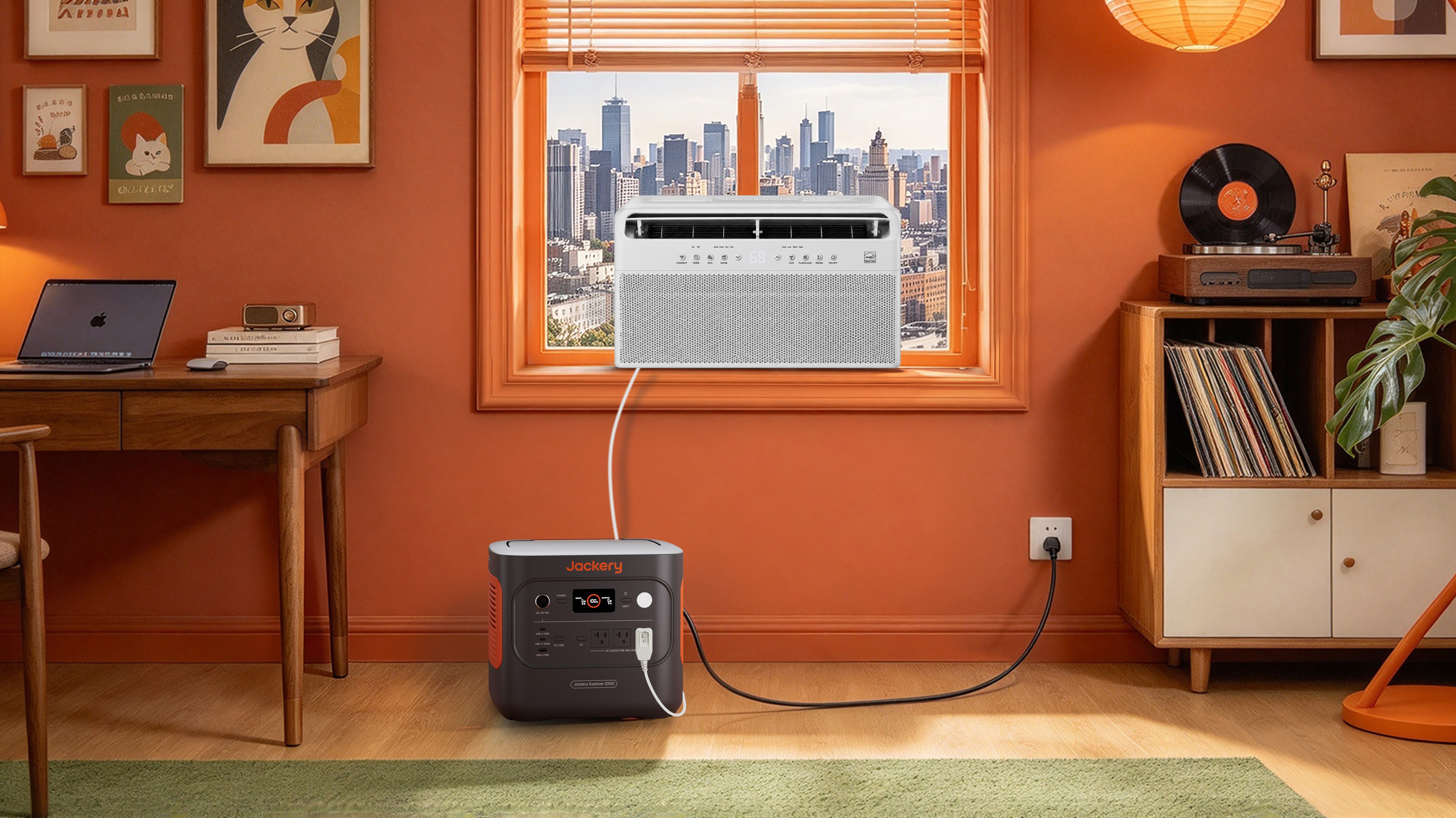
The program combines Jackery portable power stations with Every Electric’s cloud software, giving renters and multifamily residents backup power while coordinating household loads during peak grid-demand periods.
Jackery and Every Electric have announced a partnership to expand a plug-in virtual power plant designed for renters, apartment residents and multifamily households.
The companies describe the initiative as North America’s first plug-and-play VPP distribution network based on self-contained, expandable portable power stations.
The system uses Jackery home backup batteries, led by the Explorer 2000 v2, and Every Electric’s cloud-based orchestration software. Participating households connect appliances such as window or portable air conditioners to the power station’s passthrough outlet.
Every Electric can then manage the connected batteries during peak and off-peak utility periods. The companies say this allows residents to earn utility-bill rewards while maintaining household backup power.
Jackery and Every Electric will present the aggregated energy system at RE+ 2026 in Las Vegas from November 17 to 19.
Plug-in VPP targets renters and apartment residents
Conventional home solar and battery systems frequently require permanent installation, electrical work, municipal permits and agreements with a utility.
Those requirements can make participation difficult for renters and residents of multifamily buildings who do not control a roof, garage or electrical panel.
The Jackery and Every Electric program uses portable power stations that connect through standard household outlets. According to the companies, onboarding does not require permanent electrical retrofits or municipal permits.
The announced process includes:
- Online registration: Residents apply online and connect the program to their local electric utility, such as Consolidated Edison.
- Direct equipment delivery: Every Electric ships a Jackery portable power station to the participant.
- Appliance connection: A window or portable air conditioner connects to the power station’s passthrough outlet.
- Wi-Fi setup: The participant connects the battery to a home Wi-Fi network using the Jackery mobile app.
- Automated operation: Every Electric manages battery use during peak and off-peak demand periods.
The model is designed to make distributed energy participation accessible to households unable to install permanent solar panels or hardwired battery systems.
Jackery supplies batteries while Every Electric manages dispatch
The partnership combines Jackery’s portable battery hardware with Every Electric’s software and distributed-energy management capabilities.
Jackery’s Explorer 2000 v2 is the primary battery identified for the program. The power station provides household backup while supporting the connected appliance through its passthrough outlet.
Every Electric’s software connects participating batteries into a coordinated network. The platform manages when the systems store or supply energy in response to utility demand patterns.
By aggregating a large number of small household batteries, the program is intended to create a flexible energy resource capable of reducing demand during congested periods.
The announcement does not disclose:
- The power available from each participating battery during an event
- The duration or frequency of dispatch events
- The battery state-of-charge reserved for household backup
- Individual customer payment formulas
- Utility-program eligibility requirements
- The cost of participating equipment
- Whether residents own, lease or receive the batteries under another commercial arrangement
Those details will influence the financial and backup-power value available to individual participants.
New York program includes approximately 2,000 power stations
The partnership is building on the NYC A/C Powerbank Program, which has operated across Consolidated Edison’s New York City service territory since September 2026.
According to the announcement, the program currently includes:
- Approximately 2,000 portable power stations
- More than 1,000 participating households
- 4 MWh, or 4,000 kWh, of flexible storage capacity
- Nearly 50 MWh of energy throughput
- Seasonal household payouts approaching $200,000
- A waitlist covering more than 15,000 air conditioners
Jackery is serving as the lead hardware provider for ongoing battery deliveries.
The companies say the aggregated batteries are being used to manage air-conditioning demand during periods of summer heat. When coordinated across participating homes, those small household loads can collectively provide grid support.
The figures are company-reported results from the New York program. The announcement does not provide the reporting period for the approximately 50 MWh of throughput or a detailed methodology for calculating the grid impact.
Households can earn rewards while retaining backup power
Every Electric automates battery operation during peak and off-peak utility windows.
Participating households can receive financial rewards linked to their contribution. The companies say the highest-contributing households have earned enough to offset an entire month of summer electricity costs.
The announcement does not disclose average or median household earnings. The approximately $200,000 in seasonal payouts represents the program-wide total rather than a guaranteed payment for each participant.
Individual rewards are likely to depend on factors including:
- Participation in dispatch events
- Connected appliance demand
- Battery availability
- Utility-program rules
- Event duration and frequency
- Household electricity use
The battery remains available for emergency backup, giving participants a second use for equipment that also supports grid-demand management.
Air conditioners become flexible household loads
The New York program focuses on window and portable air conditioners because cooling demand can rise sharply during hot weather.
Under the announced setup, the air conditioner connects to the Jackery battery’s passthrough outlet. The battery remains plugged into a standard wall outlet and connected to the network through Wi-Fi.
Every Electric’s system then manages power use during relevant demand periods.
The arrangement is intended to shift or smooth electricity demand without requiring residents to manually control the battery during each event.
The announcement does not specify which air-conditioner models or power ratings are compatible. Prospective participants will need confirmation that their appliance, electrical outlet and Jackery system meet the program’s requirements.
Portable batteries create a different VPP model
A virtual power plant coordinates distributed energy devices so that they can respond collectively.
Many residential VPP programs rely on permanently installed solar batteries, smart thermostats, EV chargers or other connected equipment.
The Jackery and Every Electric initiative instead centers on portable batteries connected through standard electrical outlets.
“Traditional solar and storage require a roof, a garage or a permanent professional installation, which leaves renters and multifamily residents out,” said Andrew Wang, Co-Founder and CEO of Every Electric.
“Jackery’s portable power stations are the trusted name brand in this category. With Every Electric, adding grid services capabilities lets any household with a wall outlet earn on their bills while supporting the broader electrical infrastructure.”
The approach gives apartment residents a potential route into distributed-energy programs without requiring ownership of the building or permanent changes to the property.
However, participation will still depend on utility coverage, program availability, equipment compatibility and household connectivity.
Jackery will showcase the system at RE+ 2026
Jackery and Every Electric will present the plug-in VPP system at RE+ 2026 in Las Vegas.
The event runs from November 17 to 19, 2026.
Jackery’s display will include the Explorer 2000 v2 used in the New York program and the higher-capacity Explorer 5000 Plus.
The Explorer 5000 Plus can be paired with the Jackery Smart Transfer Switch for modular home backup applications.
The announcement does not provide a national rollout schedule or identify the next utility territories expected to offer the plug-in VPP model.
New York results will shape wider deployment
The NYC A/C Powerbank Program provides an early operating example of portable household batteries being aggregated for grid support in a dense urban environment.
Its reported 4 MWh of flexible storage, nearly 50 MWh of energy throughput and approximately $200,000 in seasonal payouts indicate that small systems can become a material resource when coordinated across many homes.
The next milestones will be expanding participation beyond the current households, addressing the waitlist of more than 15,000 air conditioners and establishing whether the model can be replicated in other utility territories.
Jackery and Every Electric have not yet announced where or when that broader expansion will begin.
FAQ: Jackery and Every Electric Plug-In Virtual Power Plant
What have Jackery and Every Electric announced?
Jackery and Every Electric have partnered on a plug-in virtual power plant for renters, apartment residents and multifamily households.
The system connects Jackery portable power stations through Every Electric’s software so participating batteries can respond collectively during peak and off-peak utility periods.
What is a plug-in virtual power plant?
The announced VPP aggregates portable household batteries that connect through standard wall outlets and home Wi-Fi networks.
Every Electric’s software coordinates the batteries, allowing them to operate as a distributed grid resource while also providing household backup power.
Which Jackery battery does the program use?
The program is centered on certified battery-storage units led by the Jackery Explorer 2000 v2.
Jackery will also display the higher-capacity Explorer 5000 Plus with Smart Transfer Switch support at RE+ 2026.
How does a participant join the program?
The announced onboarding process includes online registration, connection to the resident’s utility provider, direct battery delivery, appliance connection through the passthrough outlet and Wi-Fi pairing through the Jackery mobile app.
Program availability will depend on the resident’s location and utility.
Which household appliances are connected?
The current New York program focuses on window and portable air conditioners.
The announcement does not provide a complete list of compatible models or appliance power limits.
How large is the New York program?
The NYC A/C Powerbank Program includes approximately 2,000 power stations across more than 1,000 households.
The companies report 4 MWh of flexible storage capacity and nearly 50 MWh of energy throughput.
How much can participating households earn?
Total seasonal payouts across participating New York City homes are approaching $200,000, according to the announcement.
Some heavily contributing households have earned enough to offset one month of summer electricity costs. Average and median household payments were not disclosed.
Does the battery still provide backup power?
Yes. The companies position household backup as one of the program’s main benefits.
The announcement does not disclose how much battery capacity is reserved for backup during utility dispatch events.
Does joining require electrical work or a permit?
Jackery and Every Electric say the onboarding process does not require electrical retrofits or municipal permits.
Participants connect the power station through a standard wall outlet and connect a compatible air conditioner to its passthrough outlet.
Is the program available outside New York City?
The announcement confirms operation in Consolidated Edison’s New York City service territory.
Jackery and Every Electric have not announced a broader rollout schedule or identified additional participating utilities.