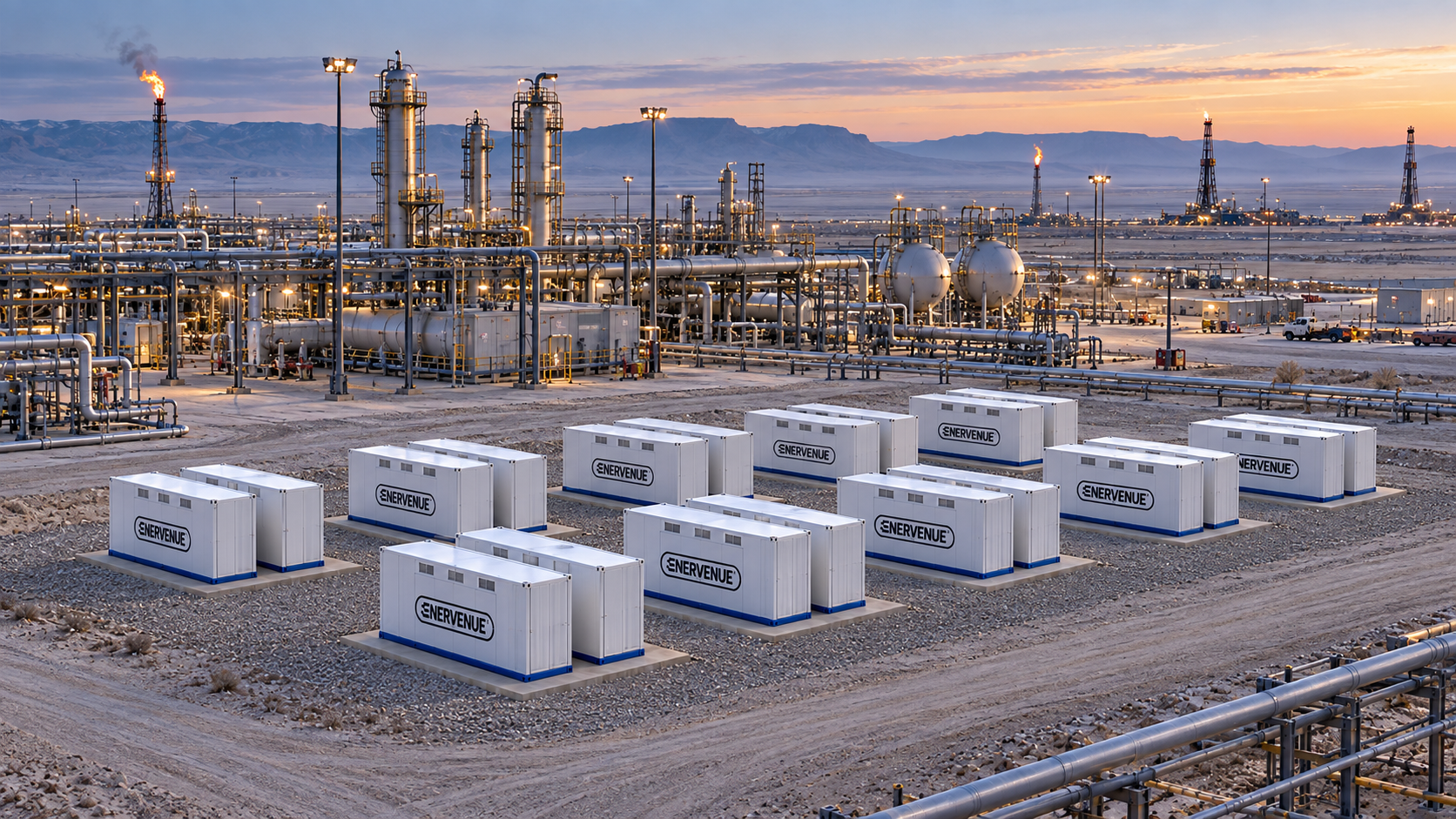
EnerVenue has secured its first multi-megawatt-hour commercial order for its lithium-free battery technology, with 26 Energy Prism containerized storage units set for deployment at an operating oilfield in northern China.
The systems will provide a combined capacity of 11 MWh and store electricity generated by an onsite solar array. The stored energy will be supplied back to the oil and gas operation when required, allowing the site to shift daytime solar generation into periods of higher demand. For EnerVenue, this marks a critical transition from pilot projects to utility-scale deployments — validating its manufacturing ramp-up in Changzhou and opening doors to other high-safety industrial sectors like mining, data centers and defense.
In Brief
EnerVenue will supply 26 Energy Prism battery storage containers, totaling 11 MWh, to an oilfield in northern China. The lithium-free systems will store energy from an onsite solar array, with the first shipments planned for December 2026 and the remaining units due in March 2027.
The first three Energy Prism units are scheduled to ship in December 2026. The remaining 23 units are due to follow in March 2027. EnerVenue has not yet disclosed the customer’s identity or the precise location of the installation, describing the buyer as a major Chinese oil and gas producer.
Based on typical containerized BESS configurations, an 11 MWh system paired with solar at an oilfield likely operates at 2–5 MW power output, suggesting 2–5 hour discharge durations — suitable for shifting midday solar to evening peaks.
Safety Requirements Drive Battery Selection
According to EnerVenue, fire and process-safety requirements were a deciding factor in the oil and gas producer’s selection of its battery technology.
Industrial oil and gas sites have strict requirements for equipment operating near production infrastructure. Battery storage systems installed in these environments must be assessed not only for performance and cost, but also for their behavior under abnormal operating conditions.
EnerVenue’s Aqueous Metal Cell uses a water-based, non-flammable electrolyte and does not contain lithium. The company says the chemistry does not follow the same sequence of events associated with thermal runaway, ignition and propagation in conventional lithium-ion cells.
The cells have undergone UL 9540A testing, with EnerVenue reporting no fire propagation at cell level. However, the company’s “zero risk” descriptions remain manufacturer claims and should be evaluated alongside project-specific safety studies, applicable codes and certification requirements.
“An oil and gas producer does not put new technology on a working site unless it is completely satisfied that the safety case is sound, and this customer examined everything before choosing us,” said Henning Rath, Chief Executive Officer of EnerVenue.
“A battery designed to run for thirty years is a piece of infrastructure, and infrastructure gets judged on how it performs across its whole life rather than on the day it is delivered.”
Dr Majid Keshavarz, Chief Technology Officer at EnerVenue, said the Aqueous Metal Cell’s chemistry does not produce the progression of exothermic events that can lead to ignition, explosion or propagation to adjacent cells.
“That is a property of the chemistry itself, and it is what allows this battery to go onto sites with the strictest fire safety requirements,” Keshavarz said.
Energy Prism Containers Will Shift Daytime Solar Generation
The northern China project will pair battery storage with an existing onsite solar array.
During periods of solar generation, electricity will be stored in the 26 Energy Prism containers. The oilfield can then draw on the stored energy when production from the solar installation falls or when the site’s electricity requirements increase.
Each Energy Prism will be delivered as a complete containerized system designed to connect to the oilfield’s power-conversion equipment. The units will be built using EnerVenue’s fourth-generation Aqueous Metal Cells.
Containerization can simplify the transport, installation and commissioning of large energy-storage projects by combining cells, battery-management equipment and internal electrical components into standardized enclosures.
EnerVenue has not disclosed the duration rating of the 11 MWh installation, the associated power output in megawatts, the power-conversion system supplier or the expected share of the oilfield’s electricity demand that the system will serve.
Aqueous Metal Cell Uses Nickel-Hydrogen Chemistry
EnerVenue’s Aqueous Metal Cell is based on nickel-hydrogen chemistry, an established battery technology previously used in aerospace applications, including satellites and space missions.
The company has redesigned the chemistry for stationary energy storage using steel, nickel, glass-fiber composite and a water-based electrolyte. The cell contains no lithium or rare-earth materials, while the nickel and steel can be recovered for reuse at the end of the product’s operating life.
Each fourth-generation Aqueous Metal Cell provides 3 kWh of usable energy. EnerVenue specifies a design life of 30,000 cycles, equivalent to as many as three charging cycles per day over 30 years under its stated operating conditions.
The company also states that the cells can operate between -20°C and 60°C without active thermal management and can reach peak round-trip efficiency above 90%. These figures are based on EnerVenue’s technical specifications and may vary according to system configuration, operating profile and environmental conditions.
EnerVenue says installations using the technology do not require scheduled capacity augmentation or active cooling. It also says a fire-suppression system may not be necessary where local regulations allow, potentially reducing the auxiliary equipment associated with a storage project.
Final system requirements will nevertheless depend on local fire codes, site design, permitting conditions and the decisions of the relevant authorities and project stakeholders.
Technology Comparison: Aqueous Metal Cell vs. Typical Lithium-Ion
| Feature | EnerVenue Aqueous Metal Cell | Typical Lithium-Ion NMC |
|---|---|---|
| Chemistry | Nickel-Hydrogen, water-based electrolyte | Lithium-Nickel-Manganese-Cobalt Oxide |
| Thermal Runaway Risk | None reported (UL 9540A passed) | Requires BMS + fire suppression |
| Cycle Life | 30,000 cycles (~30 years) | 8,000–10,000 cycles (~7–10 years) |
| Operating Temp Range | -20°C to 60°C (no active cooling) | Typically 0°C to 45°C (needs cooling/heating) |
| Materials | Steel, nickel, glass-fiber, water | Lithium, cobalt, graphite, rare earths |
| End-of-Life Recyclability | High (steel/nickel recoverable) | Complex recycling, lower recovery rates |
First Commercial Contract at Multi-Megawatt-Hour Scale
The 11 MWh order represents a significant step up from EnerVenue’s first operational Aqueous Metal Cell installation.
A 150 kWh system has been operating at a Towngas facility in Jintan, Changzhou, since November 2025. That pilot combines onsite renewable generation with electric bus charging and uses 50 Aqueous Metal Cells, an inverter and a battery-management system.
The pilot charges and discharges over two-to-four-hour periods to match demand and reduce electricity costs. It gives the technology direct relevance to the EV charging sector by demonstrating how stationary storage can integrate renewable generation with charging infrastructure for electric buses.
The northern China oilfield project is considerably larger and represents EnerVenue’s first commercial contract at multi-megawatt-hour scale. It will test the company’s ability to move from pilot operation to a larger industrial deployment.
“Oil and gas operators are among the world’s most demanding buyers of industrial equipment, and fire safety is non-negotiable,” said Rahul Mehta, Chief Revenue Officer at EnerVenue.
“This order demonstrates growing demand for energy storage designed not only for exceptional fire safety, but also for reliable performance over decades.”
New Changzhou Factory Will Supply the Cells
The Aqueous Metal Cells for the oilfield order will be produced at EnerVenue’s new high-volume manufacturing line in Changzhou, Jiangsu.
The first phase of the facility is designed to produce 250 MWh of cells annually, equivalent to approximately 300 cells per day at full automation. EnerVenue plans to expand production capacity to 1 GWh in 2027 and reach multi-gigawatt-hour scale by 2028.
EnerVenue describes the site as the first factory to manufacture its Aqueous Metal Cell technology at commercial scale. The company is also introducing four products built around the same chemistry:
- Energy Core: A 30 kWh system for distributed, telecommunications and remote-site applications
- Energy Cube: A 108 kWh system designed for in-building and data center applications
- Energy Rack: A 150 kWh system for commercial, industrial and grid-connected projects
- Energy Prism: A containerized product for utility-scale and heavy industrial installations
The Energy Core and Energy Cube use natural-air cooling and integrate Aqueous Metal Cells, battery-management systems and internal wiring into site-ready DC blocks.
The Changzhou production expansion is being supported by a $300 million Series B extension announced by EnerVenue in March 2026 and led by Full Vision Capital. The company says it has raised more than $700 million in total.
EnerVenue reports customer projects across China, Australia, the United States, the European Union, Saudi Arabia and Canada. Its named customers include Radiance Energy, PowerSecure and Western Australian utility Horizon Power.
The new oilfield order gives the company its first opportunity to deploy the lithium-free technology at an 11 MWh commercial scale, while pairing containerized storage with onsite renewable generation in a safety-sensitive industrial environment.
For more information, visit EnerVenue’s official press release.
FAQ: EnerVenue 11 MWh Battery Order
What has EnerVenue been contracted to supply?
EnerVenue will supply 26 containerized Energy Prism battery storage units with a combined capacity of 11 MWh. The systems will be installed at an oil and gas production site in northern China.
What will the 11 MWh battery system be used for?
The system will store electricity generated by an onsite solar array and supply it back to the oilfield operation when required, shifting daytime solar production into other periods of demand.
When will EnerVenue deliver the Energy Prism units?
The first three Energy Prism containers are scheduled to ship in December 2026. The remaining 23 systems are expected to ship in March 2027.
Does EnerVenue’s battery contain lithium?
No. EnerVenue’s Aqueous Metal Cell uses nickel-hydrogen chemistry with a water-based electrolyte. The company says the cell contains no lithium or rare-earth materials.
Has the Aqueous Metal Cell undergone fire testing?
EnerVenue says the cell has completed UL 9540A testing without fire propagation at cell level. The company describes its water-based electrolyte as non-flammable, although project-level safety requirements remain subject to applicable codes, certifications and site assessments.
Does EnerVenue’s battery technology have an EV charging application?
EnerVenue’s first operational Aqueous Metal Cell project is a 150 kWh system in Changzhou that combines onsite renewable generation with electric bus charging. The 11 MWh oilfield order is an industrial solar-storage project rather than a dedicated EV charging deployment.