For a long time, the EV story has been a tale of steel and copper: the number of plugs, kilowatts involved, how fast can a car charge. This story still remains valid, but there is another one becoming equally relevant for operators, utilities, and fleets – who decides when and how this electricity will flow.
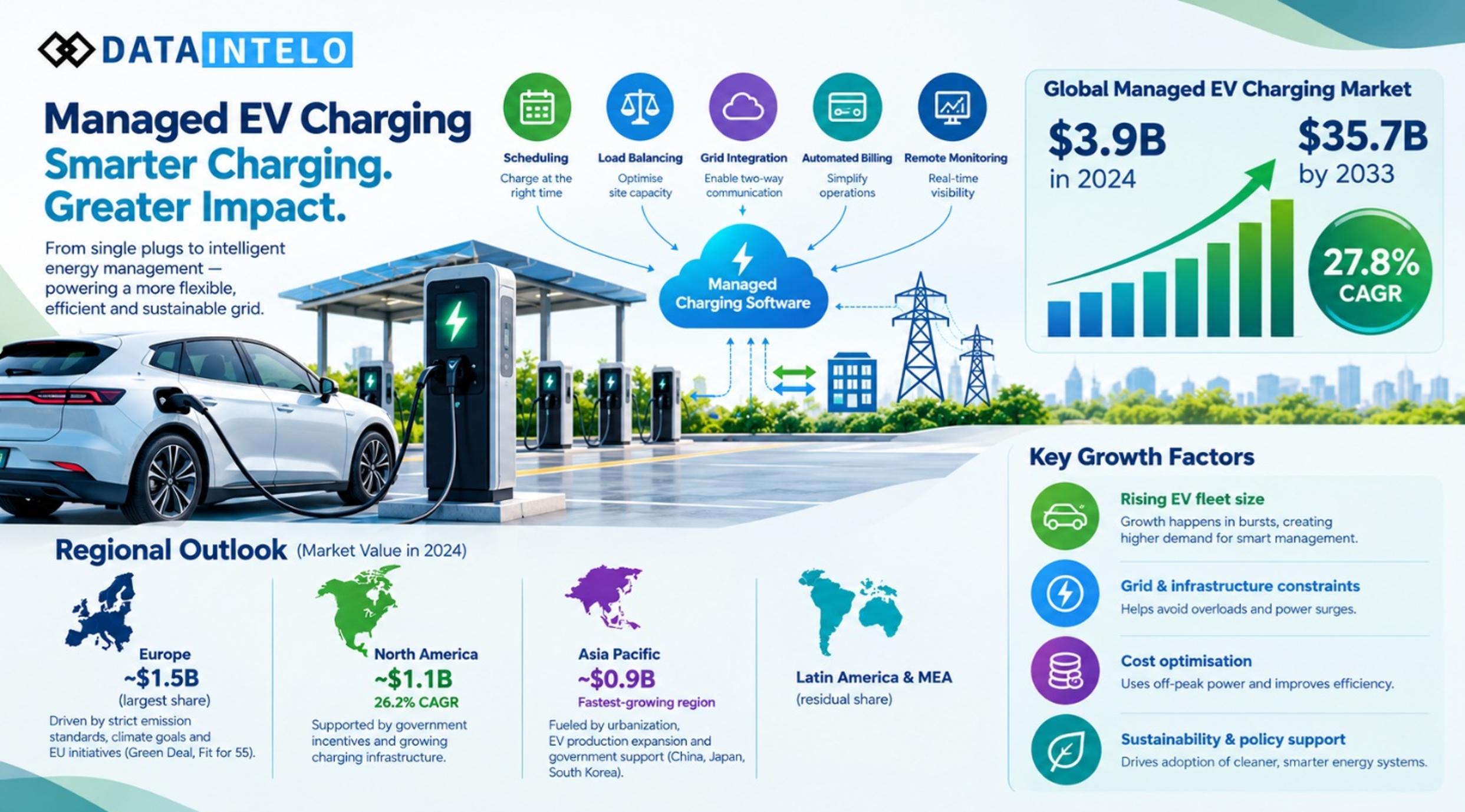
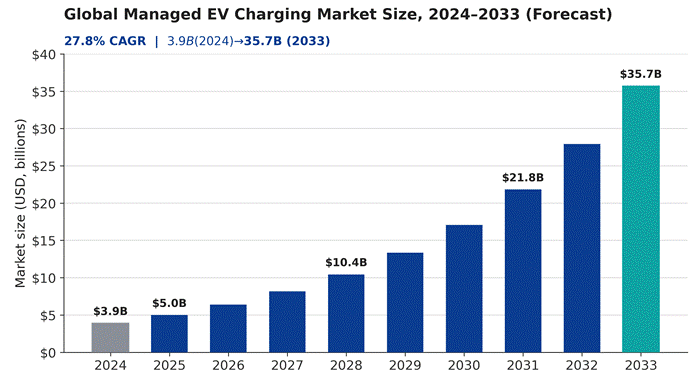
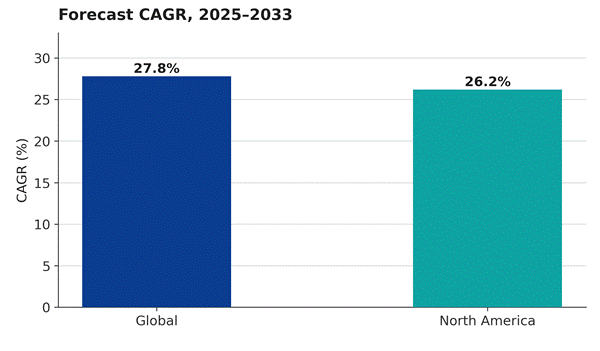
This story is called “managed” charging – a software and service layer, which schedules charging sessions, balances load among devices on-site, communicates with the grid, and manages an entire room of dumb chargers into a powerful energy asset. Furthermore, based on the available estimates and forecasts, managed charging constitutes one of the most rapidly expanding segments in the entire EV value chain. According to Dataintelo’s assessment of the global managed EV charging market, the latter was estimated to be worth $3.9 billion in 2024 and is expected to attain the value of $35.7 billion by 2033, registering a CAGR of 27.8%.
Why “managed” charging, and why now
For the better part of the last decade, however, the conversation surrounding EV charging was mostly dominated by a single query: where are the plugs? This hasn’t gone away – there are more than 65,000 fast DC charging stalls available today within the U.S. alone – but another, more difficult question has taken central stage in the minds of utility providers and planners everywhere: how do you deal with the situation where multiple thousand of those plugs attempt to pull power from the same transformer, substation, or already overloaded grid system?
Uncontrolled charging views each plug as an independent, full-power draw the second the vehicle becomes connected. This is okay on smaller scales but not on larger – it creates the exact type of power draw surges that utility companies have been trying to control for over a century. Managed charging, on the other hand, takes the same hardware and adds an intelligent layer to it: remote monitoring, load balancing, scheduling in order to take advantage of off-peak rates, automatic billing, and even two-way grid communication.
That intelligence layer is what’s compounding at nearly 28% a year. This is a software and services growth story on top of a hardware growth story, but more and more, the two are being sold together rather than separately.
Market outlook and region-specific dynamics
In the regional segment, the outlook as per the industry report positions Europe at the top, holding nearly $1.5 billion of the total market value in 2024, with strong demand supported by tough emission standards, ambitious climate goals and substantial investments in charging infrastructure, which are augmented by initiatives at the EU level including the Green Deal and Fit for 55. North America comes next, capturing approximately $1.1 billion, growing at an estimated 26.2% CAGR of its own, owing to government incentives at the federal and state levels and the development of charging infrastructure in certain states including California, New York and Texas. Asia Pacific captures nearly $0.9 billion of the total market in 2024, although smaller in size, but growing at the fastest pace among other regions due to rapid urbanization, production capacity expansion of electric vehicles, and government-sponsored infrastructure in China, Japan and South Korea.
This trend is also reflected in what is emerging in terms of industry news each week. For the U.S., the topic of the week is still related to federal funding of charging infrastructure development: recently, company PowerUp America received four fast charging stations in the state of North Carolina within the National Electric Vehicle Infrastructure (NEVI) program, collaborating with the hardware company Kempower. Fleet and commercial vehicles are being supplied with new facilities, like the acquisition of EV Realty of a facility in Ontario, California, which is meant for the construction of 9 megawatts of heavy-duty truck charging station facilities (which require managed charging almost as a necessity). And finally, in the UK, battery buffered chargers are being installed by energy hardware company TUAL in cooperation with SP Energy Networks.
Growth factors: what’s actually driving the curve
A few different factors contribute to the creation of this 27.8% number, and their significance varies based on an organization’s place in the value chain:
- The EV fleet size continues to rise, and the process takes place in bursts rather than slowly. Whereas consumers will spread their load over time in terms of adopting EVs, businesses that adopt electrification are likely to put a lot of pressure on one location in terms of EVs and associated loads. This is precisely what creates the need for load management.
- Grids have failed to keep up with the charging capabilities. Grid operators in growth markets find themselves constrained by substation capacity and distribution capacity, leading them to adopt the use of software load management and battery buffer solutions, which are cheaper and quicker than upgrading grids, which may take many years to implement.
- The emergence of regulatory and design innovations is generating new sources of income for “smart” charging. Demand response programs, time-of-use pricing, and early V2G pilots all incentivize providers able to schedule or modify the charging loads – a capability available to connected systems only. The recent introduction by ev.energy of the “Charge & Earn” service in Great Britain, with more than 10,000 connected devices earning by scheduling their charging periods, is a clear example of such emerging source of income.
- Since software offers higher margins and revenue streams that can be repeated, compared to hardware, it is worth noting that the software sector will continue to account for a larger portion of total market value as vendors transition from selling hardware to subscription-based products, which are always upgradable.
- Businesses running commercial and hospitality sites have been making use of managed charging as both an amenity and a tool for cost management. For instance, Kitu Systems recently implemented its managed charging technology called “Expedition” in two short-term rental facilities in Alhambra, California, enabling property owners to provide EV charging amenities to their guests without getting out of hand when it comes to load and billing.
Segment insights: where the value is concentrated
The market breaks down along several axes that matter for anyone building a business case:
| Segmentation axis | Categories tracked |
| Component | Hardware · Software · Services |
| Charging type | AC charging · DC charging |
| Application | Residential · Commercial · Public |
| Connectivity | Connected · Non-connected |
| End-user | Fleet operators · Private EV owners · Commercial parking operators · Utilities · Others |
| Regions covered | North America · Europe · Asia Pacific · Latin America · Middle East & Africa |
In terms of components, hardware remains critical in the physical installation, but software is the segment growing at the fastest rate and is most profitable; real-time analysis, automated billing, and AI-driven demand forecasts are becoming the unique features setting one platform apart from the rest. Services such as installation services, consulting, and even complete outsourced network management have become an integral part of the business itself, especially for fleet operators who prefer results over managing charging networks.
From a type of charge perspective, AC (level 1/2) charging prevails in domestic and office environments where cars remain parked for a prolonged period of time and slower, scheduled charging suffices; whereas DC fast charging occurs mostly in commercial and public places where speed is the primary consideration. The managed charging systems require a capability to handle both types via one portal more often than not, as mixed facilities such as depots for fleet overnight charging and fast charging during the day become common practice.
Among end users, the segment which will witness growth in the near future is fleet operators since centralization, prediction, and cost-saving measures will be directly connected to their bottom lines, not as a side benefit. Private EV owners will still be the largest segment of the market because of application scheduling and off-peak savings. Also, commercial parking providers and utilities cannot be omitted from the discussion – the former are becoming more aware of how EV charging can serve as a differentiation factor and source of income, while the latter utilize such platforms as demand management tools as well as customer services.
Regulatory and grid context
As much as technology is impacting the market, so too is regulation. In the United States, the current challenge in the Fourth Circuit regarding FERC Order 1920, which seeks to enhance long-term transmission planning, sees the Electricity Transmission Competition Coalition contesting a right of first refusal carve-out in the order. This case will have an indirect but significant impact on managed charging operators as transmission planning rules determine the rate at which new capacity is added to the grid and, thus, how much pressure there is on load management software to do what new wires would have been able to do. Site grants that come as a result of NEVI funding keep coming as a reliable stream of new, usually high-powered, professionally managed charge points installations in U.S. states.
Within Europe, climate goals at the EU level and incentivization schemes at the member state level remain the main regulatory headwinds, whereas grid operators are getting increasingly institutionalized in terms of adopting demand response and dynamic pricing, which are rewarding connected and controllable load.
Adoption evidence and the “detour” problem
One of the more telling recent data points for the industry comes from a Driivz study finding that 91% of EV drivers will detour from their planned route to reach a charger they’ve been specifically recommended, rather than simply using whatever charger is nearest. That statistic speaks directly to why managed, connected charging matters beyond load balancing: drivers are already making decisions based on real-time reliability and recommendation data, which only connected, software-managed networks can supply. A charger that isn’t reporting its status, uptime and availability into a managed platform is, functionally, invisible to a growing share of EV drivers before they ever arrive.
Expert and industry perspective
Industry commentary now views software as the new bottleneck and new opportunity for the business. As Tom McCalmont, CEO of Paired Power, has said in industry commentary, electric vehicles are basically equal with combustive cars when it comes to reliability and usability — except in the area of charging software, which is still lagging behind, with 2026 being a possible inflection point where AI-based solutions can address issues in charging software as opposed to developing more hardware. This sentiment is echoed by the hardware vendors themselves, who continue developing new fast-charging hardware in the form of modules offered by Acbel and Heliox, but whose marketing emphasizes remote management and dual port load sharing as well as software capability — an indication that managed capability is a requirement, not an add-on.
Challenges that temper the growth story
Senior decision-makers should weigh this growth rate against real friction points that industry analysis and broader market coverage both flag:
- Upfront costs remain high, particularly for hardware-software-service bundles at fleet or public scale, and capital access is uneven across regions.
- Interoperability is still incomplete. Without standardized protocols, mixed-vendor sites can face compatibility issues that blunt the value of a “managed” layer meant to unify everything.
- Regulatory uncertainty around data privacy, grid interconnection and tariff design persists in multiple markets, and ongoing litigation such as the FERC Order 1920 challenge illustrates that even foundational grid-planning rules are still being contested.
- Cybersecurity exposure grows with connectivity. As more chargers become networked and billing- and usage-data-rich, they become a larger attack surface — a concern software vendors are increasingly expected to address as a baseline feature, not an afterthought.
What this means for decision-makers
The lesson for utilities is that the managed charging platforms are fast becoming a pragmatic option — or at least a transition solution — to grid capacity that they currently lack but cannot develop quickly; investment or partnership with such solutions is now as much an act of grid stability planning as customer services delivery. For the fleet managers, the numbers are increasingly speaking against the choice of unmanaged solutions, with software being the layer responsible for the actual management of operating costs and uptime of electric vehicles. For the hardware manufacturers, the way forward is through integration — straight hardware plays are becoming less competitive in the face of integrated hardware-software-service plays, and the companies which will have an upper hand are those developing or buying software capabilities now rather than later on. For investors and corporate strategists in general, a market that is growing at an annual compounded rate of almost 28%, which at present accounts for about $4 billion but will reach nearly $35.7 billion in a decade from now, is one of the growth trends that remains clear in the wider EV infrastructure rollout space.
Reference: https://dataintelo.com/report/managed-ev-charging-market
Bio:
Ashish Kolte is a Marketing Manager at Dataintelo with expertise in marketing, market intelligence, and business strategy. He combines marketing insights with industry research to analyze market trends, identify growth opportunities, and provide data-driven perspectives on emerging industries and global business developments.
LinkedIn: https://www.linkedin.com/in/ashishkolte/