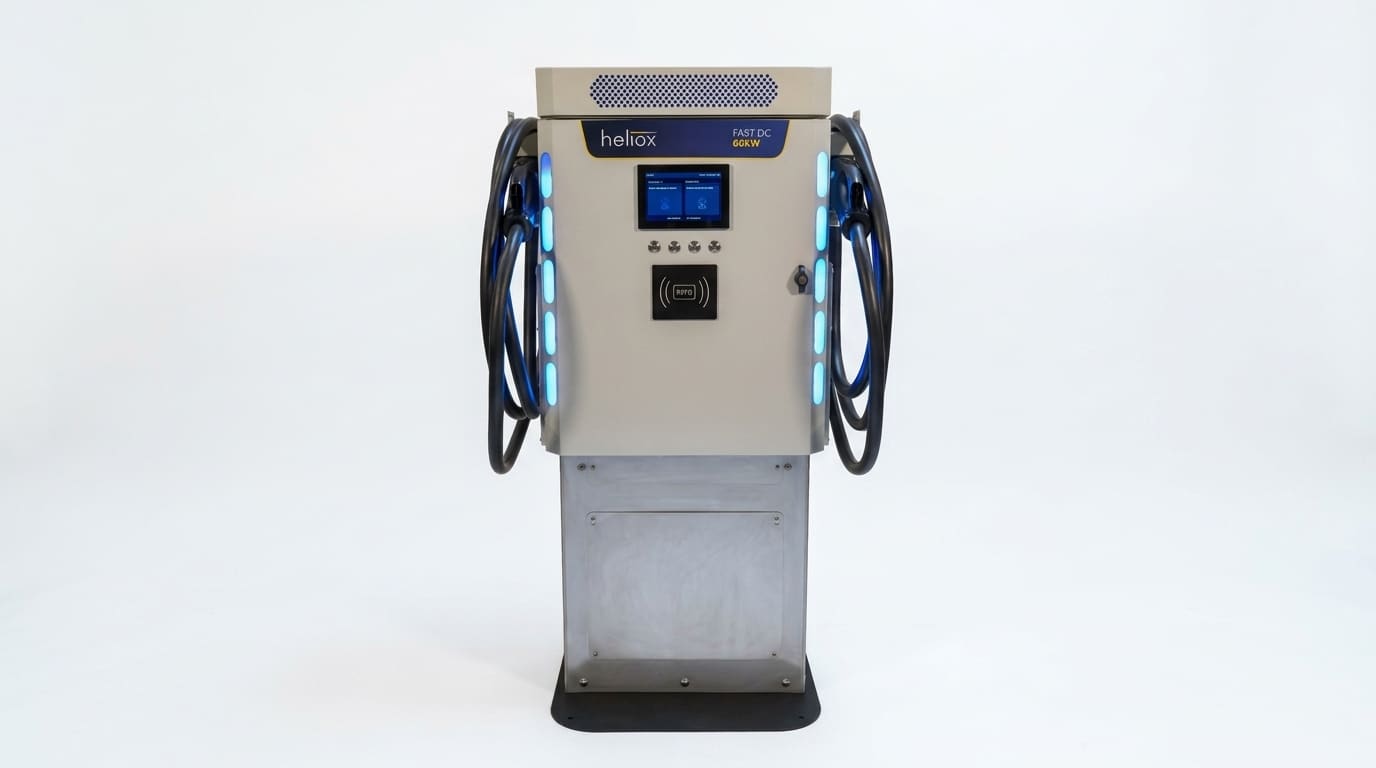
The Heliox H60D uses dynamic power sharing to charge two electric vehicles from a single unit, targeting bus, truck and commercial fleet deployments in North America.
Heliox, a Siemens business, has introduced the H60D, a compact 60 kW DC fast charger designed to serve electric cars, buses and trucks.
The charger features two CCS1 outlets that can operate simultaneously. Its dynamic power-sharing system can direct the full 60 kW output to one vehicle or distribute the available power between two vehicles according to charging demand.
According to Heliox, this dual-port configuration can help fleet operators increase the number of vehicles served at a site while reducing the hardware footprint and capital expenditure required per charging connection.
The charger delivers up to 150 A of DC current and has a peak efficiency of more than 96%. The company is positioning the unit for fleet depots, vehicle yards, commercial facilities and parking environments where space, charger utilization and installation flexibility are important considerations. The manufacturer’s product information identifies school buses, last-mile delivery fleets and medium-duty commercial vehicles as key applications.
Dynamic power sharing supports two charging sessions
The H60D’s two CCS1 charging cables allow operators to run parallel charging sessions from one charger.
When a single vehicle is connected, the unit can provide up to 60 kW. When two vehicles are charging, the system dynamically divides the available output between the two connectors.
Heliox’s product page indicates that the system can charge two vehicles at up to 30 kW each, depending on vehicle demand and operating conditions. This approach is intended to improve infrastructure utilization, particularly for fleets in which vehicles have different dwell times, charging requirements or operating schedules.
For depot operators, the value of the configuration is not necessarily maximum charging speed. Instead, the charger is designed to increase the number of vehicles connected while limiting the amount of charging hardware installed at the site.
This could make the H60D suitable for overnight and return-to-base operations where vehicles remain parked for predictable periods and do not always require high-power charging.
Wall-mounted and pedestal installation options
The H60D can be installed on a wall or pedestal, giving site designers greater flexibility when planning charging infrastructure around existing buildings, parking spaces and vehicle circulation routes.
It can also operate in networked or standalone configurations. Network connectivity enables the charger to integrate with supported management platforms, while standalone operation may be appropriate for simpler fleet applications that do not require continuous backend communication.
A new RFID function supports driver identification and access control. This can help fleet operators restrict charging to authorized users or vehicles and manage charger access across depots and other controlled locations.
The charger is housed in a NEMA 3R-rated enclosure and is designed for indoor and outdoor installation. Heliox specifies an operating temperature range of -22°F to 131°F, equivalent to approximately -30°C to 55°C, supporting deployment across a range of North American climates.
CCS1 compatibility and a 200 to 1,000 V output range
For vehicle connectivity, the H60D supports the SAE J1772 CCS1 standard used by many electric vehicles in North America.
Its DC output range extends from 200 V to 1,000 V, allowing the charger to support a variety of current and emerging commercial EV battery architectures. This wide voltage window may help operators accommodate mixed fleets containing vehicles from different manufacturers.
The unit supports OCPP 1.6J and OCPP 2.0.1 for communication with compatible charging-management systems.
OCPP support can provide fleet and charging-network operators with access to capabilities such as charger monitoring, session management, remote diagnostics and smart charging, depending on the functionality offered by the selected backend platform.
Support for OCPP 2.0.1 also gives operators a pathway toward more advanced charging-management and security capabilities as software platforms evolve.
US engineering and manufacturing
Heliox says the H60D is engineered and manufactured in the United States. The company operates a North American headquarters in Atlanta and a manufacturing facility in North Carolina. It also states that its North American products are designed to comply with Build America, Buy America requirements.
The charger includes thermal and durability upgrades intended to maintain consistent performance throughout its operating life. Heliox provides a standard 24-month warranty and offers optional preventive maintenance programs intended to support charger availability and predictable lifecycle performance.
Siemens completed its acquisition of Heliox in January 2024. The acquisition expanded Siemens’ DC fast-charging portfolio and strengthened its presence in the electric bus, electric truck and fleet-depot charging markets in Europe and North America.
The H60D adds a lower-power, dual-port option to that portfolio, aimed at operators that prioritize flexibility, charger utilization and space efficiency over ultra-high-power charging.