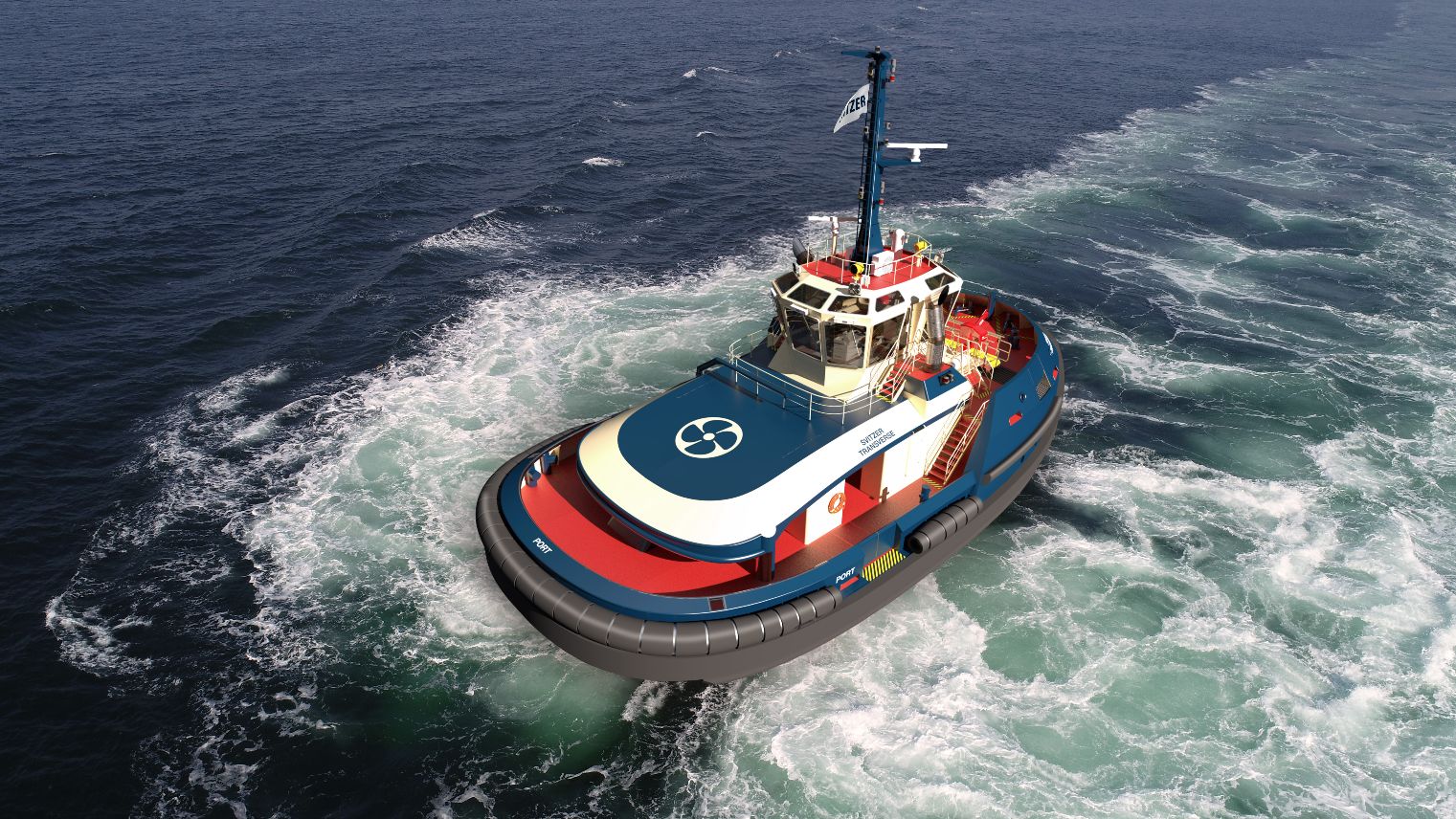
The marine battery manufacturer will provide an ABS-certified 4,838 kWh OrionAN+ lithium-iron-phosphate system for each TRAnsverse 2600e tug under construction at Cochin Shipyard in India.
AYK Energy has secured a contract with Kongsberg Maritime to supply battery systems for four fully electric Svitzer TRAnsverse 2600e tugs.
Each vessel will be equipped with an ABS-certified OrionAN+ lithium-iron-phosphate battery system providing 4,838 kWh of nominal capacity. The four confirmed systems represent a combined capacity of 19,352 kWh, or approximately 19.4 MWh.
The agreement also includes an option for four additional vessels. The optioned tugs should not be treated as confirmed orders unless the option is exercised.
The tugs are being built at Cochin Shipyard Limited in India and will use an integrated electrical, automation and propulsion architecture supplied by Kongsberg Maritime. Construction of the four vessels began in September 2026.
AYK batteries to integrate with Kongsberg Maritime systems
AYK’s OrionAN+ batteries will be integrated with Kongsberg Maritime’s electrical and automation package for the four tugs.
The package includes DC and AC switchboards, permanent magnet propulsion motors, K-Chief control systems and shore-charging equipment.
The integrated architecture will connect AYK’s battery systems with the vessels’ propulsion, power-distribution, automation and shore-charging equipment.
AYK has not disclosed the charging power, expected charging time, usable battery capacity or delivery schedule for the OrionAN+ systems.
“This is such an exciting moment for AYK,” said Chris Kruger, founder of AYK Energy.
“I’ve been working on this technology since 2012 with Svitzer’s four diesel-electric hybrid tugs on the west coast of Australia.”
Kruger said the contract continues AYK’s work with Kongsberg Maritime and Svitzer on electric tug technology.
“It’s only possible to bring technology to the mass market when the biggest operators invest in, and believe in, the battery systems’ return on investment,” Kruger said.
“The passion from all parties to change the industry for the better is really there.”
TRAnsverse 2600e tugs designed for fully electric operation
The TRAnsverse 2600e is the electric version of Svitzer’s next-generation tug design, developed with naval architecture company Robert Allan Ltd.
The 26-meter vessels are intended for demanding harbor and terminal operations. The design uses a double-ended hull and in-line propulsion arrangement intended to improve maneuverability in close-quarter operating environments.
The initial program covers four fully electric tugs, with the option for four additional vessels potentially expanding the series to eight.
The batteries will support electric propulsion during tug operations, while the shore-charging equipment included in Kongsberg Maritime’s package will replenish the vessels’ energy between operating periods.
Kongsberg Maritime previously said the integrated system would include two US L Drive azimuth thrusters per vessel, powered by permanent magnet motors and managed through its AquaPilot control system.
The announcement does not identify the ports where the vessels will operate or provide a confirmed timetable for delivery, commissioning and entry into service.
OrionAN+ systems use LFP battery chemistry
AYK’s OrionAN+ systems use lithium-iron-phosphate battery chemistry, commonly known as LFP.
The company has focused its marine battery development on delivering greater power and energy density while maintaining the safety and reliability required for vessels operating in demanding marine environments.
“Vessel operators and integrators have told us they want more energy density and greater power without compromising safety,” Kruger said.
“This is what we’ve worked so hard to achieve. Marine batteries and electric ships are not an easy technology. The rugged conditions of the sea make it much more challenging than electric road vehicles.”
Kruger said the potential consequences of battery failure at sea make close cooperation between battery manufacturers, vessel operators, system integrators and classification organizations particularly important.
“If a vessel suffers battery failure, you cannot simply step out onto the road,” Kruger said.
“That is why we’ve worked so closely with class and innovators like Kongsberg Maritime and Svitzer to bring lithium-iron-phosphate chemistry to the market at scale.”
AYK says it was the first company to secure marine class approval for an LFP battery system as an alternative to nickel-manganese-cobalt chemistry. The press release does not identify the certificate, approval date or specific product associated with that claim.
The OrionAN+ systems being supplied for the TRAnsverse tugs are certified by the American Bureau of Shipping, according to AYK.
Contract extends AYK’s relationship with Svitzer
The four-vessel agreement builds on AYK’s work across five previous Svitzer tug projects.
Kruger’s involvement with Svitzer dates to 2012, when he oversaw the original battery design for four diesel-electric hybrid tugs built for an LNG terminal on Barrow Island in Western Australia.
The vessels included Svitzer Euro, Svitzer Perentie, Svitzer Boodie and Svitzer Dugong.
In 2025, AYK returned to the fleet to complete a battery-renewal program. The company installed Aries LFP battery systems across all four vessels, delivering more than 5 MWh of replacement battery capacity.
AYK subsequently supplied an ABS-certified 6 MWh AriesA battery system for Svitzer Balder, which was built by Uzmar Shipyard in Türkiye.
Svitzer Balder combines battery-electric propulsion with dual-fuel methanol engines. AYK describes it as the world’s most powerful electric escort tug and says the vessel was designed to conduct more than 90% of its towing and docking operations using battery-electric power.
The TRAnsverse 2600e program represents a further development in the relationship, moving from hybrid and battery-methanol tug projects to a series of fully electric vessels.
For AYK, the confirmed four-vessel order represents approximately 19.4 MWh of additional marine battery capacity. Exercising the option for four additional tugs would double the number of OrionAN+ systems covered by the program.
FAQ: AYK Energy and Svitzer Electric Tugs
What will AYK Energy supply?
AYK Energy will supply an ABS-certified 4,838 kWh OrionAN+ lithium-iron-phosphate battery system for each of four fully electric Svitzer TRAnsverse 2600e tugs.
How much battery capacity will each tug have?
Each TRAnsverse 2600e tug will have an AYK battery system with 4,838 kWh, or approximately 4.8 MWh, of nominal capacity.
What is the total capacity of the order?
The four confirmed battery systems represent 19,352 kWh, or approximately 19.4 MWh, of combined nominal capacity.
Where are the electric tugs being built?
The four vessels are being built at Cochin Shipyard in India. Construction began in September 2026.
What will Kongsberg Maritime provide?
Kongsberg Maritime’s package includes the electrical and automation architecture, DC and AC switchboards, permanent magnet propulsion motors, K-Chief control systems and shore-charging equipment.
What battery chemistry will the vessels use?
The OrionAN+ systems use lithium-iron-phosphate battery chemistry, commonly known as LFP.
Does the contract cover more than four tugs?
The agreement includes an option for four additional vessels. Those vessels are not confirmed orders unless Svitzer exercises the option.