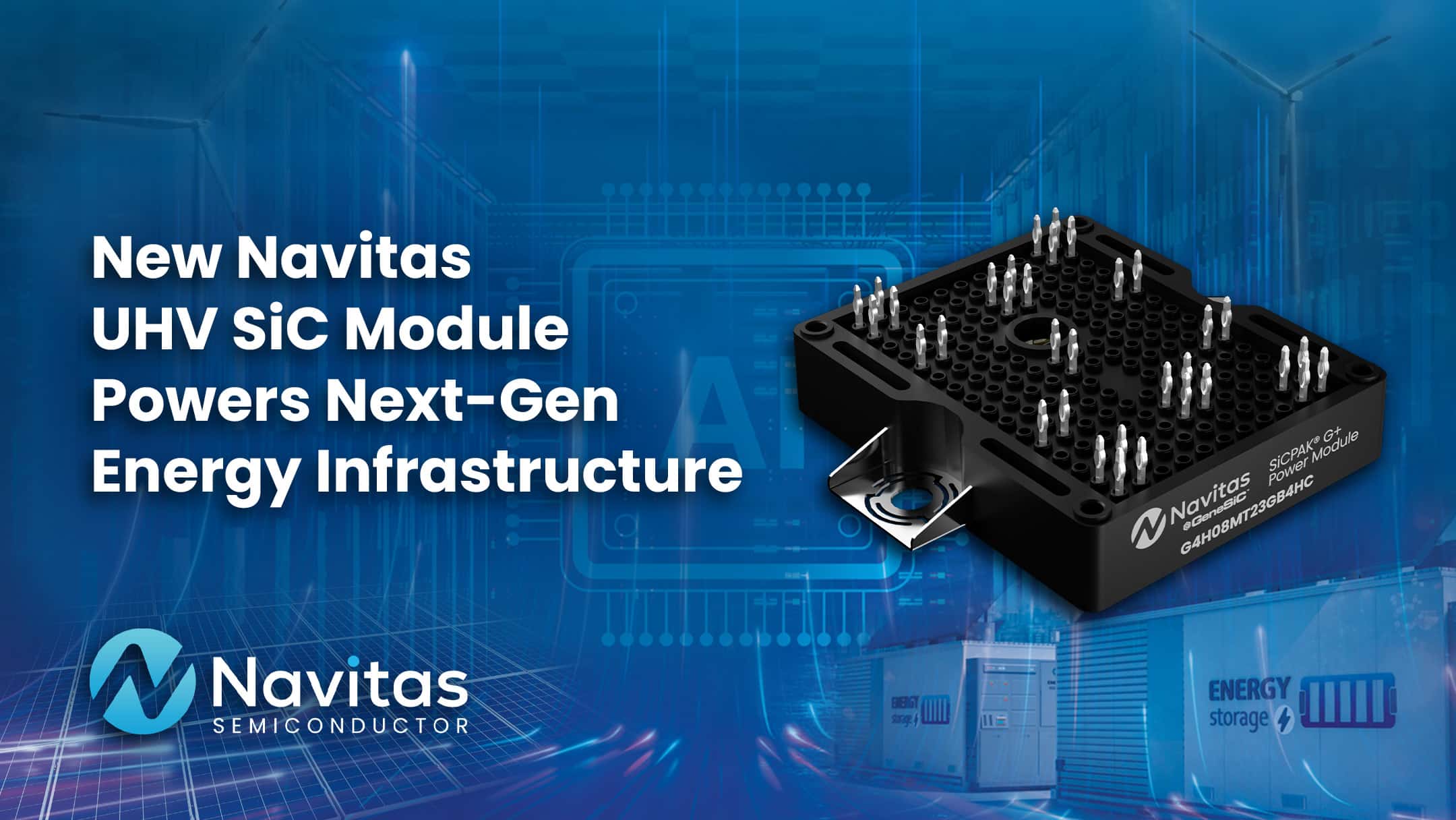
Navitas Semiconductor has introduced a 2300 V, 8 mΩ full-bridge silicon carbide power module family designed to improve efficiency and power density in grid infrastructure, energy storage and megawatt EV charging applications.
The G4H08MT23GB4 module family uses Navitas’ fourth-generation GeneSiC Trench-Assisted Planar (TAP) technology and the industry-standard SiCPAK form factor.
Navitas says the ultra-high-voltage SiC modules are intended to serve as medium-voltage building blocks for solid-state transformers, grid-scale battery energy storage systems, solar inverters and megawatt charging infrastructure.
A 2300 V module for high-power conversion
The G4H08MT23GB4 is a 2300 V full-bridge SiC power module with a stated on-resistance of 8 mΩ.
Navitas says the module is designed to help solid-state transformers convert grid power directly into high-voltage DC rails, reducing the number of conversion stages compared with conventional lower-voltage architectures.
That approach is intended to support higher efficiency and power density in applications including megawatt charging systems for heavy-duty commercial EVs, battery energy storage, solar inverters, hydrogen electrolysis and industrial motor drives.
The module does not itself constitute a megawatt charging station. It is a power-semiconductor component that could be used within the power-conversion hardware behind such systems.
For context on high-power charging technology, see EV Charging Magazine’s guide to ultrafast charging stations.
Packaging designed for thermal stress
Navitas has incorporated several packaging features intended to support operation in high-power environments.
The module uses an aluminium nitride active-metal-braze substrate, which the company says improves heat spreading and provides electrical isolation above 5 kV.
Epoxy-resin potting replaces silicone gel. Navitas says this reduces internal stress, limits moisture and contaminant ingress and delivers a 10-fold improvement in thermal conductivity compared with silicone gel.
The module also uses high-current press-fit pins, which Navitas says provide twice the current-carrying capacity per pin compared with standard press-fit connections. An optional pre-applied thermal interface material is available to simplify heatsink assembly.
Reliability testing beyond standard requirements
Navitas says the module family will be qualified under its internal AEC-Plus reliability benchmark, which extends beyond standard AEC-Q101 and JEDEC requirements.
The qualification programme includes dynamic reverse-bias and dynamic gate-switching tests, which are intended to reflect fast-switching operating conditions.
Navitas also says it will more than triple the duration of static high-temperature, high-voltage tests and carry out extended power-cycling and temperature-cycling evaluations.
These are manufacturer-defined qualification requirements. They do not independently establish field reliability or operational lifetime in a particular charging or grid deployment.
Four module configurations available
Samples of the G4H08MT23GB4 family are available immediately in four configurations:
| Part number | Configuration | Pre-applied TIM | Pin type |
|---|---|---|---|
| G4H08MT23GB4 | Full-bridge | No | Standard |
| G4H08MT23GB4-T | Full-bridge | Yes | Standard |
| G4H08MT23GB4HC | Full-bridge | No | High-current |
| G4H08MT23GB4HC-T | Full-bridge | Yes | High-current |
Navitas has also made a double-pulse test system, the EVB-UHVSIC-GB-E-DPT-1, available on request. The company says it is intended to help engineers evaluate switching performance.
A technical white paper on Trench-Assisted Planar technology is also available through Navitas.
Navitas positions module across energy markets
Navitas is positioning the 2300 V module as part of a broader portfolio for AI data centres, grid infrastructure, battery storage, solar, hydrogen, industrial drives and EV charging.
“Our fourth-generation GeneSiC Trench-Assisted Planar architecture continues to push the limits of what’s possible in ultra-high voltage SiC,” said Paul Wheeler, VP and GM of Navitas’ SiC Business Unit.
“This new 2300 V module delivers a leading RDS(ON) of any device using the SiCPAK form factor, giving system designers a proven, reliability-tested building block for the solid-state transformers and energy storage systems that are reshaping grid and AI data center infrastructure.”
The company says the launch extends its 2300 V and 3300 V ultra-high-voltage SiC portfolio.
FAQ
What is the Navitas G4H08MT23GB4?
It is a 2300 V full-bridge silicon carbide power module family built on Navitas’ fourth-generation GeneSiC Trench-Assisted Planar technology. It uses the SiCPAK form factor and has a stated on-resistance of 8 mΩ.
How could it support megawatt EV charging?
Navitas says the module could be used in solid-state transformers and power-conversion hardware for megawatt charging systems. It is a component within that infrastructure, not a complete charging station.
Does the module eliminate conversion stages?
Navitas says its high-voltage approach is designed to reduce the number of conversion stages by enabling more direct conversion from grid power to high-voltage DC rails. Actual system gains will depend on the complete power-conversion architecture.
Is the module already qualified to AEC-Plus?
Navitas says the module family will be qualified under its AEC-Plus benchmark. AEC-Plus is Navitas’ internal reliability programme and extends beyond standard AEC-Q101 and JEDEC requirements.
Are samples available?
Yes. Navitas says samples are available immediately in four configurations, with options for pre-applied thermal interface material and high-current pins.
Is a development kit available?
Navitas offers a double-pulse test system, EVB-UHVSIC-GB-E-DPT-1, on request to help engineers evaluate switching performance.