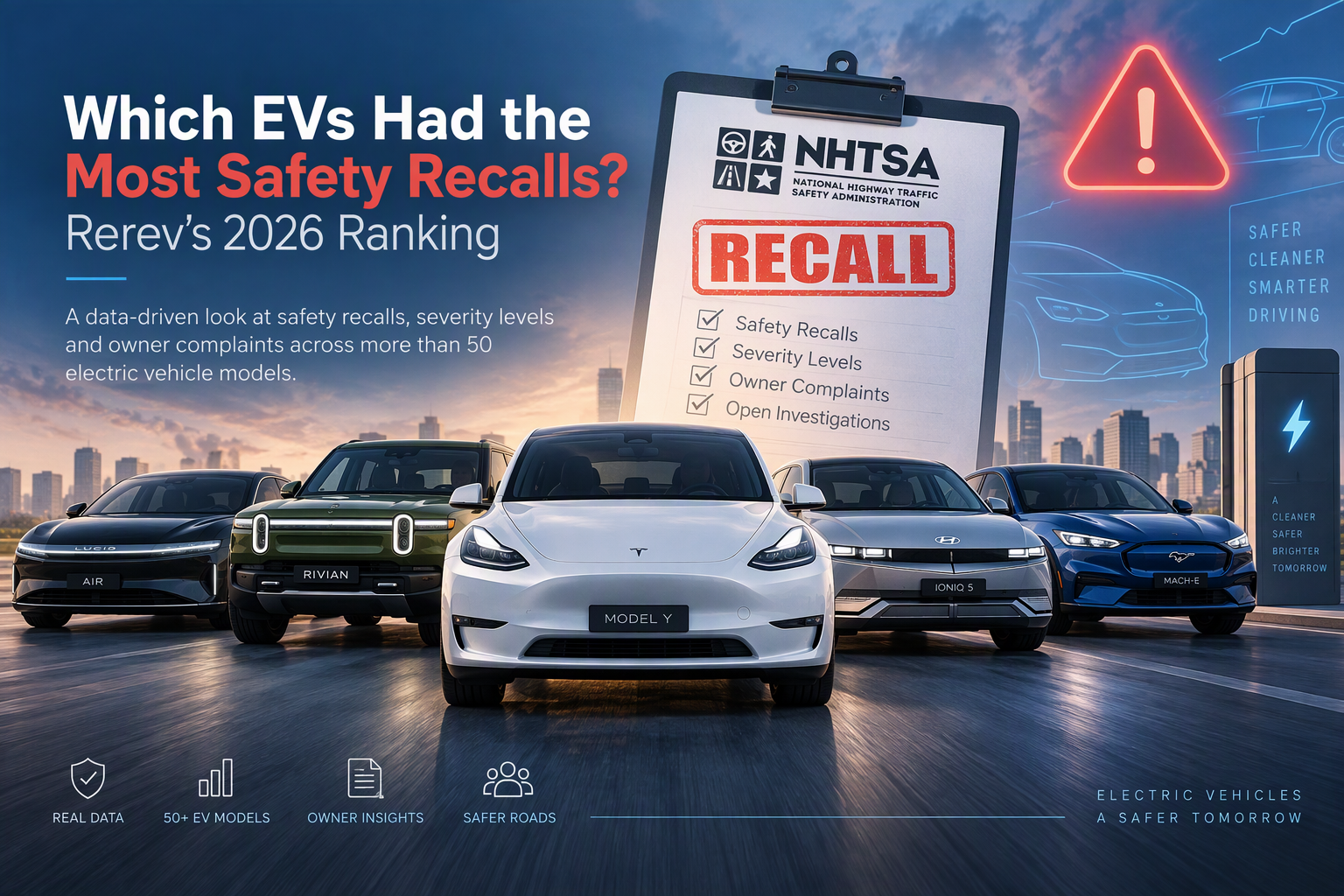
A new Rerev analysis ranks more than 50 electric vehicle models sold in the U.S. by safety recalls, using NHTSA recall data, recall counts, severity levels and owner complaints.
The Tesla Model Y leads Rerev’s October 2026 ranking with five safety recalls affecting about 146,000 vehicles. The Lucid Air and Rivian R1S follow with four recalls each.
However, Rerev’s analysis emphasizes that recall volume alone does not indicate overall vehicle reliability. Some campaigns involve minor software or labeling issues that can be addressed remotely, while others concern more serious safety risks.
Rerev’s key findings
Rerev says the Tesla Model Y recorded five separate safety recalls affecting approximately 146,000 vehicles. The company notes that several involved relatively minor issues, including rearview-camera display delays, overly bright headlights and missing certification labels.
The analysis also identifies more severe concerns among other models. Rerev cites Lucid Air recalls involving potential fire risks from lighting-circuit software and loose half-shaft bolts.
The Hyundai Ioniq 5 recorded more than 600 owner complaints to NHTSA in Rerev’s dataset. The study also identifies safety fixes related to battery short-circuit fire risks.
Ford’s Mustang Mach-E recorded three recalls affecting nearly 130,000 vehicles.
Rerev’s top 10 electric models by safety recalls
| Make | Model | Safety recalls | Vehicles affected | NHTSA owner complaints | Complaints reporting a crash | Open NHTSA investigations |
|---|---|---|---|---|---|---|
| Tesla | Model Y | 5 | 146.04K | 787 | 157 | 7 |
| Lucid | Air | 4 | 43.67K | 21 | 4 | 1 |
| Rivian | R1S | 4 | 72.93K | 47 | 8 | 1 |
| Rivian | R1T | 4 | 47.76K | 40 | 2 | 1 |
| Hyundai | Ioniq 5 | 4 | 2.6K | 610 | 7 | 0 |
| Ford | Mustang Mach-E | 3 | 129.41K | 96 | 10 | 1 |
| Kia | EV9 | 3 | 21.74K | 55 | 2 | 0 |
| Jeep | Wagoneer S | 3 | 23.83K | 45 | 2 | 0 |
| Volvo | EX30 | 3 | 1.79K | 9 | 1 | 0 |
| Tesla | Model 3 | 3 | 69.94K | 412 | 60 | 6 |
Figures are from Rerev’s October 2026 analysis of more than 50 U.S. electric models, based on NHTSA safety-recall data, recall counts, severity levels and owner complaints.
Why recall volume does not equal unreliability
Rerev’s analysis highlights an important distinction: a high number of recalls does not automatically mean that a vehicle has poor mechanical build quality.
Some recalls involve software-related issues, such as digital-interface adjustments, camera-display timing or driver-assistance parameters. Rerev notes that some of these can be addressed through over-the-air updates, although the remedy depends on the specific campaign and vehicle configuration.
Hardware-related recalls, by contrast, may require parts replacement or a dealership visit. Their significance also depends on the nature of the defect, the number of vehicles affected and whether the remedy has been completed.
What used-EV buyers should check
Safety recalls remain attached to a vehicle regardless of ownership. Buyers considering a used electric vehicle should check its VIN through NHTSA’s official recall lookup tool before purchase.
An open recall means the manufacturer’s remedy has not been recorded as completed. Buyers should also ask whether prior software updates or hardware replacements were completed and retain service records where available.
The full ranking, methodology notes and detailed analysis are available in Rerev’s 2026 EV safety-recall study.