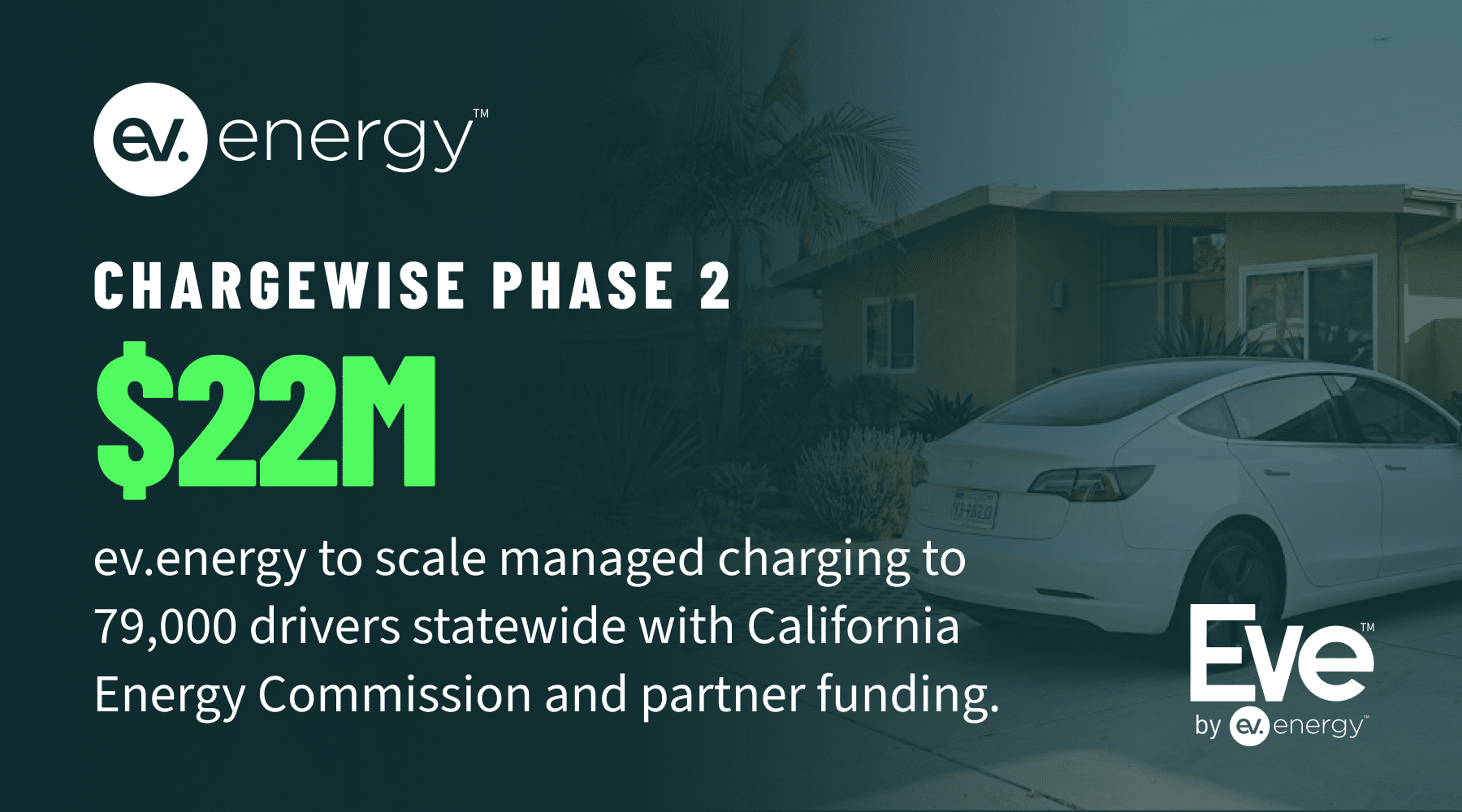
ChargeWise aims to grow from around 9,000 enrolled EV drivers to 79,000 total customers by the end of 2028, supported by a $22 million matched budget.
ev.energy has secured $11 million from the California Energy Commission to deliver Phase 2 of ChargeWise, its managed electric vehicle charging program.
With matching funds from participating partners, the program will have a total Phase 2 budget of $22 million. The funding will support an expansion from around 9,000 enrolled EV drivers to a target of 79,000 total customers by the end of 2028.
ChargeWise functions as an EV virtual power plant by coordinating charging across participating vehicles in aggregate. This allows their combined electricity demand to shift in response to market and grid signals. The current model manages charging demand and does not require vehicles to export electricity.
The majority of the award will be available as match funding to California utilities, Community Choice Aggregators and other participating energy providers. According to ev.energy, the funding will cover 50% of eligible customer-acquisition, incentive and onboarding costs.
The announcement also allocates $1 million to product development, including work on vehicle-to-everything technology.
ChargeWise targets 79,000 customers by the end of 2028
ChargeWise is ev.energy’s program under the California Energy Commission’s Responsive, Easy Charging Products with Dynamic Signals initiative, known as REDWDS.
The initiative was awarded in 2023, and ev.energy is one of two Phase 1 recipients selected to advance to Phase 2.
Phase 1 was delivered with Community Choice Aggregators MCE and Silicon Valley Clean Energy. Phase 2 will also support incentives through Clean Power Alliance’s EV SmartCharge program.
The planned expansion would increase enrollment to nearly nine times its current level. The 79,000-customer figure is a target for the end of 2028, not a confirmed enrollment total.
Managed charging will use day-ahead CAISO signals
ChargeWise uses ev.energy’s Eve platform to determine when participating vehicles should charge.
The platform develops daily charging schedules using day-ahead signals from the California Independent System Operator, or CAISO, covering expected electricity supply, demand and pricing.
The objective is to shift flexible EV charging away from California’s evening peak, particularly between 4 p.m. and 9 p.m., and into less expensive periods. Charging can also be moved into midday hours when solar generation is abundant.
According to ev.energy, the platform optimizes charging without requiring customers to intervene each day or change their electricity rate.
Rather than introducing a new dynamic retail tariff, ChargeWise uses changing market signals to develop charging schedules and incentives under existing rate structures. The company says this avoids the regulatory approvals and billing changes associated with introducing dynamic electricity rates.
ev.energy reports up to 98% off-peak charging
In presenting the findings supporting ChargeWise’s expansion, ev.energy cited the following program results:
| Reported measure | Result |
|---|---|
| Charging energy delivered off-peak | Up to 98% |
| Charging shifted into solar-rich midday hours | Up to 30% |
| Customer savings compared with time-of-use rates alone | $10 to $20 per month |
| Average annual customer savings | Around $200 |
| Payments for customers on MCE’s dynamic tier | Up to $40 per month |
| First-month enrollment | More than 1,000 customers |
| First-month enrollees in disadvantaged communities | More than 50% |
The 98% off-peak figure combines California programs using dynamic pricing tiers on the Eve platform. It should not be interpreted as a separately reported result for every ChargeWise participant.
ev.energy compares the 98% result with 60% to 70% off-peak charging under time-of-use rates alone and approximately 90% when time-of-use rates are combined with managed charging.
The company says the time-of-use-only benchmark is based on its research involving participants in the United States and the United Kingdom. The 90% figure is an average from its live California programs.
The figures come from different program groups and should not be treated as a controlled, like-for-like comparison or as guaranteed outcomes for future participants.
The release does not clarify whether MCE’s payments of up to $40 per month overlap with the reported customer savings. They should therefore not be presented as separate, cumulative benefits without clarification.
Phase 2 sets requirements for participation from disadvantaged communities
At least 50% of enrolled drivers in Phase 2 must live in disadvantaged communities.
Separately, at least half of all participants must take part through the program’s dynamic pricing signal.
The match-funding structure is intended to help utilities, Community Choice Aggregators and other energy providers cover customer outreach, incentives and onboarding costs.
ev.energy says the program can broaden access to managed-charging benefits among households that do not already have rooftop solar or home battery storage.
“Managed charging has become one of the more practical affordability tools available to us,” said Alice Havenar-Daughton, Vice President of Customer Programs at MCE.
“Phase 1 showed our customers could save real money simply by automating charging at different times, and that the design worked for households across our service area, not just those already equipped with solar and batteries.”
Havenar-Daughton said the additional cost sharing would help MCE expand the initiative while balancing transportation electrification against other community priorities.
Clean Power Alliance to receive support for EV SmartCharge
Phase 2 will support incentives through Clean Power Alliance’s EV SmartCharge program in Los Angeles and Ventura counties.
“Our EV SmartCharge program shifts charging into cleaner, cheaper hours automatically, without asking drivers to change their routines,” said Joanne O’Neill, Senior Director of Customer Programs at Clean Power Alliance.
“Support from ChargeWise reduces what the program costs us to run and to grow, and has allowed us to consider new and innovative structures to increase ongoing customer engagement.”
ev.energy also plans to collaborate with investor-owned utilities, additional Community Choice Aggregators, energy providers, driver associations and businesses across the EV supply chain.
The announcement does not identify every utility or energy provider that will participate in Phase 2 or explain how the 79,000-customer target will be distributed among the partners.
Vehicle and charger integrations broaden technical reach
Eve can connect through either a compatible vehicle or charging station, rather than requiring customers to use one specific charging-hardware brand.
ev.energy estimates that its combined vehicle and charger integrations provide the technical ability to connect to approximately 95% of EV-owning households in the United States.
That estimate is modeled from 2025 US vehicle and charging-hardware market shares alongside Eve’s existing integrations.
The figure reflects potential technical reach. It does not mean that 95% of EV-owning households are currently connected, enrolled or eligible for ChargeWise.
Actual participation will depend on the customer’s vehicle or charger, electricity provider and the availability of a compatible program in the customer’s area.
$1 million allocated to product development, including V2X
The announcement includes development work on vehicle-to-everything technology but does not specify which bidirectional applications are planned.
The current ChargeWise model primarily manages when vehicles consume electricity. The release does not identify a commercial bidirectional-charging deployment, compatible export-capable vehicle model or timetable for participants to supply electricity to homes, buildings or the grid.
California EV drivers can register interest
California EV drivers can now register their interest in ChargeWise. Energy providers and businesses can also contact ev.energy to discuss program design and match funding.
“Phase 1 proved dynamic signals move EV charging at scale automatically,” said Nick Woolley, CEO of ev.energy.
“Phase 2 makes that permanent by co-funding CCAs and energy providers to expand access in underserved communities.”
Woolley said ev.energy intends to establish ChargeWise as long-term grid infrastructure that continues operating beyond the current grant period.
The announcement does not provide details of the funding or incentive model that would apply after California Energy Commission support ends.
Reaching the 79,000-customer target by the end of 2028 will depend on partner participation, customer enrollment, technical compatibility and continued driver engagement.
FAQ: ev.energy ChargeWise California
What is ChargeWise?
ChargeWise is ev.energy’s California managed-charging program under the California Energy Commission’s REDWDS initiative.
It coordinates charging across participating EVs using changing electricity-market signals, allowing their combined demand to shift without requiring the vehicles to export power.
How much funding has ev.energy secured?
ev.energy has secured $11 million from the California Energy Commission.
With matching partner funds, the total Phase 2 budget will be $22 million.
How many customers does ChargeWise aim to enroll?
The program currently has around 9,000 enrolled EV drivers and aims to reach 79,000 total customers by the end of 2028.
The 79,000 figure is a future target, not a confirmed enrollment total.
What costs will the match funding cover?
The majority of the award will be available as match funding to participating California utilities, Community Choice Aggregators and other energy providers.
According to ev.energy, it will cover 50% of eligible customer-acquisition, incentive and onboarding costs.
What are the Phase 2 participation requirements?
At least 50% of enrolled drivers must live in disadvantaged communities.
Separately, at least half of participants must take part through the program’s dynamic pricing signal.
How much can customers save?
ev.energy reports customer savings of $10 to $20 per month, averaging approximately $200 annually compared with time-of-use rates alone.
Actual results will vary according to electricity rates, charging behavior, incentives and program participation.
The release also cites payments of up to $40 per month for customers on MCE’s dynamic tier. It does not clarify whether those payments overlap with the reported savings, so they should not be treated as separate, cumulative benefits without further information.
Does ChargeWise require a new electricity rate?
ev.energy says ChargeWise can operate under customers’ existing retail electricity rates.
The platform uses dynamic market signals to create charging schedules and incentives rather than requiring participants to move to a dynamic retail tariff.
Does ChargeWise require vehicle-to-grid equipment?
No. Its current model manages when vehicles charge rather than requiring them to export electricity.
Phase 2 includes V2X product-development work, but the announcement does not identify which bidirectional applications are planned or provide a timetable for a commercial deployment.
Which organizations participated in Phase 1?
Phase 1 was delivered with MCE and Silicon Valley Clean Energy.
Phase 2 will also support incentives through Clean Power Alliance’s EV SmartCharge program.