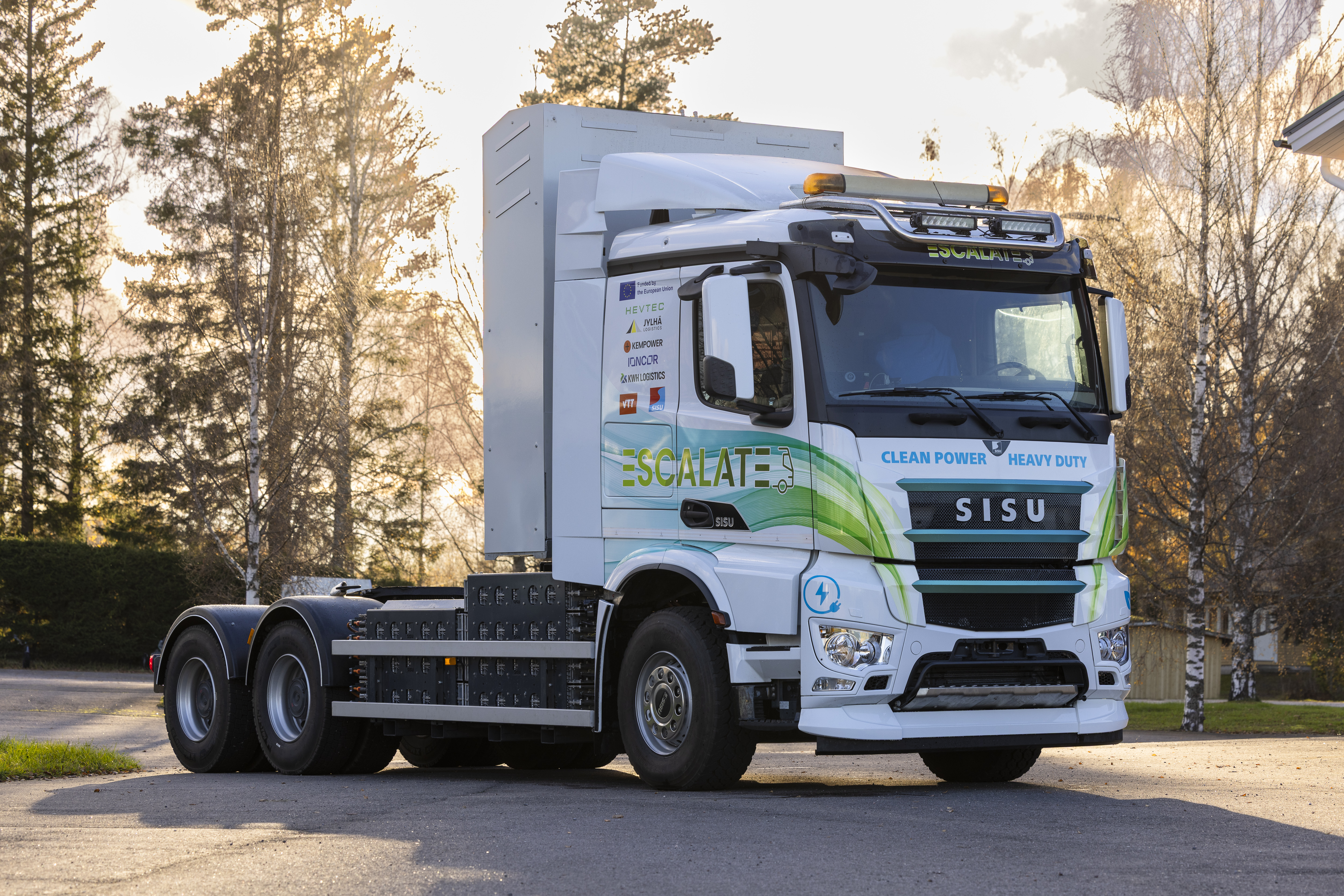
A 68-tonne SISU Escalate demonstrator will begin regular operations in late 2026, testing whether a battery-first, fuel-cell-supported truck can handle a 540-kilometer daily route in Finnish winter conditions.
A battery–hydrogen hybrid truck developed for zero-emission heavy-duty transport will begin regular operation in Finland in late 2026.
The SISU Escalate truck, manufactured by Sisu Auto, will be tested by VTT Technical Research Centre of Finland as part of the EU-funded ESCALATE project. It combines a 650 kWh battery with a 120 kW hydrogen fuel cell, allowing the vehicle to prioritize electric driving while retaining an additional energy source for long-haul work.
Jylhä Logistics will operate the truck between Vuosaari harbour in southern Finland and Jyväskylä in central Finland. The pilot is designed to assess energy consumption, reliability, charging and refueling needs, and operating costs in real transport conditions.
A battery-first approach
Unlike a conventional fuel-cell truck, the SISU Escalate demonstrator is designed to run primarily on battery electricity.
The 650 kWh battery provides the principal energy source, while the 120 kW fuel cell supports longer assignments. The announcement does not disclose the truck’s usable battery capacity, hydrogen storage capacity, electric-only range or combined operating range.
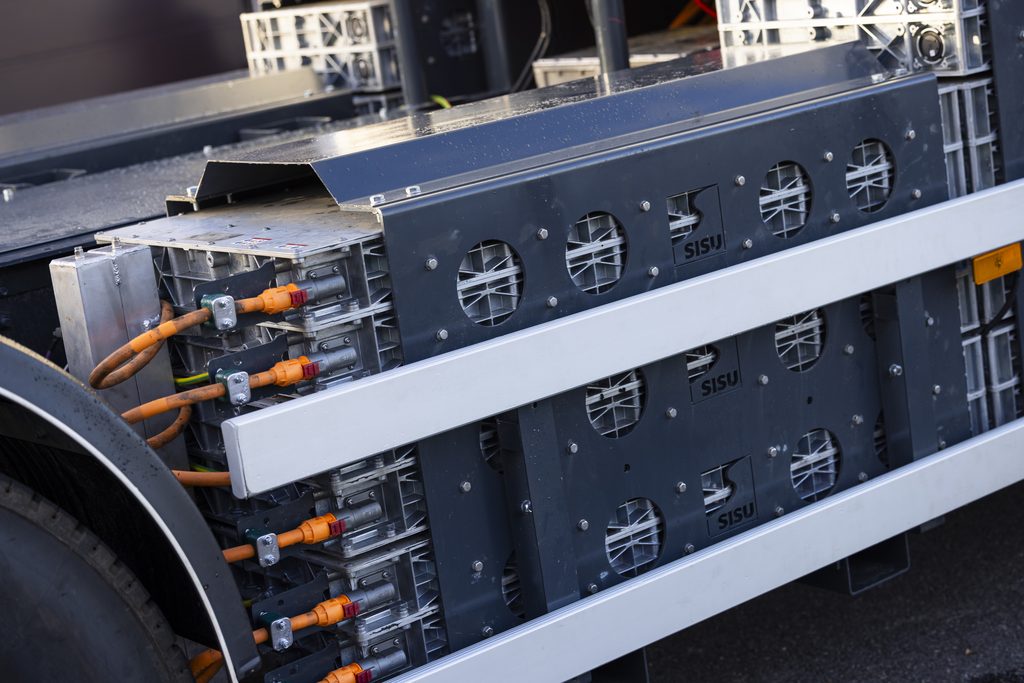
The vehicle’s longer chassis reflects the space required for both the battery pack and hydrogen tanks.
“Battery technology is a key element in the electrification of traffic,” said Juuso Kelkka, Senior Manager of Technology Development at IONCOR, which supplied the battery system.
“The pilot is carried out with a highly demanding setup: the modular battery platform must function in a 76-tonne articulated vehicle, in harsh winter conditions, and on a long-haul route.”
IONCOR says the trial will help demonstrate that lithium-ion batteries can operate in demanding heavy-duty conditions.
Six months of real-world testing
VTT will monitor the truck for six months using vehicle data and a digital twin.
The vehicle is expected to cover 540 kilometers per day. Researchers will track electricity and hydrogen consumption, reliability, and the effect of factors such as weather on energy use.
“We will collect data on the technology, energy consumption, and overall functionality and reliability of different solutions,” said Mikko Pihlatie, Research Professor at VTT.
“The vehicle will drive 540 kilometres per day, during which we will monitor how much electricity and hydrogen it is using.”
The 540-kilometer figure is a planned daily operating distance, not a stated single-charge range or total range.
The pilot will also examine how the vehicle performs during regional distribution work in the Helsinki metropolitan area.
Charging and hydrogen infrastructure
The route includes charging stations at both ends, while a megawatt-scale charging station is planned along the corridor.
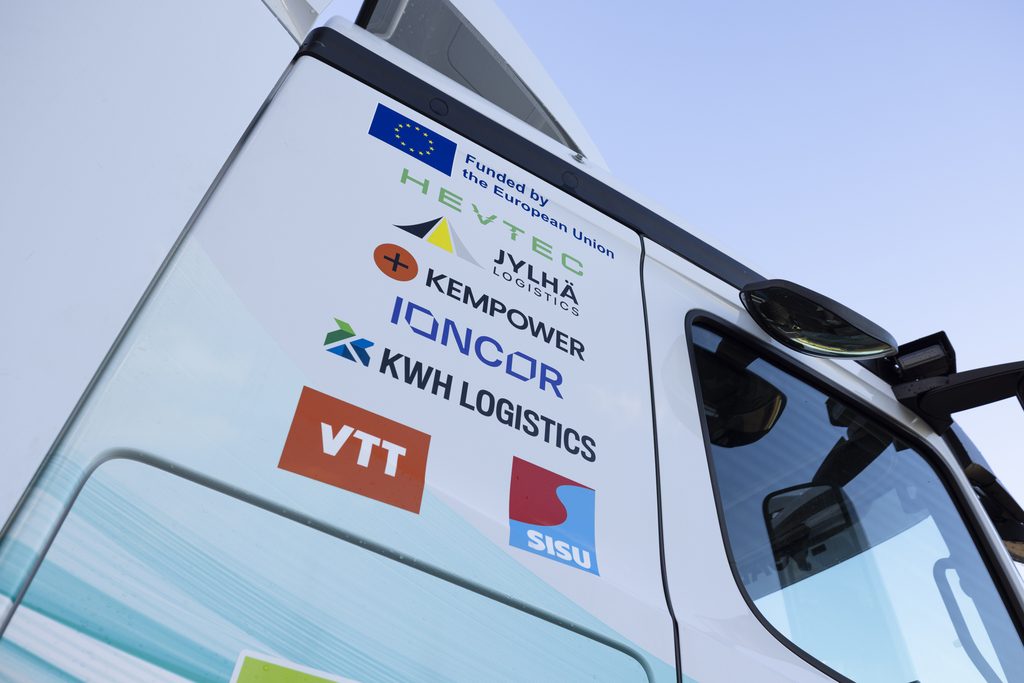
Kempower is supplying the Megawatt Charging System infrastructure. Hevtec is responsible for the vehicle-side charging solution and integration of the electric powertrain.
The truck will also use Finland’s first hydrogen refueling station, located in Jyväskylä.
The announcement does not specify the output of the planned charging station, the truck’s maximum charging power or expected charging times. The term “megawatt-scale” describes the planned infrastructure, not a confirmed charging rate for the vehicle.
Testing a 68-tonne combination
The truck will operate with a gross vehicle combination weight limited to 68 tonnes during the pilot.
That is below the maximum 76-tonne vehicle combinations used in Finland and Sweden, but substantially heavier than the roughly 40-tonne articulated-truck configurations common elsewhere in Europe.
The project will use the Finnish conditions to assess how zero-emission powertrains and supporting infrastructure perform in demanding heavy-duty operations.
“A total of four trucks are piloted across Europe in this project, with different structures and power sources,” Pihlatie said.
“SISU Escalate is the heaviest and longest of these. With its size and the difficult winter conditions in Finland, the operating environment of this truck is the most demanding of the four.”
Cost and energy strategy
The pilot team will combine electricity and hydrogen consumption data with energy-price information to identify the most cost-effective operating strategy.
The analysis will consider how much energy should be loaded, where charging or refueling should occur, and how the balance between electricity and hydrogen affects costs.
Results will be benchmarked against diesel-powered vehicles. No measured consumption figures, cost savings or completed total-cost-of-ownership comparison have yet been published.
Sisu Auto says the data will help develop energy-management systems and optimize battery use to maximize the distance driven using electricity.
“Hydrogen is, after all, the more expensive fuel,” said Petri Kananen, Head of Development at Sisu Auto.
A demonstrator, not a commercial model
Sisu Auto says the SISU Escalate truck is not a commercial product and will not be launched to market in its current form.
Instead, the company will use the pilot’s findings to inform future product development, including energy-management systems and powertrain choices.
The ESCALATE project includes four trucks across Europe with different structures and power sources. The Finnish vehicle is intended to test zero-emission technology in one of the project’s most demanding operating environments.
FAQ
What is the SISU Escalate truck?
It is a battery–hydrogen hybrid technology demonstrator manufactured by Sisu Auto. It uses a 650 kWh battery as its primary energy source and a 120 kW hydrogen fuel cell as secondary support.
When will the pilot begin?
Regular transport operations are planned to begin in late 2026.
Where will the truck operate?
Jylhä Logistics will run the truck between Vuosaari harbour and Jyväskylä. It will also carry out regional distribution assignments in the Helsinki metropolitan area.
Does the truck have a 540-kilometer range?
No. The 540-kilometer figure is the planned daily driving distance. The announcement does not state the vehicle’s single-charge range or total battery-and-hydrogen range.
How heavy is the vehicle combination?
The pilot limits gross vehicle combination weight to 68 tonnes. The 76-tonne reference relates to the heavier vehicle configurations used in Finland and Sweden.
Does it use megawatt charging?
Kempower is supplying MCS infrastructure and a megawatt-scale charging station is planned along the route. The announcement does not specify the truck’s maximum charging power or charging time.
Is the truck available for purchase?
No. Sisu Auto describes it as a technology demonstrator intended to inform future commercial product development.