USCALE’s 2026 survey of 4,004 fully electric vehicle drivers found that willingness to recommend reached a new high, while charging difficulties, vehicle software and connected apps remained major frustrations.
Electric vehicle satisfaction has reached its highest level in USCALE’s survey series, according to the company’s EV Satisfaction Study 2026.
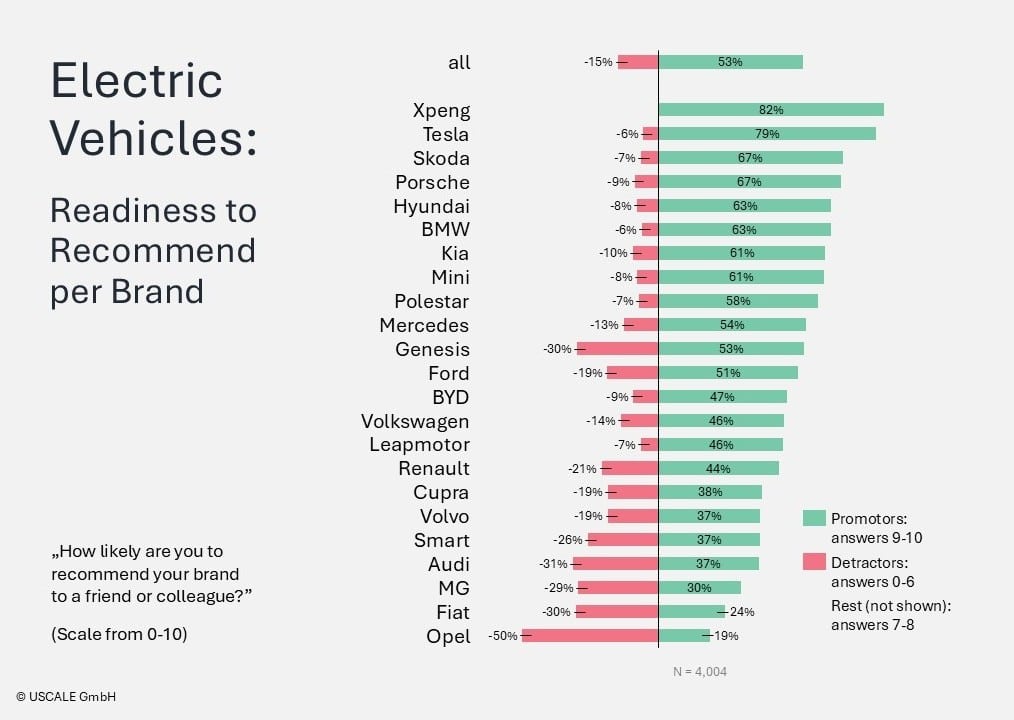
The overall Net Promoter Score, or NPS, rose to 38, up from 33 in 2025. Across all brands, 53% of respondents were promoters, 15% were detractors and 32% were passives.
The improvement marks the third consecutive annual increase. Among the brands included in the study, XPENG retained first place, followed by Tesla, Skoda and Porsche. MG, Fiat and Opel recorded the weakest recommendation results.
The online study surveyed 4,004 drivers of fully electric vehicles in Germany, Austria and Switzerland during June and July 2026. Their vehicles were no more than three years old.
Participants were recruited through social media, meaning the findings reflect a self-selected group of engaged EV owners rather than a population-representative survey of all EV drivers.
Willingness to recommend rises for a third consecutive year
The overall NPS increased by five points year over year, reaching its highest level since USCALE began the series.
NPS measures willingness to recommend a product or brand. Respondents scoring nine or ten are classified as promoters, those scoring seven or eight as passives, and those scoring from zero to six as detractors.
The percentage of detractors is subtracted from the percentage of promoters to calculate the final score. In the 2026 study, 53% promoters minus 15% detractors produced the overall NPS of 38.
The latest increase follows a rise from 24 in 2024 to 33 in 2025, as reported in USCALE’s previous EV Satisfaction Study.
“EV drivers have never been more satisfied. But they are also becoming increasingly demanding,” said Dr. Axel Sprenger, founder and managing director of USCALE.
“What was exciting yesterday is standard today. Manufacturers have done their homework on range and charging. Now competition will be decided by software, connectivity and a seamless charging experience.”
Real-world range improves as expectations increase
The survey indicates that respondents are experiencing longer driving ranges.
In 2026, 59% reported a real summer range exceeding 400 kilometers, compared with 50% in the previous year.
Despite that improvement, the 400-kilometer benchmark is becoming less impressive to drivers. The proportion rating that summer range as good or very good fell from 79% in 2025 to 75% in 2026.
Only 15% now consider a summer range of 400 kilometers very good. USCALE says the comparable proportion was twice as high in 2023.
The findings suggest that improved vehicle capabilities are raising expectations. A range that once differentiated an electric vehicle is increasingly being treated as a baseline.
Higher charging power no longer guarantees satisfaction
Vehicle charging capabilities also continued to improve.
The share of respondents whose vehicles offered at least 150 kW of DC charging power increased from 75% to 77%. However, only 58% considered 150 kW good or very good, down from 65% in 2025.
USCALE’s previous study had already recorded substantial progress. The proportion of respondents whose vehicles supported at least 150 kW rose from 61% in 2024 to 75% in 2025.
The latest results show that expectations for charging performance are rising alongside vehicle specifications. A higher peak-power figure does not necessarily translate into a more satisfying charging experience.
Real-world performance can also depend on the charging curve, battery temperature, state of charge, battery preconditioning and the charging station’s available power.
Charging remains the most frequently reported problem
Despite improvements in range and charging power, 71% of respondents reported charging-related problems, down slightly from 73% in 2025.
The most frequently cited issues were:
- Difficulties starting a charging session
- Unexpectedly low charging power
- Poorly implemented charger-search functions
- Weak integration of charging into vehicle navigation
Only 43% considered the charging-station search in their vehicle well implemented, while 56% saw room for improvement.
The release does not specify how the reported problems are divided between public charging, workplace charging, destination charging and home charging. It also does not establish whether each issue originated in the charging station, vehicle, app, payment process or communication between systems.
For manufacturers and charging-service providers, the results point to a broader challenge: reliable session starts, useful charger information and effective route planning matter alongside maximum charging power.
Software becomes the leading improvement priority
Software quality was the area respondents most frequently identified for improvement.
| Area requiring improvement | Share of respondents |
|---|---|
| Vehicle software | 44% |
| Charging power | 42% |
| Connected vehicle app | 39% |
| Route planning | 35% |
| Driving range | 34% |
Problems with connected vehicle apps were reported by 48% of respondents.
The differences between brands were substantial. According to USCALE, only 8% of Tesla respondents reported app problems, compared with 92% of Opel respondents.
While range, energy consumption and charging power improved, USCALE says software quality attracted more criticism than in the previous year.
The findings suggest that digital functions remain an important part of the ownership experience as core vehicle specifications improve. For many drivers, the app, route planner and charging interface are no longer secondary features. They are integral parts of using an electric vehicle.
Warning sounds frustrate half of respondents
Warning and notification sounds emerged as another source of dissatisfaction.
Half of respondents said they were bothered by vehicle alerts, while warnings from driver-assistance systems alone bothered 30%.
The results varied considerably between manufacturers. Only 29% of Mini respondents reported being bothered by warning sounds, compared with approximately 80% of Kia and Hyundai respondents.
USCALE said the wide variation between brands suggests that warning-sound implementation is partly a design choice rather than solely a technical requirement.
XPENG leads as Tesla returns to second place
XPENG retained first place in USCALE’s 2026 recommendation ranking. The accompanying chart shows that 82% of XPENG respondents were promoters.
According to USCALE, XPENG scored particularly well for charging power, charging management and range. Its connected app improved substantially, while route planning remained its largest weakness. Energy consumption also attracted more criticism than in 2025.
Tesla returned to second place after finishing sixth in the previous study. The chart shows a 79% promoter share and 6% detractors.
Tesla performed strongly in software, its connected app, route planning and energy consumption. However, more than half of Tesla respondents identified charging power as an improvement priority. Acoustics, build quality and driver-assistance functions also attracted criticism.
Skoda and Porsche followed in third and fourth place. Both recorded a 67% promoter share, while detractors represented 7% of Skoda respondents and 9% of Porsche respondents.
These percentages describe the surveyed owners of each brand. The accompanying chart does not provide brand-level sample sizes or uncertainty estimates, so small differences should be interpreted cautiously.
Brand results reveal different strengths and weaknesses
USCALE’s findings show that manufacturers achieved recommendation scores through different combinations of vehicle capability and customer experience.
Skoda benefited from the Elroq, which respondents rated more positively than the Enyaq in most areas. Route planning and software remained improvement priorities.
Porsche received strong feedback for charging performance and build quality, while software and route planning were rated below average.
Hyundai scored strongly for range and charging power and improved in almost all areas.
BMW performed well in software, app quality, route planning and charging management. USCALE notes that its Neue Klasse models were not included in the study.
Kia combined good range with improved software quality, although route planning remained a weakness.
Polestar performed well in usability, route planning and its connected app, while energy consumption, software quality and noise insulation attracted criticism.
Mercedes-Benz improved in range, consumption and charging power, which USCALE attributes to newer vehicles based on the MMA platform. Software and build quality received more criticism than in the previous year.
BYD respondents rated software, the connected app and route planning positively, while charging power, energy consumption and usability remained improvement priorities.
Volkswagen remained below average overall. Respondents rated the ID.7 more positively than the ID.3, ID.4 and ID.5 for range, consumption and charging power, but software and app problems persisted.
Leapmotor entered the ranking in the middle of the field. Respondents praised its range and app but identified usability and route planning as weaknesses.
MG, Fiat and Opel occupy the final positions
MG, Fiat and Opel recorded the weakest recommendation results among the brands included in the ranking.
MG received positive feedback for range and equipment but performed poorly in software and its connected app.
Fiat scored well for low energy consumption, while range, charging management and app problems weighed on its result.
Opel ranked last, with 19% promoters and 50% detractors. Alongside widespread connected-app problems, USCALE identified weaknesses in charging management, software and usability.
These results reflect the experiences of the respondents included in the study and should not be interpreted as definitive ratings for every model or owner.
What the survey can and cannot show
USCALE surveyed 4,004 drivers of fully electric vehicles in Germany, Austria and Switzerland in June and July 2026. The vehicles included were no more than three years old.
Participants were recruited through social media. USCALE acknowledges that they are not representative of the average EV driver and says they tend to examine vehicle functions more closely, appreciating well-designed features and criticizing poorly implemented ones.
The results therefore describe the experiences of this engaged owner sample. They should not be presented as definitive satisfaction levels for every EV customer, vehicle model or national market.
The 2026 edition is the seventh study in the series. USCALE says the full report contains more than 170 pages and over 12,000 recommendations for manufacturers’ product, engineering and IT teams.
Further methodology, study contents and purchasing information are available on USCALE’s official EV Satisfaction Study page.
FAQ: EV Satisfaction Study 2026
Are EV drivers becoming more satisfied?
In USCALE’s survey series, willingness to recommend has increased for a third consecutive year. Overall NPS rose from 33 in 2025 to 38 in 2026.
The findings concern the surveyed owners and are not representative of every EV driver.
Which EV brands ranked highest?
Among the brands included in USCALE’s ranking, XPENG placed first, followed by Tesla, Skoda and Porsche.
The accompanying chart shows promoter shares of 82% for XPENG, 79% for Tesla and 67% for both Skoda and Porsche.
Brand-level sample sizes and uncertainty estimates are not shown, so small differences should be interpreted cautiously.
What was the most frequently reported problem?
Charging was the most frequently reported problem area, with 71% of respondents reporting charging-related difficulties.
Common complaints included difficulties starting charging sessions and unexpectedly low charging power. The release does not attribute every issue specifically to public charging infrastructure.
What improvements did respondents prioritize?
Vehicle software ranked first at 44%, followed by charging power at 42%, the connected app at 39%, route planning at 35% and driving range at 34%.
Are range and charging capabilities improving?
Yes. The proportion reporting a summer range above 400 kilometers rose to 59%, while 77% of respondents had vehicles offering at least 150 kW of DC charging power.
However, respondents’ expectations also increased.
Is the survey representative of all EV owners?
No. Participants were recruited through social media, and USCALE describes them as more engaged with vehicle functionality than the average driver.
The findings should be interpreted within that limitation.