While an outright rejection of electric mobility is confined to a distinct minority, converting the remaining majority of internal combustion engine (ICE) drivers will require addressing structural and financial hurdles rather than relying on general awareness campaigns.
According to the EV Adopter Persona Study 2026 released by Stuttgart-based research firm USCALE, only 10% of ICE drivers in Germany consistently reject electric vehicles (EVs) regardless of financial status, age, or housing situation. The study surveyed 1,066 combustion-engine drivers across Germany in June 2026, representative of age, gender, and state demographics. For automakers and policymakers, the takeaway is clear: the biggest gains won’t come from persuading skeptics, but from removing practical barriers for the open-but-blocked majority.
Driver Persona Breakdown
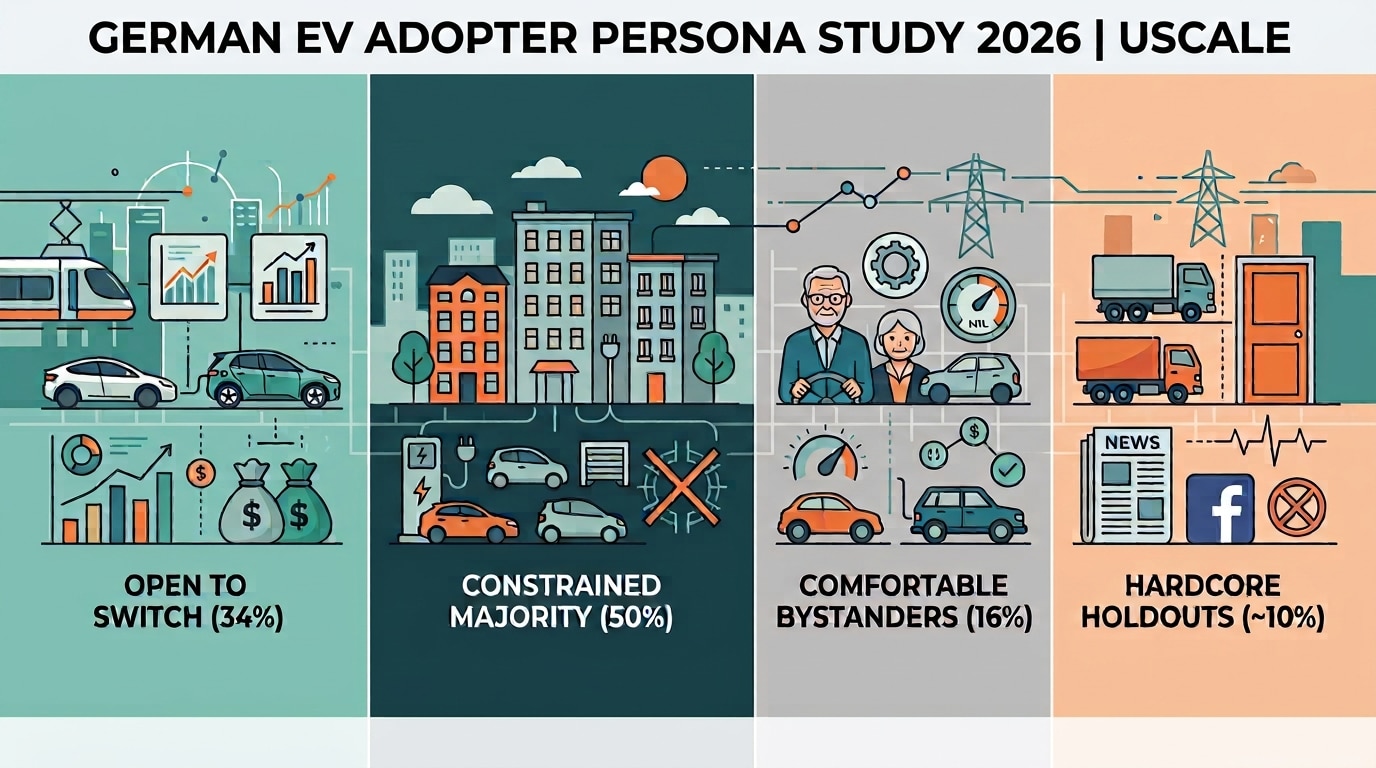
| Driver Persona Group | Market Share (%) | Key Behavioral Drivers & Adoption Barriers | Target Strategy for Industry & Policy |
|---|---|---|---|
| Hardcore Holdouts | ~10% | Broader reluctance toward technology; 2/3 in constrained financial situations; rely on local print & Facebook. | High resistance; general media campaigns fail to reach this segment. |
| Constrained Majority | ~50% | Lack home charging access, initial capital, or affordable used EVs; inadequate non-motorway charging. | Infrastructure deployment in multi-family housing; expansion of used EV market supply. |
| Comfortable Bystanders | ~16% | Older, low-mileage drivers satisfied with ICE status quo despite having practical EV capability. | Requires clear incentives or value propositions to trigger a switch beyond basic information. |
| Innovative Status Buyers & Informed Realists | ~24% (1 in 4) | High purchasing budgets; actively planning or open to EV transition; backbone of current market. | Continued expansion of premium and tech-focused zero-emission models. |
Analyzing the Hardcore Holdout Segment
The study reveals that the 10% of drivers who consistently reject EVs are primarily driven by broader skepticism toward new technology rather than EV-specific grievances. Only 12% of this group describe themselves as curious about technological developments, compared to 37% across all surveyed drivers.
Furthermore, standard editorial and online marketing channels fail to penetrate this segment effectively. Only 19% of holdouts consume online news outlets (versus 32% overall), relying primarily on local print newspapers and social platforms like Facebook.
Dr. Axel Sprenger, founder and CEO of USCALE, stated:
“Ten percent hardcore holdouts might sound like a small number, but assuming that leaves ninety percent of potential buyers would be a mistake.“
“For manufacturers and providers, what matters is the difference between genuine rejection, practical hurdles, and simple disinterest. Only by telling these groups apart can you address them effectively.“
Practical Constraints and Status Quo Satisfaction
The largest barrier to accelerated EV adoption in Germany lies within the “Constrained Majority,” which accounts for roughly half of all surveyed ICE drivers. This group is open to electric mobility in principle but faces immediate practical barriers, such as a lack of dedicated home charging infrastructure, elevated acquisition costs, and a limited supply of affordable pre-owned EVs. Non-motorway public charging infrastructure near residential areas is also cited as insufficient.
Survey Breakdown (1,066 ICE Drivers – Germany, June 2026):
- Active / Open Buyers (34%): High-budget “Status Buyers” & “Informed Realists”
- Constrained Majority (50%): Practical barriers (No home charging, cost, used market)
- Comfortable Bystanders (16%): Low mileage, satisfied with current status quo
- Hardcore Holdouts (10%): Tech-averse, systemic rejection across all income brackets
An additional 16% of respondents—categorized as “Comfortable Bystanders”—consist largely of older, low-mileage drivers. While they possess the financial capacity and housing arrangements required for EV ownership, they lack a strong incentive to replace their existing operational combustion vehicles.
Implications for Policymakers and Energy Providers
The study concludes that expanding market share beyond the current 25% EV share of new German car registrations requires targeted policy and infrastructure adjustments:
- Targeted Funding for Residential Charging: Policymakers must establish regulatory frameworks and targeted financial support for charging installations in multi-family housing and urban residential districts.
- Energy Grid and Utility Scaling: Energy providers must continue scaling regional public charging capacity, ensuring local grid readiness even during temporary fluctuations in vehicle registration rates.
- Secondary Market Growth: A natural increase in used EV availability over the medium term will help address budget constraints for the Constrained Majority.
For more information, visit USCALE.
FAQ: USCALE 2026 EV Adopter Persona Study
What percentage of drivers in Germany outright reject electric vehicles?
According to the USCALE EV Adopter Persona Study 2026, just under 10% of surveyed combustion-engine drivers in Germany consistently reject EVs regardless of their income or age.
What is the largest group of combustion-engine drivers holding back from buying an EV?
The “Constrained Majority” represents approximately 50% of drivers. They are open to EVs but are restricted by high costs, lack of home charging access, or insufficient neighborhood charging infrastructure.
What methodology was used in the USCALE 2026 study?
The study surveyed 1,066 combustion-engine vehicle drivers in Germany during June 2026. The sample was representative of age, gender, and federal state demographics.