TOKYO — Asahi Kasei has developed a novel lithium pre-doping technology for high-voltage lithium-ion batteries with silicon-based anodes. The technology allows lithium carbonate to serve as an additional lithium source at lower voltages, helping reduce the permanent capacity loss that can occur in silicon-rich cells during their first charge-discharge cycle.
The Asahi Kasei lithium pre-doping technology is intended to improve energy density while reducing material costs for next-generation lithium-ion batteries. The company said it will work with customers worldwide to explore practical applications through proof-of-concept evaluations.
Overcoming Silicon Anode Limitations
As electric vehicle adoption and interest in humanoid robots grow, lithium-ion batteries are being asked to deliver greater energy density. Battery developers have increasingly focused on partially replacing graphite in the anode with silicon-based materials, while also increasing cathode operating voltages.
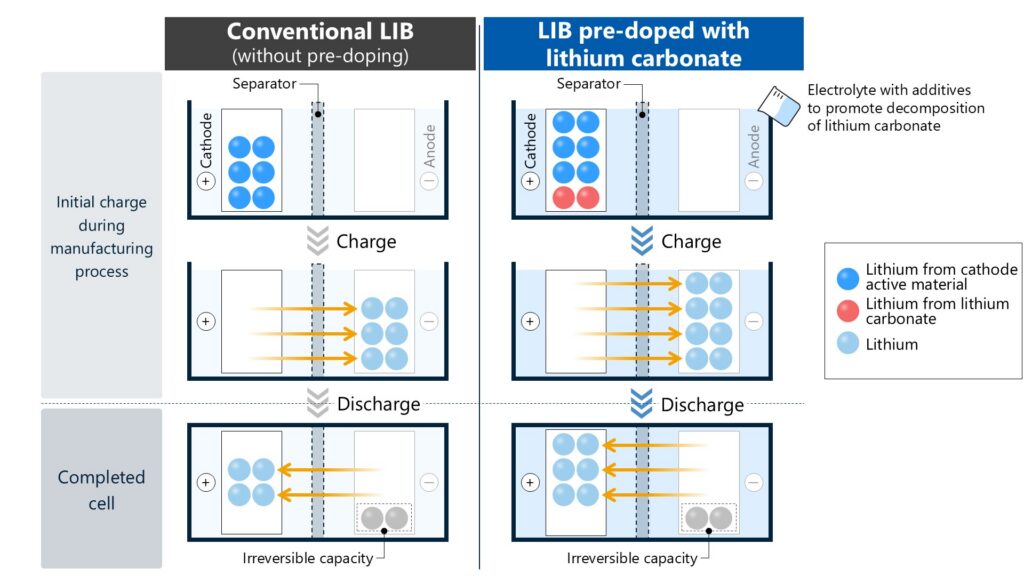
However, silicon-based anodes can experience substantial irreversible capacity loss during the initial charge. That loss can reduce usable battery capacity and energy density, while compensating for it may require additional cathode active material, increasing material use and cost.
Using Lithium Carbonate as a Sacrificial Lithium Source
Asahi Kasei focused on lithium carbonate as an alternative lithium source because it is comparatively inexpensive and already has an established track record as a lithium-ion battery material.
Historically, lithium carbonate has been difficult to use in lithium pre-doping applications because its decomposition voltage is considerably higher than the nominal operating voltage range of standard lithium-ion batteries.
Asahi Kasei’s technology uses specialized electrolyte additives to promote the decomposition of lithium carbonate at typical cell voltages. This allows lithium carbonate to be pre-added to the cathode as a sacrificial lithium source, which decomposes during the initial charge and supplies lithium to offset irreversible capacity loss.
Energy-Density Gains and Manufacturing Compatibility
In internal testing, an NMC (nickel-manganese-cobalt) cell with an anode comprising 90% graphite and 10% silicon monoxide (SiO) achieved a 10% increase in energy density, according to Asahi Kasei.
The company said its technology can also improve cycle life at a lower cost per Wh, or watt-hour. It added that the process can be applied without significant modifications to existing battery-manufacturing lines and may be compatible with a range of cathode and anode material systems.
The approach could make silicon-containing lithium-ion batteries more commercially attractive by combining greater battery energy density with the use of lower-cost lithium carbonate.
Global Commercialization and Licensing Strategy
Asahi Kasei plans to license the technology and offer flexible collaboration frameworks tailored to customers at different development stages.
The strategy forms part of the company’s medium-term management plan and its Technology-value Business Creation (TBC) initiative. Through the programme, Asahi Kasei aims to create value from intangible assets including patents, know-how, data and algorithms through licensing and other business models.
The company aims to conclude at least 10 new licensing agreements during fiscal 2025 through 2027, with cumulative profit contributions of ¥10 billion or more expected by around 2030.
About Asahi Kasei
Asahi Kasei is a diversified global company founded in 1922. It operates across three core business sectors: Healthcare, Homes and Material.
The company employs approximately 50,000 people worldwide and develops products and technologies intended to address sustainability and other global challenges. More information is available at Asahi Kasei’s website.