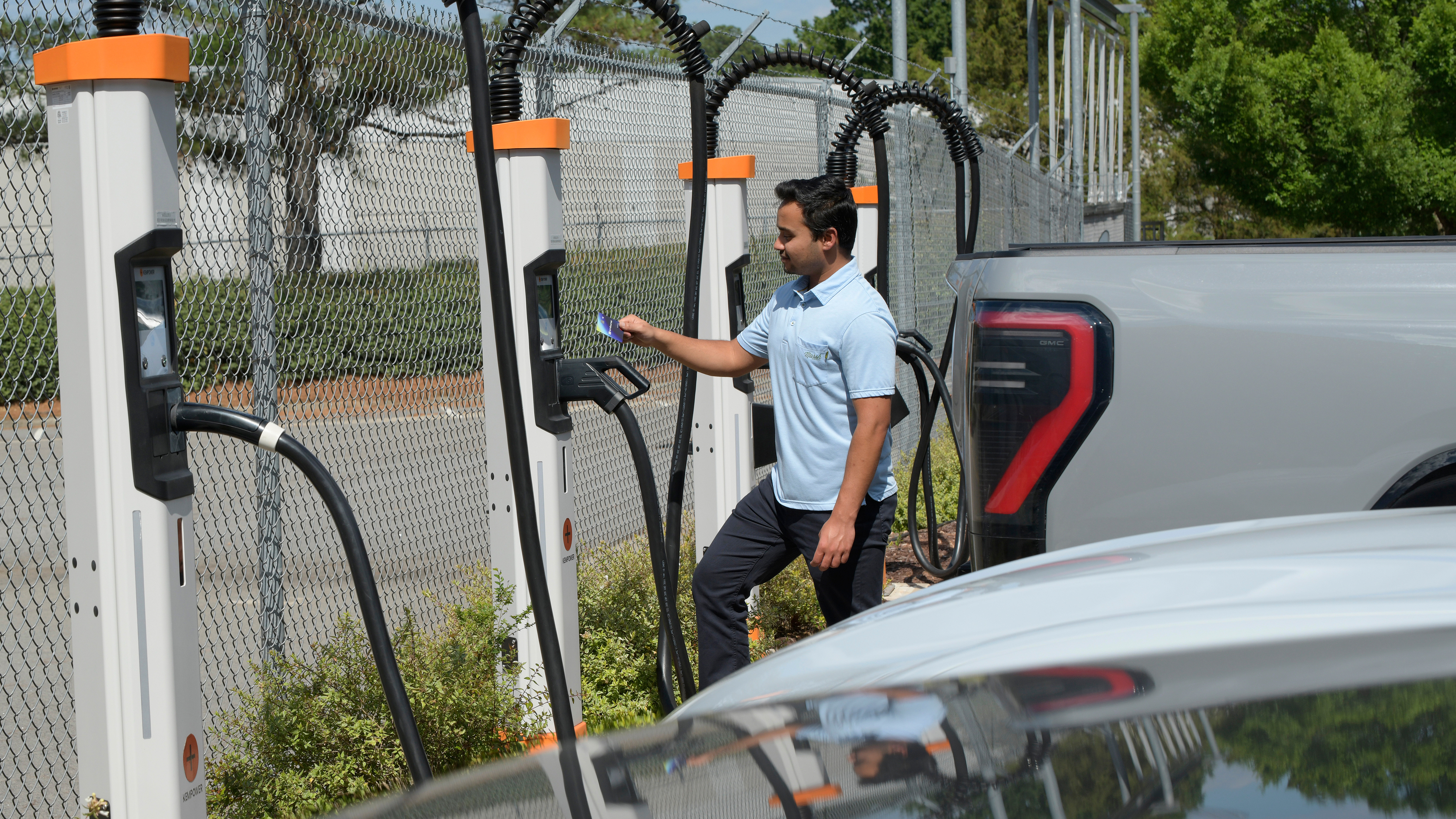
DURHAM, N.C. — Fast-charging technology provider Kempower has released a new white paper analyzing real-world data from public charging sites connected to its ChargEye cloud management platform across North America. The study found that the number of installed charging plugs correlates more strongly with site utilization and energy throughput than total installed charging power alone.
Kempower’s analysis shows that charging plug count correlated roughly three times more strongly with site utilization (R = 0.63) than total installed power (R = 0.228). The white paper also found that distributed charging sites recorded 83% higher utilization than fixed-power dispenser deployments across the North American ChargEye-connected sites analyzed.
Jed Routh, Vice President of Markets & Products North America at Kempower, said:
“Public charging is increasingly becoming an infrastructure utilization challenge, not simply a power deployment challenge. Our ChargEye data shows that giving more vehicles access to charging and dynamically distributing available power can help operators get more from their charging infrastructure.”
Why Plug Count Matters for Public Charging Utilization
Traditional EV charging infrastructure is often provisioned around theoretical peak demand, leaving capacity unused because vehicles rarely sustain maximum charging rates throughout an entire session. The ChargEye data indicates that installing raw power without increasing plug availability can result in underutilized assets.
The white paper highlights a relationship between plug density and total energy delivered (kWh), which can support greater revenue potential for Charge Point Operators (CPOs). Across the analyzed North American network, sites equipped with eight plugs delivered more than double the energy of four-plug sites—averaging 128,342 kWh compared to 61,453 kWh.
Dynamic Power Sharing Improves Site Efficiency
Kempower’s distributed charging architecture addresses capacity constraints by dynamically sharing available power across multiple outlets based on real-time vehicle demand. The system reallocates energy in 25 kW increments—the lowest granularity available on the DC fast-charging market—redirecting unused power from idle or ramping plugs to active sessions.
Key structural takeaways for site design from the white paper include:
- High vehicle access: Up to 12 EVs can charge concurrently from a single 600 kW or 1,200 kW Kempower Power Unit.
- Power benchmark: Sizing sites to roughly 100 kW per plug serves as a practical baseline for maximizing utilization when all connectors are occupied.
- Peak output on demand: Idle capacity is dynamically shifted to support individual vehicles with up to 320 kW when required.
- Total cost of ownership: Prioritizing plug count and dynamic distribution allows operators to avoid over-provisioning grid capacity for rare peak events while increasing session volume and total energy sold.
What Kempower’s Data Means for Charging-Site Design
The findings suggest that charging-site utilization depends more on operational dynamics—concurrent charging and power-distribution efficiency—than on absolute capacity. Designing sites around efficient power allocation and higher plug accessibility may help ensure capacity is actively used rather than passively provisioned.
For CPOs, the white paper identifies three key insights:
- Site utilization over installed power: Adding raw power barely moved utilization. The number of plugs was the stronger predictor of both how much a site is used and how much energy it delivers.
- Extra charging power sits underused: Sites with more installed power did not see higher utilization. Capacity was added without being fully used, tying up investment.
- Distributed charging closes the gap: Sharing power across more plugs, in increments as small as 25 kW, delivered 83% higher utilization than fixed-power dispensers—more sessions, shorter waits and potentially faster ROI.
Methodology and Data Scope
The findings are based on Kempower ChargEye data from connected public charging sites across North America. The white paper compares plug count, installed power, energy delivered and utilization across the analyzed network. Results may vary by location, pricing, uptime and driver demand.
Download the full white paper, to explore the complete North American data and analysis.