The launch of the UK government’s multi-year £170 million Depot Charging Scheme (DCS) marks a defining moment for commercial fleet electrification. Covering up to 70% of eligible infrastructure costs – capped at a generous £1 million per organisation – the scheme significantly lowers the financial barrier for operators looking to transition vans, heavy goods vehicles (HGVs) and coaches. Lee Ackerman, general manager at metering and multi-utility connections consultancy Connectus Utilities discusses the key insights fleet managers need to know, and provides guidance of how to bridge the gap between funding and energising their depots on time.
For many fleet managers, securing a grant during Window 1 of the DCS may feel like crossing the finish line. However, this is only the first step of a bigger journey.
A critical detail many operators overlook is that while DCS covers on-site civil works, trenching and hardware installation, it excludes off-site Distribution Network Operator (DNO) grid upgrades and external network reinforcement. With initial award decisions scheduled for September 2026 and a non-negotiable project completion deadline of 31 March 2027, operators face a remarkably tight window to align their funding with grid realities.
If your depot lacks the electrical capacity to support your new chargers and local grid lead times stretch into 12 or 18 months, you risk losing your grant allocation entirely.
Understanding grid constraints
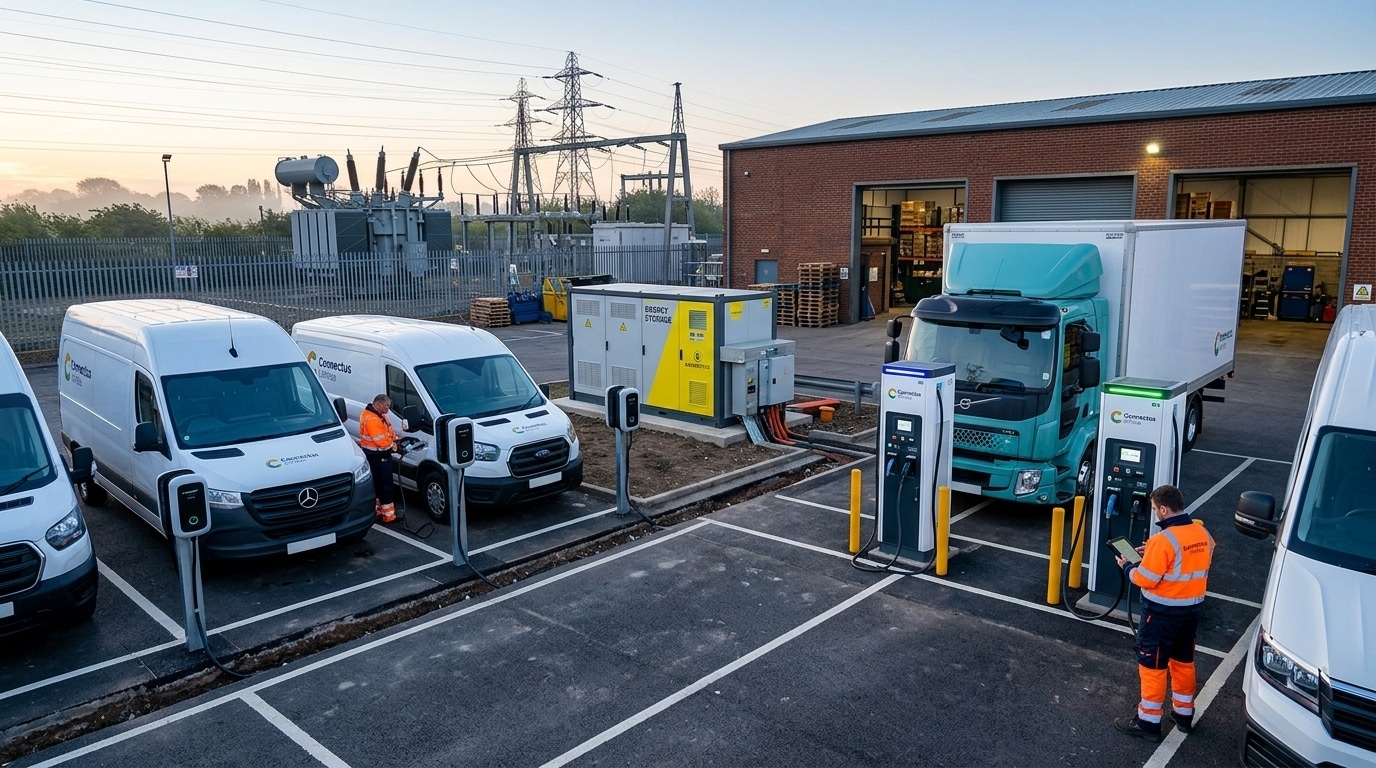
Upgrading a commercial depot from standard building power to an industrial-grade charging hub requires major electrical upgrades. A fleet of 20 electric vans or a small squad of heavy eHGVs can easily demand megawatt-level connections – far more than what standard local substations were designed to supply.
When a depot attempts to draw more power than the local network can handle, the local DNO must undertake upstream grid reinforcement. This might involve upgrading transformers, installing heavier cabling or re-routing high-voltage lines.
The problem is that DNO lead times for major off-site upgrades can take anywhere from six months to well over two years. Because off-site reinforcement costs fall outside the scope of DCS grant funding, fleets that discover a power shortfall after receiving their grant decision in September will find themselves in a race against time before the March 2027 completion cut-off.
Immediate action
For operators who have submitted applications or are preparing for upcoming funding windows, waiting passively for decision letters is a high-risk strategy. Immediate, proactive steps must be taken:
- Conduct a comprehensive physical site audit: assess current depot layouts, existing cabling pathways and spatial constraints for chargepoints. Long runs of underground trenching will increase civil costs and delivery times.
- Inspect on-site substation and capacity: evaluate your local transformer and incoming supply panels. Knowing your exact peak load, current use and spare headroom is essential before specifying what you need.
- Determine realistic operational duty cycles: calculate exactly when vehicles return to base and how long they will be idle. Oversizing charging hardware based on peak potential rather than actual operational requirement is one of the fastest ways to cause unnecessary grid upgrade requests.
Proving site viability
Ensuring grid viability is an essential part of keeping your project moving. This includes engaging with your local DNO or an independent utility consultant early, allowing you to secure Point of Connection (POC) designs and formal connection offers.
A formal DNO assessment clarifies the following:
- Available capacity: exactly how much headroom exists on the local high-voltage network without requiring external upgrades.
- Realistic timeline: whether any required contestable or non-contestable utility works can actually be carried out prior to the March 2027 deadline.
Having a clear utility strategy sorted at an earlier date helps to turn assumptions into milestones, ensuring your civil and electrical contractors aren’t left waiting on a grid connection that is still months away.
Smart infrastructure
If the DNO confirms the power needed requires a long, multi-year grid upgrade, it does not mean that your electrification journey – or your DCS grant – has to stall. By leveraging alternative infrastructure strategies, operators can maximise their existing grid connection and bypass network delays:
- Dynamic Load Management (DLM): intelligent software solutions monitor total depot energy use in real-time, ensuring you don’t exceed your maximum agreed capacity, allowing you to charge more vehicles on a smaller grid connection.
- Battery Energy Storage Systems (BESS): installing on-site battery storage allows depots to charge energy from the grid during off-peak hours (or from solar PV arrays) and use that for vehicles during peak charging windows.
- Phased deployment: design your electrical groundwork for your full, future fleet size but only energise the active sockets required for your immediate need.
Bridging the gap to protect funding and ROI
A grant award is a positive financial milestone, but it is ultimately not applicable until power can flow. Securing funding without an integrated utility delivery strategy creates severe operational and financial risk.
Successful depot electrification requires a synchronised approach where vehicle delivery, civil engineering, chargepoint and grid connection strategies are aligned. By auditing your site today, engaging utility specialists early and embracing smart energy management, commercial fleets can successfully navigate grid realities of the Depot Charging Scheme – turning government funding possibility into operational, zero-emission potential.
For more information, visit: https://connectus-utilities.co.uk/
Author biography – Lee Ackerman:

Lee Ackerman is a general manager at Connectus Utilities, a metering and multi-utility connections consultancy that forms part of the wider Consultus group.
With over a decade of experience in the energy sector, Lee combines a mechanical engineering background with project management experience to support multi-utility infrastructure schemes. Services range from connections, relocations and disconnections across electricity, gas, water, telecoms, sewerage and other utilities.
Offering a full turnkey solution, Lee leverages his network of installers and specialists to manage the risk and strategy in major schemes, helping customers avoid delays while saving time and additional costs.