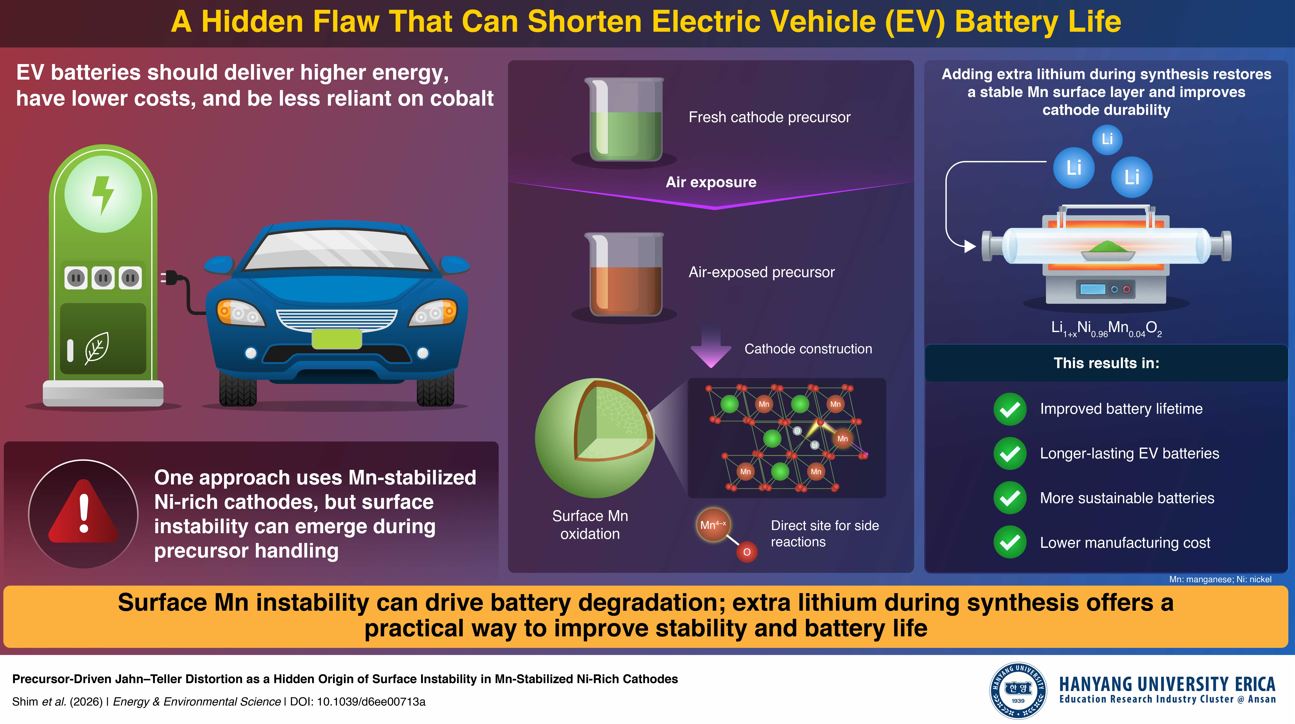
Cobalt-free, high-nickel cathode batteries—such as manganese-coated nickel core batteries—have emerged as a lower-cost alternative that can reduce reliance on critical minerals. However, a new study led by researchers at Hanyang University ERICA reveals that exposing precursor materials to air alters manganese chemistry, creating reactive surface defects that accelerate electrolyte breakdown and cause EV battery degradation.
The study, led by Professor Jin Ho Bang alongside PhD Scholar JinHa Shim from Hanyang University ERICA, South Korea, identifies an overlooked challenge in precursor storage and provides a practical strategy to restore material stability. The findings were made available online on May 13, 2026, and published in Volume 19, Issue 12 of Energy and Environmental Science on June 23, 2026.
Key Study Insights
- Root Cause: Storing cathode precursor materials in air-exposed storage areas oxidizes surface manganese prior to final synthesis.
- Degradation Mechanism: Creates defective surface regions enriched with Jahn-Teller distorted manganese species, nearly doubling capacity fading in extended cycling tests.
- Synthesis Adjustment: Increasing excess lithium during synthesis suppresses defective surface phase formation and restores stable manganese-oxygen bonding.
- Performance Result: Modified high-nickel cathodes retain over 90% of their capacity during extended cycling tests.
Controlling Manganese Chemistry in High-Nickel Cathodes
Manganese is commonly introduced to stabilize high-nickel EV batteries, but the research team demonstrated that it can unexpectedly become a source of instability if precursor history is neglected.
“We found that a manganese-rich shell, which is normally introduced to protect high-nickel cathodes, can instead become a catalyst for degradation if the precursor chemistry is not carefully controlled,” explains Prof. Bang. “Even small variations in precursor storage history can substantially affect battery stability.”
To address the flaw without requiring major redesigns of production lines or expensive secondary coatings, the researchers adjusted the synthesis parameters. By increasing excess lithium, the team neutralized the surface defects caused by precursor air exposure and restored stable manganese chemistry.
“Our results show that even minor variations in precursor history can have major consequences for battery performance, making precursor management an important consideration for large-scale manufacturing,” adds Prof. Bang.
Careful control of precursor handling and lithium stoichiometry provides a practical route toward more durable batteries, extending battery lifetimes for EVs and energy storage systems.
Context & Research Details
- Original Paper: “Precursor-driven Jahn–Teller distortion as a hidden origin of surface instability in Mn-stabilized Ni-rich cathodes” (Journal: Energy and Environmental Science, DOI: 10.1039/d6ee00713a).
- Research Leadership: Led by Prof. Jin Ho Bang (Nanostructured Energy Materials Laboratory) and PhD candidate JinHa Shim in the Department of Energy and Bio Sciences at Hanyang University ERICA, South Korea.