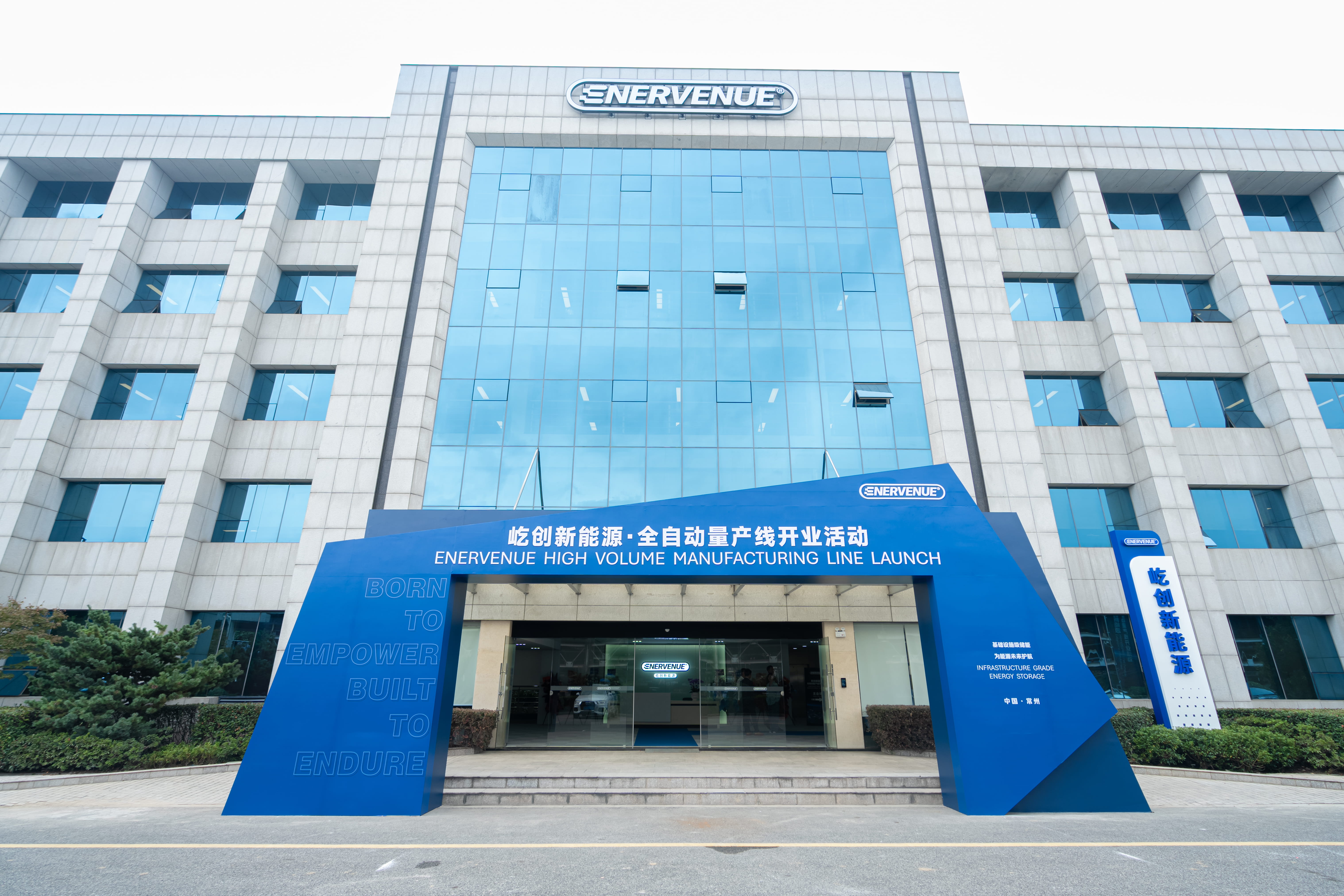
EnerVenue has started production at a new high-volume manufacturing line for its Aqueous Metal Cell technology in Changzhou, China. Located in Wujin, the first phase of the facility is rated at 250 MWh of annual manufacturing capacity, with plans to expand to 1 GWh in 2027 and multiple gigawatt-hours by 2028.
The line is scheduled to ramp up to its full production rate through November 2026. At full automation, it is designed to manufacture approximately 300 fourth-generation Aqueous Metal Cells per day. For stationary storage developers, the move signals that EnerVenue’s lithium-free chemistry is transitioning from pilot projects to industrial-scale supply, potentially opening new options for data centers, industrial sites and safety-sensitive applications.
EnerVenue broke ground on the facility in April 2026 and completed the manufacturing line in approximately 25 weeks. The company described it as the first high-volume production line built specifically for its water-based nickel-hydrogen battery technology.
“The EnerVenue AMC is now being manufactured at scale, that’s what changes today,” said Henning Rath, Chief Executive Officer of EnerVenue.
“This is the only facility in the world making this high-performing water-based nickel-based battery. It’s the first battery of its kind that acts like infrastructure rather than a degrading asset.“
Custom Equipment Supports Automated Cell Production
EnerVenue said the manufacturing equipment used at the Changzhou plant was designed and built specifically for the Aqueous Metal Cell. Because the battery uses a different architecture and manufacturing process from conventional lithium-ion cells, the company developed dedicated machinery for each stage of production.
The line operates as a continuous process from raw materials to finished cells. Automated guided vehicles transport cells between production stations, reducing the need for manual handling as each cell moves across the factory floor.
A purpose-built stacking machine assembles the electrode stack under a machine-vision system. The cell is then wound in fiberglass using a process that controls tension from the inside outward, creating a shell designed to retain its structural integrity throughout the cell’s working life.
Every machine is connected to a single manufacturing execution system, allowing EnerVenue to monitor production activity and quality data across the line. The equipment was initially engineered and validated at EnerVenue’s research and development line, located approximately six kilometers from the new plant, before being transferred to high-volume manufacturing.
Each Aqueous Metal Cell Undergoes 41 Quality Checks
Every cell manufactured at the Changzhou facility undergoes 41 quality checks across 11 testing and measurement stations before leaving the plant. The checks are designed to assess weld integrity, leak tightness and battery performance. EnerVenue will also test fully commissioned 150 kWh Energy Racks at the facility before shipping them to customers.
“A cell only leaves this building after 41 checks across 11 stations,” said TJ Hua, Head of Production at EnerVenue.
“Anyone can make one good vessel. The job is making the ten-thousandth one exactly the same.“
The plant occupies approximately 20,000 square meters. Its production stations have been standardized so that EnerVenue can add capacity by replicating the existing equipment and processes. The building also includes provision for a second phase of approximately the same size. EnerVenue intends to use the Changzhou line as a manufacturing blueprint for future regional production facilities.
The Line Will Manufacture Cells for Four Storage Products
The Changzhou production line will supply fourth-generation Aqueous Metal Cells for four products covering distributed, commercial, industrial and containerized energy storage applications.
| Product | Capacity | Typical Application |
|---|---|---|
| Energy Core | 30 kWh | Telecom, UPS, distributed/remote sites |
| Energy Cube | 108 kWh | In-building and data center UPS |
| Energy Rack | 150 kWh | Commercial, industrial, grid-connected |
| Energy Prism | ~600 kWh – 1 MWh (containerized) | Utility-scale and heavy industrial |
All four products use the same fourth-generation Aqueous Metal Cell. The company’s current published specifications describe the Energy Prism as a pre-integrated DC storage block carrying onboard battery management and internal wiring. Power conversion equipment can then be connected to complete the AC system.
New Factory Will Support an 11 MWh Commercial Order
The production launch follows EnerVenue’s announcement of its first commercial order at multi-megawatt-hour scale. A major Chinese oil and gas producer has ordered 26 Energy Prism containers with a combined storage capacity of 11 MWh for an established oilfield in northern China.
The storage system will capture electricity generated by an onsite solar installation and supply that energy to the oilfield when required. The first three containers are scheduled to ship in December 2026, with the remaining 23 following in March 2027.
EnerVenue said the customer selected its technology after evaluating the battery against the oilfield’s fire and process-safety requirements. The company has not disclosed the end user, precise project location, power rating or commissioning date. The Energy Prism units will be manufactured using cells from the Changzhou line and delivered as complete containerized systems ready to connect to the project’s power conversion equipment.
Aqueous Metal Cells Are Already Supporting Electric Bus Charging
Cells manufactured in Changzhou are already in operation at a smaller energy storage installation in Jintan. The 150 kWh project has operated with The Hong Kong and China Gas Company Limited, also known as Towngas, since November 2025. It combines onsite renewable energy generation with charging infrastructure for electric buses.
The system uses 50 fourth-generation Aqueous Metal Cells in a customized Energy Rack configuration, together with an inverter and battery management system. It charges and discharges over two-to-four-hour periods to follow site demand and reduce energy costs.
For the EV charging sector, the project demonstrates one potential application of EnerVenue’s technology: storing locally generated renewable electricity and making it available when electric vehicles or buses need to charge.
EnerVenue said cells manufactured in Changzhou have also been shipped to customers in the United States, Belgium and Saudi Arabia. The company reports active projects and customer engagements across China, Australia, the United States, the European Union, Saudi Arabia and Canada.
EnerVenue Targets a 30-Year Operational Life
The Aqueous Metal Cell is based on nickel-hydrogen chemistry and uses a water-based electrolyte. Nickel-hydrogen batteries have previously been used in aerospace applications, including the Hubble Space Telescope and the International Space Station. EnerVenue has adapted the chemistry for stationary energy storage using materials and manufacturing processes intended to reduce its cost for terrestrial applications.
The company specifies a design life of 30,000 charge-discharge cycles, equivalent to as many as three cycles per day over 30 years. Its technical documentation lists 3 kWh of nominal energy per cell and a peak round-trip efficiency above 90%.
EnerVenue says its storage systems do not require scheduled capacity augmentation during their design life. The company is therefore positioning the technology around total lifetime energy delivery rather than solely around the initial cost per kilowatt-hour.
The Aqueous Metal Cell uses no lithium or rare-earth materials. Its principal materials include nickel, steel, fiberglass and a water-based electrolyte, while the nickel can be recovered for reuse at the end of the cell’s operating life, according to EnerVenue.
Water-Based Electrolyte Addresses Thermal Runaway Concerns
EnerVenue says the Aqueous Metal Cell does not follow the thermal runaway pathway associated with conventional lithium-ion battery chemistry. Its electrolyte is water-based and non-flammable. The company’s technical documentation states that the cell has completed UL 9540A testing without fire propagation at cell level.
“While thermal runaway is generally defined as a self-accelerating sequence of exothermic reactions, the AMC chemistry does not produce the same progression of events that leads to ignition, fire, explosion or propagation to adjacent cells,” said Dr Majid Keshavarz, Chief Technology Officer at EnerVenue.
EnerVenue says these characteristics can allow its systems to operate without complex active cooling or auxiliary fire-suppression equipment where local regulations permit. The company’s safety, lifecycle and performance statements remain manufacturer claims. Requirements for individual projects will depend on system design, local codes, environmental conditions, certification requirements and approval by the relevant authorities.
Changzhou Provides Access to an Established Battery Supply Chain
EnerVenue selected Changzhou because of the battery manufacturing ecosystem concentrated around the city. According to the company, approximately 160 battery-industry businesses operate in the area, with a substantial part of the relevant supply chain located within 50 to 100 kilometers of the plant.
EnerVenue intends to use Changzhou as the proving ground for a “local-for-local” manufacturing model. The standardized production line could be replicated in other regions as customer demand and project pipelines expand.
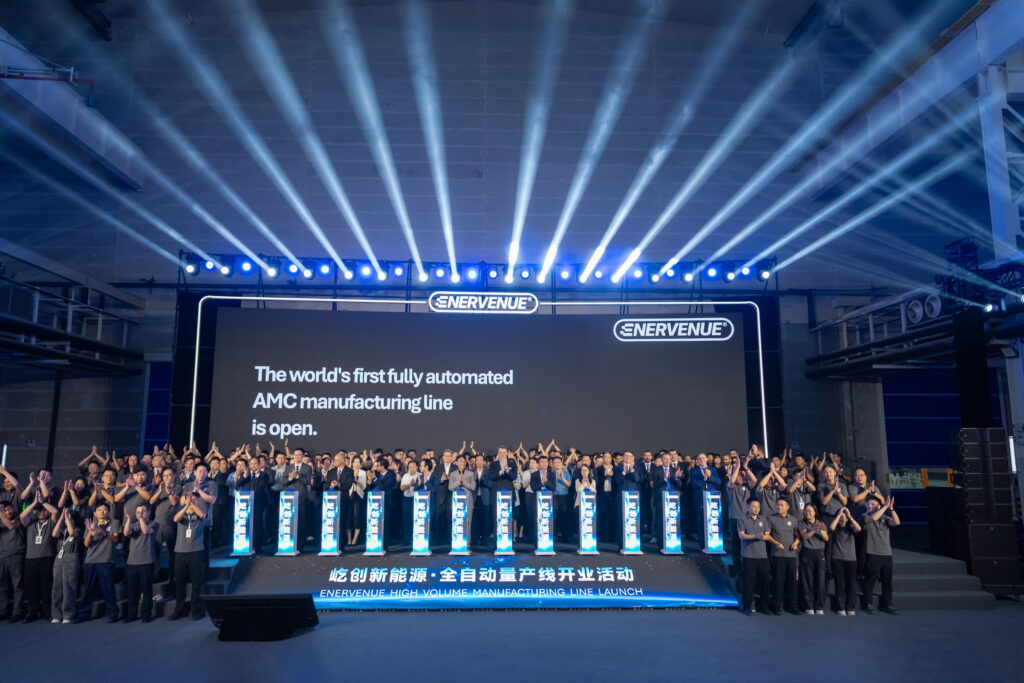
At the factory’s opening ceremony, EnerVenue signed memoranda of understanding covering potential future business with eight companies. The parties named in the announcement include Towngas, Towngas Smart Energy, Shanghai Electric, Guangzhou Development Group, Jiangsu Huahong New Energy Development, PCG Power, Suzhou Yuanzhang New Energy Technology, Desert Technologies and KIOZ.
Memoranda of understanding indicate interest in future cooperation but do not constitute binding purchase agreements or guaranteed deployment volumes.
The Changzhou line is backed by a $300 million Series B extension announced in March 2026 and led by Full Vision Capital. EnerVenue says it has raised more than $700 million in total.
With production now underway, EnerVenue’s near-term manufacturing priorities will be ramping the line through November, delivering the first Energy Prism systems in December and preparing for the planned expansion to 1 GWh of annual capacity in 2027.
FAQ: EnerVenue Changzhou Production Line
What has EnerVenue opened in Changzhou?
EnerVenue has opened a high-volume manufacturing line for its fourth-generation Aqueous Metal Cell. The first phase is rated at 250 MWh of annual production capacity.
How many cells will the EnerVenue factory produce?
At full automation, the Changzhou line is designed to manufacture approximately 300 Aqueous Metal Cells per day. EnerVenue expects the line to ramp to its full production rate through November 2026.
How will EnerVenue expand the factory?
EnerVenue plans to increase annual manufacturing capacity to 1 GWh in 2027 and reach multiple gigawatt-hours by 2028. The standardized production stations can be replicated to add capacity.
What is an Aqueous Metal Cell?
EnerVenue’s Aqueous Metal Cell is a stationary energy storage battery based on nickel-hydrogen chemistry. It uses a non-flammable, water-based electrolyte and contains no lithium or rare-earth materials.
What products will use cells from the new factory?
The Changzhou line will supply cells for the 30 kWh Energy Core, 108 kWh Energy Cube, 150 kWh Energy Rack and containerized Energy Prism.
Is EnerVenue’s technology used for EV charging?
A 150 kWh EnerVenue installation in Jintan, Changzhou, integrates onsite renewable electricity with electric bus charging. The new factory will also supply cells for industrial, commercial, data center and grid-connected storage applications.