Once straightforward symbols of climate resiliency, electric vehicles (EVs) have come under scrutiny for the energy they consume. But that line of thinking overlooks something important about EVs: their potential to contribute to the grid.
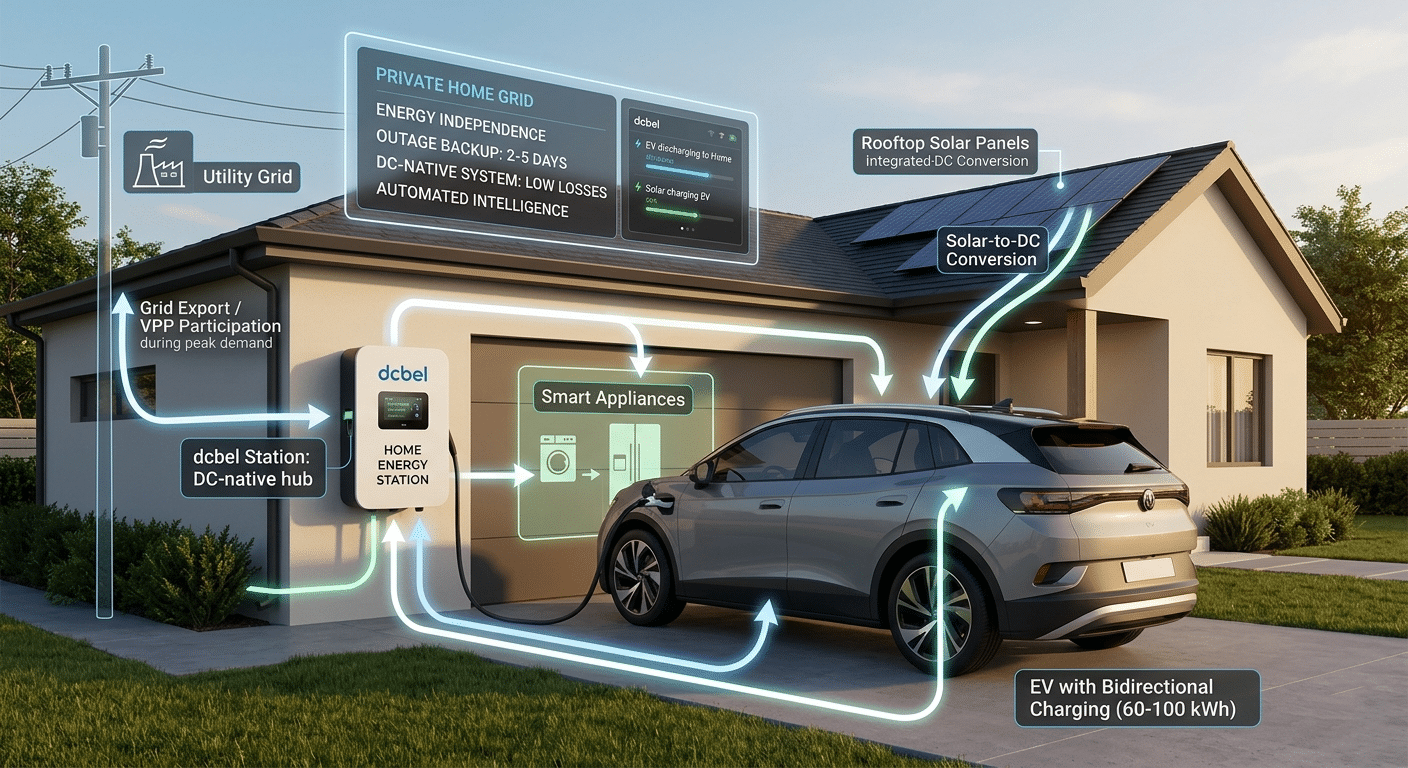
EV batteries are massive reservoirs of stored energy, and for long stretches of the day, they sit idle holding power that could be doing something. That energy can turn a home into a flexible, private grid of its own, one that stores excess power and feeds it back to the larger grid when demand peaks.
The vehicles once seen as threats to the grid may end up being one of its most important assets. Scaled across millions of homes, they would form the largest distributed battery fleet ever created, built not by utilities or grid operators, but by people buying cars.
Bidirectional Charging Unlocks EVs’ Potential
Bidirectional charging is not a new concept, but the challenge to date has been everything around it: hardware compatibility, software control, and regulatory constraints that make it difficult to deploy at scale. As a result, most EVs are still limited to one-way charging.
With bidirectional charging, EVs can move energy in and out. In practice, that means the car can charge when electricity is cheap or when solar production is high, then power the home later in the evening when demand — and prices — go up. During an outage, it can keep essential systems running for days. And when the grid is under stress, it can send energy back instead of drawing from it.
Why EVs Are the Perfect Storage Assets
EV batteries weren’t designed with the grid in mind. They were designed to power a 5,000-pound vehicle from a standstill. Turns out, that’s exactly the potency the grid needs.
- Outsize capacity. A typical home battery stores around 13.5 kWh, while most EVs store between 60 and 100 kWh.
- High-power performance. EV batteries are designed to deliver large amounts of power quickly—enough to accelerate a multi-ton vehicle in seconds. That potency makes them effective for grid support, where fast response matters.
- Built-in thermal management. Heating and cooling systems are standard in EV battery design to maintain performance and longevity, which are also essential for reliable storage.
- Extended home backup. A modern EV can power an average American home for two to five days, offering resilience in emergencies.
- Scales with adoption. Every EV added to the road brings new storage capacity with it. Unlike standalone batteries, this capacity comes as part of a purchase consumers are already making.
Most homes have never had access to this level of storage. Whether it can be put to work depends on how the home is wired, how energy is managed, and whether the EV is actually set up to send power back out.
What it Takes to Make EVs Part of the Energy System
An EV won’t become a functional energy asset on its own. Getting there means treating the home as a single, coordinated energy system—and building the infrastructure and controls to support that.
1. A system built around DC, not constant conversion
Most home energy setups weren’t designed to move power efficiently between solar, storage, and EVs. Solar panels generate DC. Batteries store DC. EV charging runs on DC. But the home itself operates on AC.
Energy gets converted back and forth, often multiple times, just to move between systems. Every conversion introduces losses. In some cases, that can mean up to 30% of the energy is lost before it’s ever used.
A DC-native approach fixes that. Solar, storage, and EV charging operate on a shared backbone. That reduces waste and makes it much easier to move energy in both directions.
2. Operational intelligence and automation
Private grids rely on continuous decision making, so coordinating them can’t be a manual task. Operational intelligence is necessary to make them work.
Automated systems can bring that intelligence, deciding when to charge, when to discharge, and when to export energy based on real-time conditions and user needs. Automation ensures the vehicle is ready when it’s needed while making good use of its stored energy.
Behind the scenes, it’s making small, ongoing adjustments: charging ahead of a price spike, holding energy instead of exporting it when rates are low, or stepping in with short bursts of power when demand surges. This kind of coordination makes distributed energy sources more predictable, so they bring value to both the homeowner and the grid.
3. EVs that are ready for bidirectional use from the start
Not every EV is equipped to send power back out. That capability depends on a few critical pieces working together.
First, the hardware needs to support bidirectional flow. Second, charging standards have to allow for it, so vehicles and chargers can actually communicate and operate safely. Third, the vehicle’s battery management system and software need to handle export limits, protect battery health, and control how and when energy is discharged.
With the right hardware, standards, and software in place, the vehicle becomes a controllable energy resource that can support both the home and the grid.
The Road Ahead
Integrating EVs into home energy systems doesn’t hinge on a single breakthrough. The pieces already exist. The challenge is getting them to work together, across vehicles, chargers, homes, and the grid.
When that happens, the EV becomes something more than a car: a flexible energy asset that fuels a private grid.
For buyers, that reframes the purchase entirely. What they’re getting is transportation, yes, but also energy independence.
It changes how the grid sees EVs too. Millions of vehicles, once seen as a drag on the grid, become a resource for managing demand at scale. Instead of adding strain, they can reduce it using EVs as energy sources redefines how we use power and stabilize the grid. The work now is to build the systems that make it real, and do it fast enough to matter.
BIO:

Daniel Fletcher is Co‑Founder and Head of Ecosystems at dcbel, where he leads partner strategy and ecosystem development. Based in Montréal, he brings deep experience across microgrid and distributed energy resource (DER) projects, with a background spanning power electronics, clean energy systems, and advanced energy integration.
Prior to dcbel, Daniel founded and served as CEO of Île Infinie, a company focused on renewable and high‑efficiency energy integration, and was previously Co‑Founder and Executive Vice President of Atlantic Hydrogen, an early innovator in hydrogen generation and storage.
At dcbel, his current work includes advancing DER monetization pathways, including models where residential energy systems participate in virtual power plants (VPPs) as dcbel Home Energy Stations are deployed.