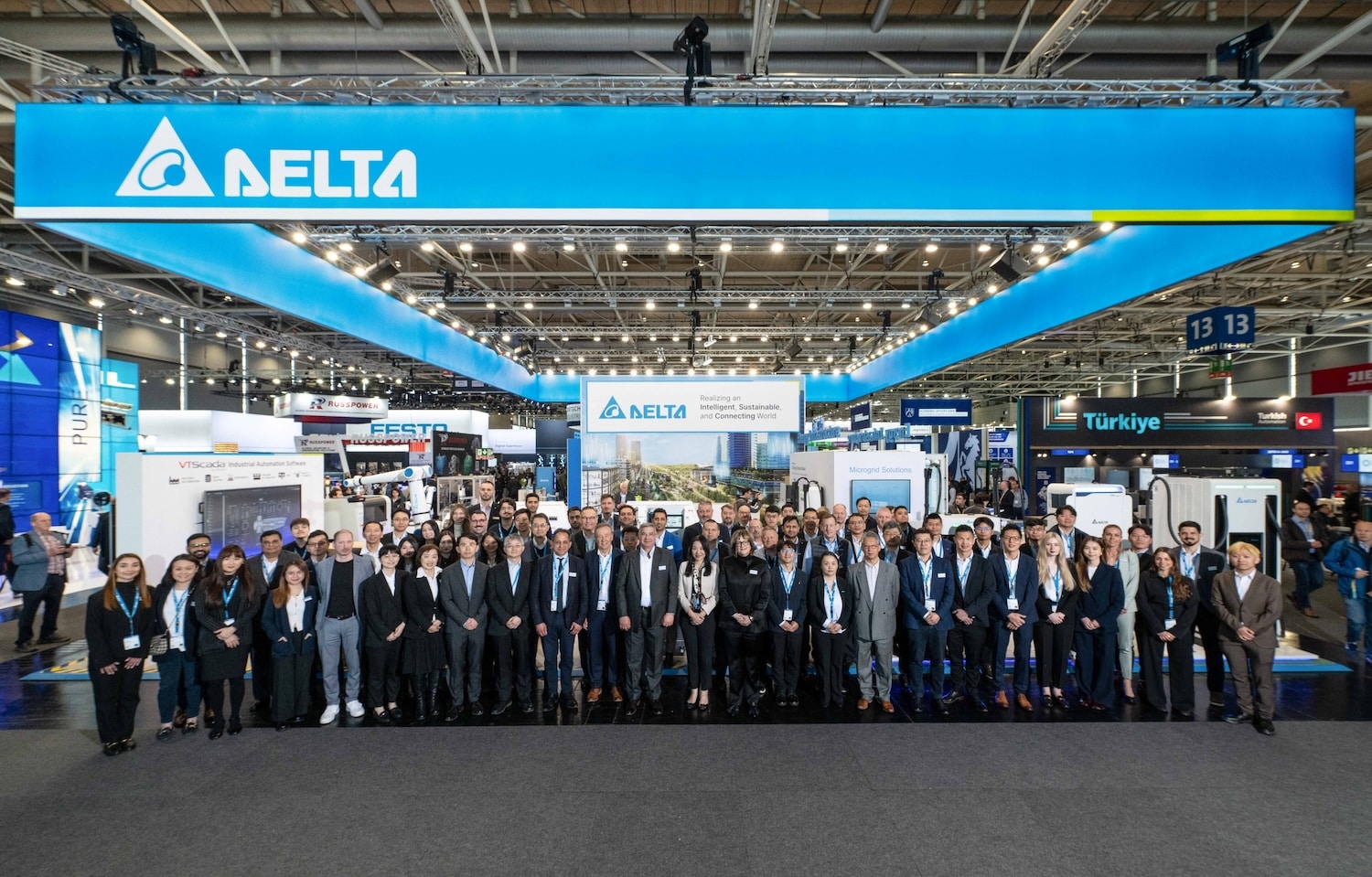
HANNOVER, Germany — Delta, a global leader in power management and smart green solutions, has unveiled a comprehensive suite of EV charging infrastructure solutions at Hannover Messe 2026. The company’s showcase emphasizes a “multi-vector” approach, integrating AI-driven smart manufacturing, digital twin technologies, and high-power energy management to address the surging demand for resilient industrial and public charging networks.
As industrial sectors navigate the dual challenges of digitalization and decarbonization, Delta is demonstrating how AI-enabled production intelligence can be seamlessly linked to electrified mobility. By feeding real-world data into physics-based digital models, the company aims to optimize the deployment and performance of charging ecosystems for fleet depots, public stations, and industrial sites.
AI-Driven Production and Digital Twin Validation
A central pillar of Delta’s presentation is the integration of its DIATwin systems, built on the NVIDIA Omniverse platform. This technology is currently being implemented within Delta’s own AI-driven smart production lines to enable a “Sim-to-Real” workflow. By validating production parameters in a digital environment before physical deployment, Delta can accelerate the commissioning of complex electrical components.
The DIATwin ecosystem utilizes PhysX libraries to generate intelligent recipes for printed circuit board (PCB) insertion. This process includes high-fidelity collision detection and iterative toolpath refinement, which improves throughput (UPH) and ensures the reliability of the hardware that powers modern electric vehicle charging stations.
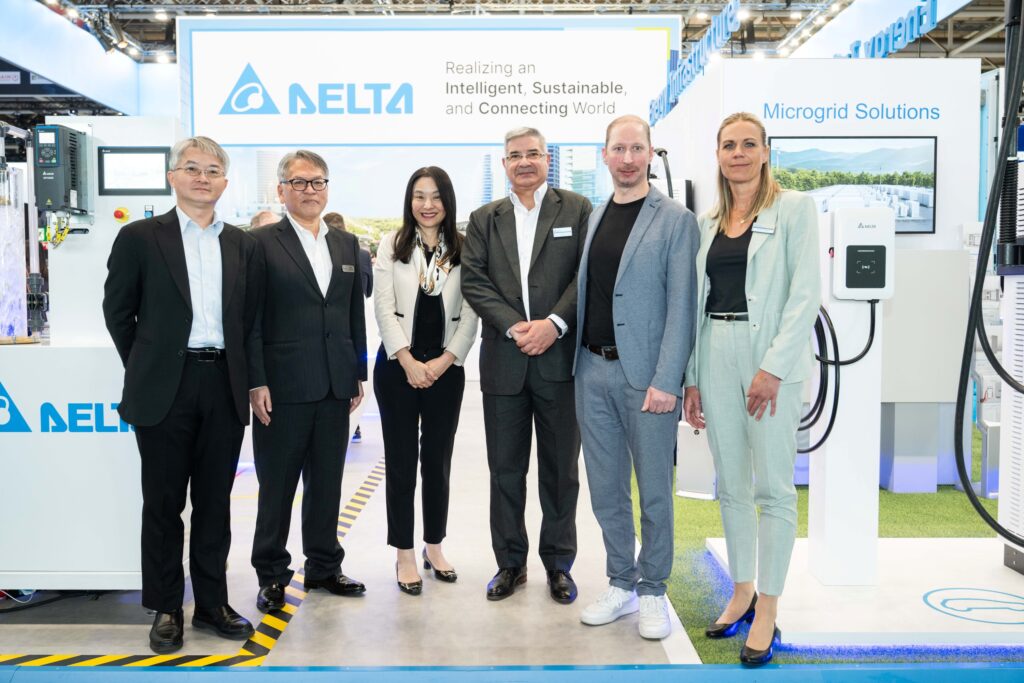
“At Delta, we have evolved to provide entire solutions and the integrated infrastructure that modern industries demand,” said Dalip Sharma, President and General Manager of Delta Electronics EMEA. “By scaling digitalized smart manufacturing, highly versatile and resilient electrification systems, as well as energy-efficient AI data centers, we help our customers not only to navigate complex production and energy challenges, but also to meet their ESG commitments.”
Strengthening Site Resilience via Integrated Energy Storage
To address the instability of decentralized power supplies, Delta is showcasing an EV charging-centric solution approach. This strategy integrates high-power charging hardware with energy storage, solar PV, and advanced energy management systems.
A key component of this resilient infrastructure is the C-Series All-in-One Energy Storage System (ESS). Designed for rapid deployment in commercial and industrial (C&I) applications, the liquid-cooled unit offers:
- Capacity: 125 kW / 261 kWh power and energy rating.
- Integration: Combines the Power Conditioning System (PCS), battery modules, and unit controller into a single cabinet.
- Flexibility: Supports peak shaving and load balancing to optimize grid utilization.
By utilizing the C-Series ESS alongside high-power chargers like the UFC500, operators can effectively manage grid constraints. This integration is critical for fleet depots and public charging hubs where simultaneous high-power draws could otherwise overwhelm local transformers.
Scalable Solutions for Industrial Electrification
Delta’s commitment to industrial transformation extends to automated intralogistics through its MOOV portfolio. The company announced a significant milestone at the event, having supported the charging of more than one million industrial vehicles worldwide. This achievement underlines the scalability of Delta’s fast charging tech in continuous logistics operations.
For energy-intensive industries, Delta is also highlighting specialized power solutions:
- Hydrogen Power Supply: Covering 5MW to 8.4MW units, providing liquid-cooled DC power for electrolyzers.
- Solid Oxide Fuel Cells (SOFCs): Providing stable, low-carbon on-site power generation to mitigate risks from grid instability and ensure continuous uptime.
These technologies provide a foundation for clean energy infrastructure that supports both stationary industrial power and the mobile energy needs of electric transport fleets.
Implications for the EV Charging Industry
The integration of AI and digital twins marks a significant evolution for EV charging infrastructure solutions. For industry professionals and investors, Delta’s move toward “closed-loop optimization” suggests that the next generation of chargers will be more reliable and faster to deploy.
By leveraging physics-based simulations, Delta can refine the motion logic and fixtures of its hardware, directly addressing the “uptime” concerns that have historically hindered public confidence in EV networks. Furthermore, the ability to combine solar, storage, and EV charging into a single managed ecosystem provides a blueprint for scalable energy ecosystems that can survive the transition to a high-demand, electrified future.
As the industry moves toward higher-power requirements, the “multi-vector” systems demonstrated at Hall 13, Stand C02, prove that battery innovation must be paired with intelligent energy management to be truly effective.