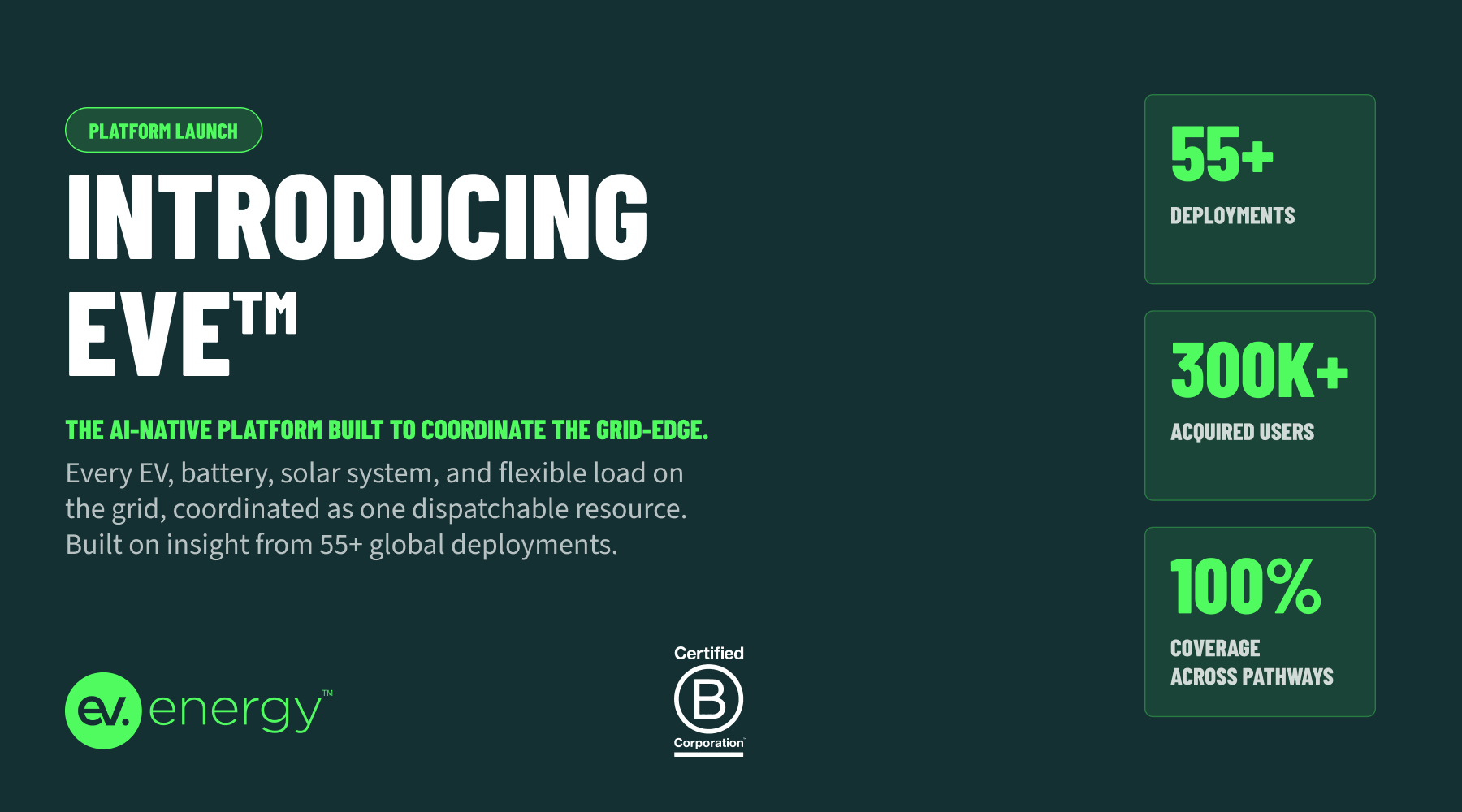
PALO ALTO, CA and LONDON, UK — Managed charging and virtual power plant (VPP) specialist ev.energy has officially launched Eve™, an AI-native multi-Distributed Energy Resource (DER) orchestration platform. The software architecture is engineered to aggregate and coordinate diverse grid-edge assets—including electric vehicles, residential batteries, rooftop solar arrays, and other flexible electrical loads—as a single, unified dispatchable resource.
Simultaneously, the company announced the BETA launch of Eve Insight, a conversational planning interface tailored for utility teams, which is currently rolling out to select utility clients. The underlying Eve platform has already scaled across more than 55 programs and serves over 300,000 customers throughout North America and Europe.
Mitigating the Grid Capacity and Affordability Crunch
The platform’s release coincides with intensifying macroeconomic and infrastructure strains on the utility sector. US retail electricity prices increased by 6.1% in the year leading up to April 2026, outpacing inflation by 61%. Furthermore, data from the Lawrence Berkeley National Laboratory indicates that the median wait time to connect a new power plant to the US grid reached approximately five years in 2023, up from less than two years in 2008, while data center energy demand is projected to more than double by 2030.
Eve addresses these constraints by allowing utilities to leverage existing grid-edge capacity. Operating via sub-5-minute, grid-aware controls at the individual device level, the platform can deploy targeted responses to highly localized infrastructure constraints. For instance, in the event of a strained distribution transformer, Eve can selectively dispatch only the assets within that specific constraint window. This coordinated fleet capability can be mathematically shaped to align with various grid signals, including distribution constraint relief, flat capacity baselines, peak arbitrage, or renewable energy matching.
“Utilities are being asked to absorb data center load growth, electrify transportation, hold customer bills, and prove ratepayer benefit across the full base – all on the same five-year clock that used to deliver a single power plant,” said Nick Woolley, CEO and co-founder of ev.energy. “Eve delivers deployed scale, device-level dispatch across every asset type, financial-grade evidence, and AI efficiency grounded in real operational data.“
Conversational Modeling via Eve Insight
The newly introduced Eve Insight interface aims to streamline complex regulatory and engineering modeling processes. Utility planners can query the system using natural language—such as evaluating feeder capacity under tripled EV penetration scenarios by 2028—to generate load growth forecasts, deferral business cases with net present value (NPV) metrics, and filing-ready regulatory evidence complete with confidence intervals.
To ensure analytical accuracy and data security, the conversational interface operates on three distinct data tiers:
- Public datasets for initial baseline modeling.
- Anonymized operational benchmarks derived from ev.energy’s 300,000+ user base.
- Isolated, sandboxed utility-specific data ingested exclusively upon explicit client authorization.
The architecture maintains SOC2 Type 2 compliance, IEEE 2030.5 CSIP certification, and European data privacy standards. During the current BETA phase, ev.energy’s internal teams will collaborate with utility clients to review all planning outputs intended for formal regulatory submission.