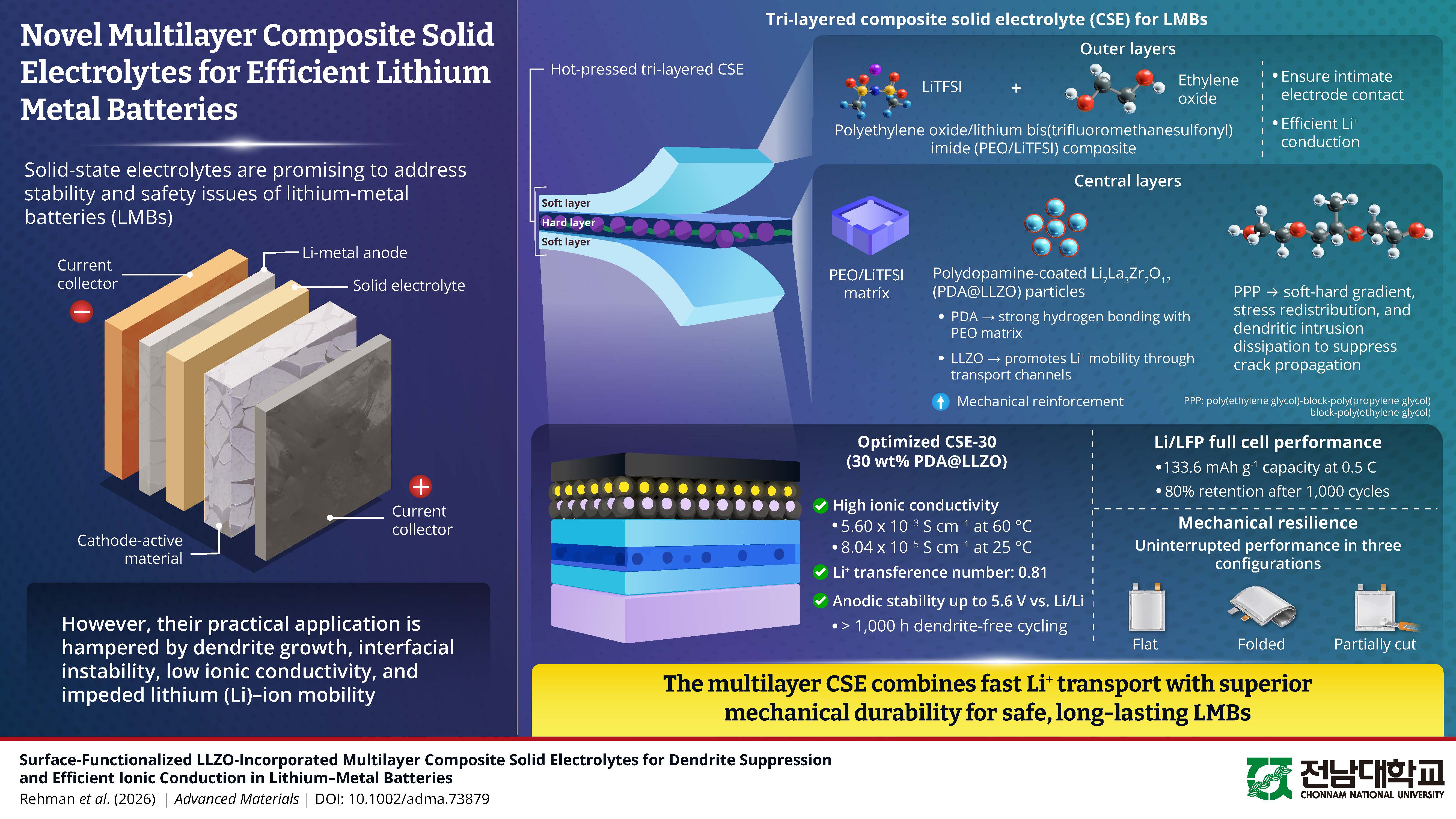
Researchers led by Professor Mincheol Chang from the Department of Polymer Engineering and the School of Polymer Science and Engineering at Chonnam National University, South Korea, have developed a new composite solid electrolyte designed to enhance ion transport and prevent dendrite formation in lithium-metal batteries (LMBs).
Lithium-metal batteries offer high theoretical storage capacity due to their pure lithium negative electrodes. However, widespread adoption has been hindered by low cycling stability, electrolyte degradation, uneven solid-electrolyte interface formation, and dendrite growth that causes safety concerns. Solid-state electrolytes provide electrochemical stability and manufacturing advantages, but conventional single-phase solid polymer systems suffer from low ionic conductivity.
The team’s study was published in Volume 38, Issue 43 of Advanced Materials on August 3, 2026.
Prof. Mincheol Chang, lead researcher at Chonnam National University, said:
“Inspired by the natural adhesive proteins mussels use to stick to rocks, our tri-layer composite incorporates chemically active ceramic fillers with a flexible triblock copolymer, boosting ionic conductivity and mechanical strength.”
Mussel-Inspired Bio-Chemistries Reinforce Solid Membrane
The tri-layer membrane is created through solvent-assisted dispersion, tape casting, thermal lamination, and hot pressing. Its structural configuration includes:
- Soft Outer Layers: Composed of a PEO/lithium bis(trifluoromethanesulfonyl)imide (LiTFSI) matrix that maintains contact with electrodes and creates pathways for lithium-ion mobility.
- Reinforced Central Core: A central layer composed of polydopamine (PDA)-coated LLZO ceramic particles combined with a ductile PPP triblock copolymer. LLZO refers to Li₇La₃Zr₂O₁₂, a garnet-type ceramic electrolyte.
- Active Chemical Mechanics: The PDA-coated LLZO (PDA@LLZO) particles increase ion transport via hydrogen-bond coupling with PEO chains, while PDA selectively interacts with TFSI⁻ anions to concentrate lithium-ion mobility. The PPP copolymer adds mechanical elasticity to help arrest lithium dendrite growth.
By improving ionic conductivity and mechanical strength at the same time, the tri-layer design addresses two of the main barriers to commercializing lithium-metal batteries: safety and cycle life.
Experimental Testing Demonstrates Enhanced Stability
The optimized formulation, designated as CSE-30 (containing 30% by weight of PDA@LLZO with balanced layer thicknesses), achieved nearly four times higher ionic conductivity than plain PEO-based electrolytes, alongside a lithium transference number of 0.81.
Laboratory testing of the CSE-30 electrolyte demonstrated:
- Symmetric Cell Stability: Delivered over 1,000 hours of continuous, dendrite-free cycling in symmetric cell tests.
- Full Cell Performance: Reached a capacity of 133.6 mAh g⁻¹ in full cell trials, retaining over 80% capacity after 1,000 charge/discharge cycles.
- Flexible Pouch-Cell Durability: Maintained uninterrupted power delivery to an LED light even when the flexible pouch cell was folded or partially cut.
Prof. Chang added:
“Our electrolyte is designed for next-generation lithium-metal batteries that can enable longer driving ranges for electric vehicles, safer batteries, flexible and wearable electronics, and long-cycle-life grid-scale energy storage.”
The multi-layer architecture offers a design model for improving the safety, structural integrity, and longevity of solid-state lithium-metal energy storage across electric mobility and consumer electronics.
Reference:
Title of original paper: Surface-Functionalized LLZO-Incorporated Multilayer Composite Solid Electrolytes for Dendrite Suppression and Efficient Ionic Conduction in Lithium–Metal Batteries
Journal: Advanced Materials
DOI: 10.1002/adma.73879