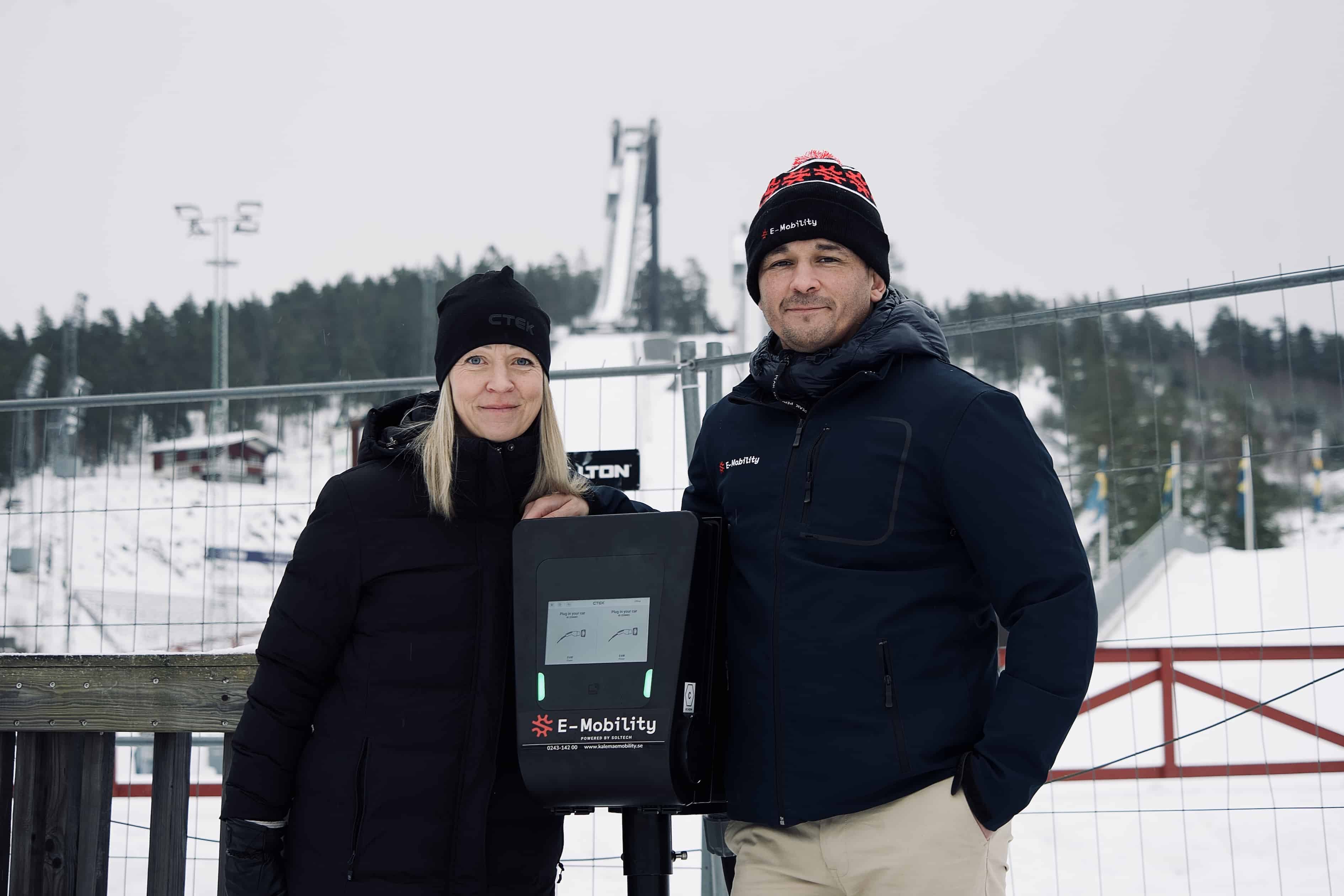
The logistical challenge of providing high-density electric vehicle charging stations at temporary sporting venues has found a new benchmark in Sweden. CTEK, the global charging brand, and installation specialist Kalema E-Mobility have successfully concluded a “pop-up” charging pilot at the Cross Country World Cup test event in Falun, proving that massive charging capacity does not require permanent, invasive infrastructure.
The installation served as a critical stress test for the upcoming Falun 2027 FIS Nordic World Ski Championships, where CTEK serves as the Official Technical Partner. By deploying a modular ecosystem that requires no ground excavation, the partners have established a repeatable blueprint for music festivals, international tournaments, and seasonal tourism destinations across Europe.
The Falun Model: High-Density Without the Digging
Temporary events typically struggle with “overbuilding”—the costly installation of permanent chargers that sit idle for most of the year. The Kalema and CTEK solution bypasses this by utilizing a “plug-and-play” architecture.
The Falun deployment featured 25 dual-outlet CTEK CC3 charge points, allowing up to 50 EVs to charge simultaneously. Each outlet delivered up to 22kW of power, a significant output for a temporary site. Notably, the entire system was built and decommissioned by just two technicians in only two days.
“Major events face growing pressure to provide sustainable transport solutions without overbuilding permanent infrastructure,” said Martin Götesson, CEO at Kalema E-Mobility. “What we’ve demonstrated in Falun is a scalable, modular charging solution that can be deployed quickly, managed efficiently, and removed or expanded as required.”
Intelligent Load Balancing and Grid Stability
A primary concern for clean energy infrastructure at remote or temporary venues is the strain on the local grid. To mitigate this, the installation integrated CTEK’s intelligent load balancing software. This technology dynamically distributes available power across the 50 active sessions, ensuring that the temporary site remains stable while maximizing the state of charge for every attendee.
The project also introduced a dual-purpose utilization model to maximize ROI:
- Daytime: Dedicated to spectator EV charging.
- Overnight: Reconfigured for charging operational and light transport vehicles.
This 24-hour cycle ensures that the hardware is constantly utilized, providing a commercially viable path for event organizers who previously viewed EV charging as a pure cost center.
Expert Insight: The Shift to Event Electrification
From an industry standpoint, the Falun pilot represents a shift in fast charging tech strategy. While permanent “hub” models like those from Tesla or IONITY focus on corridor charging, the “pop-up” sector addresses a massive, underserved gap in the market: peak-demand events.
As European regulations increasingly mandate lower carbon footprints for major public gatherings, the ability to scale up from 50 to 200 chargers—as planned for the 12-day championship in 2027—will become a competitive necessity. CTEK’s move into high-density modular hardware positions them as a primary competitor to traditional rental power companies that are now racing to pivot toward electrification.
Scaling for 2027: A Championship Blueprint
Following the success at the World Cup test event, the partnership is set to quadruple its footprint. For the FIS Nordic World Ski Championships in 2027, plans are underway for an installation of 100 dual-outlet charge points, accommodating 200 vehicles simultaneously.
Patrik Blomquist, Commercial Director for Falun 27, noted that the demand is already proven: 43 full-day charging spaces were booked in advance for the test event, with more sold on-site. “A much appreciated and sustainable element of the event,” Blomquist remarked.
Henk Lubberts, President of the Professional Division at CTEK, emphasized that this is a turning point for the visitor experience. “What Falun shows is that it doesn’t require permanent infrastructure to deliver meaningful capacity. With the right technology and the right delivery partner, it can be deployed efficiently and scaled as demand grows.”
Implications for the European EV Market
The success of this modular ecosystem is directly transferable to international sporting tournaments, exhibitions, and cultural festivals across the Nordics and beyond. By eliminating the need for “digging for cabling,” organizers can preserve the integrity of venues—such as parks or historic sites—while meeting the clean energy expectations of modern spectators.
As EV adoption rates continue to climb, the Falun case marks the transition from sponsorship-driven “token” charging to robust, solution-led electrification of the event industry.