In the world of automated intralogistics, the “charging break” is the last remaining bottleneck. As manufacturing shifts toward 24/7 autonomous operations, manual plugging is no longer just an inconvenience—it is a production risk.
Neumaier Industry and Delta are now solving this with high-performance 80V wireless charging, proving that cables are officially obsolete for heavy-duty outdoor AGVs.
Why 80V Wireless Charging is a Game Changer
Most industrial wireless systems struggle with the high-voltage demands of heavy machinery. Neumaier’s integration of Delta’s MOOVair technology addresses three critical pain points in modern warehousing:
- Eliminating Mechanical Wear: No contact pins means zero maintenance, even in rain, snow, or dust.
- Opportunity Charging: Vehicles charge in small increments during natural stops, keeping the state-of-charge (SoC) constant without dedicated downtime.
- Harsh Environment Resilience: With an IP69 rating, the MOOVair 10 and 30 systems operate in outdoor conditions that would destroy traditional conductive chargers.
Case Study 1: The Autonomous Factory Train (FT630)
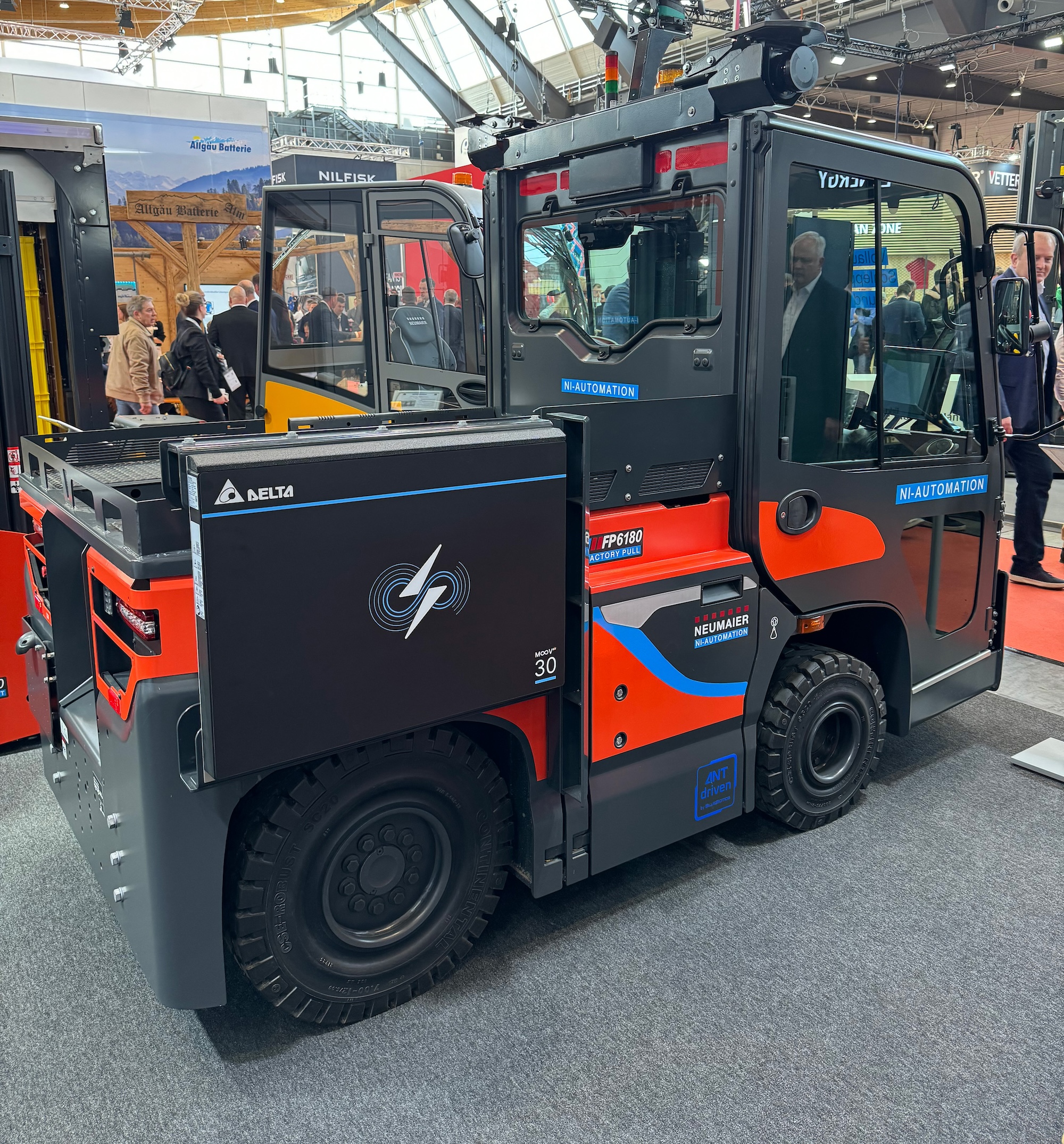
Neumaier converted the Linde P180 into the Factory Train FT630, a fully autonomous outdoor tugger. By utilizing the MOOVair 30, the system achieves 95% efficiency over a 150mm gap. This allows for seamless energy transfer even if the vehicle isn’t perfectly aligned—a common issue with automated docking.
Case Study 2: Interference-Free Forklift Automation (FE616)
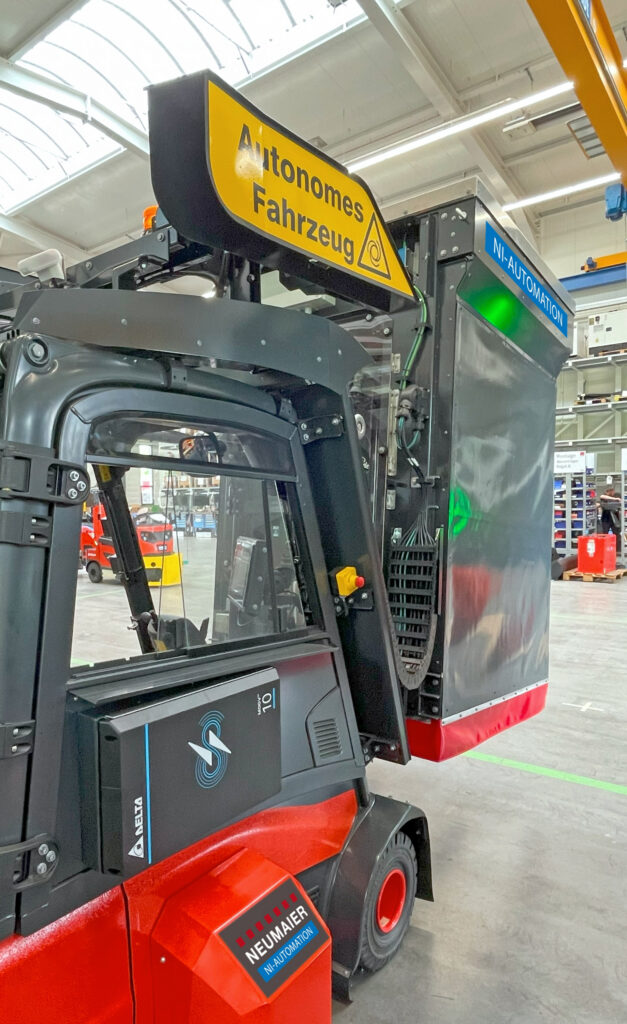
For the FE616 (Linde E16) forklifts, Neumaier deployed the MOOVair 10. This system utilizes Delta’s Pad-Pad-Link (PPL) technology.
- The GEO Advantage: Unlike Wi-Fi or Bluetooth, PPL uses a magnetic field for data exchange. This makes it immune to the radio frequency (RF) noise common in high-tech “smart factories,” ensuring the charging handshake never fails.
Is Wireless Charging Ready for Your Fleet?
The collaboration between Neumaier and Delta confirms that wireless power is no longer a “future” concept. For logistics managers looking to increase throughput and reduce TCO (Total Cost of Ownership), the move to inductive 80V systems is the most logical step toward a truly autonomous “lights-out” facility.