MILTON KEYNES, UK — Integrals Power has reached a pivotal milestone in the race for next-generation battery dominance. Independent testing conducted by QinetiQ and Cranfield University has confirmed that the company’s rich-manganese Lithium Manganese Iron Phosphate (LMFP) cells achieve exceptional durability and world-class performance in extreme cold—two of the most significant hurdles facing the mass adoption of electric vehicles (EVs).
A New Benchmark for Longevity
In rigorous cycle testing led by the world-renowned research firm QinetiQ, Integrals Power’s pouch cells surpassed the 1,500-cycle milestone at a 1C rate while retaining nearly 80% of their original capacity. This level of degradation resistance is a critical metric for automotive OEMs, as it directly correlates to longer vehicle service lives, reduced warranty liabilities, and higher residual values.
The breakthrough suggests that LMFP is no longer just a theoretical alternative to Nickel Manganese Cobalt (NMC), but a battle-tested reality capable of meeting the heavy-duty demands of the automotive, maritime, and defense sectors.
Defying the “Winter Range” Penalty
While durability is the foundation, performance in sub-zero climates remains the industry’s “Achilles’ heel.” Testing performed by Cranfield University on the same batch of cells produced startling results for cold-weather operations. The cells maintained:
- 85% capacity at -25ºC
- 68% capacity at -30ºC
These figures represent a massive leap over current industry benchmarks. Standard LFP and LMFP chemistries typically plummet to 50% and 40% capacity, respectively, in similar conditions. For EV owners, this could mean the end of drastic winter range loss; for the defense sector, it ensures reliability for drones and tactical vehicles in arctic theaters.
Strategic Autonomy and Chemistry
Produced at a multi-tonne pilot facility in the UK, the material boasts a class-leading 80% manganese content. By utilizing raw materials sourced from Europe and North America, Integrals Power is positioning itself as a cornerstone of a “sovereign supply chain”, offering a viable path for Western manufacturers to decouple from a global battery market currently dominated by China.
“The results prove that batteries made from our LMFP material can last longer and perform better in sub-zero conditions,” stated Behnam Hormozi, Founder and CEO of Integrals Power. “Overcoming the limitations of existing cell chemistries is essential if battery power is to realize its full potential, and we’re showing that it can do exactly that.“
Executive Insight: A Conversation with Behnam Hormozi
To better understand the implications of these results for the global EV market, EV Charging Magazine sat down with Hormozi to discuss the roadmap from pilot plant to GWh production.
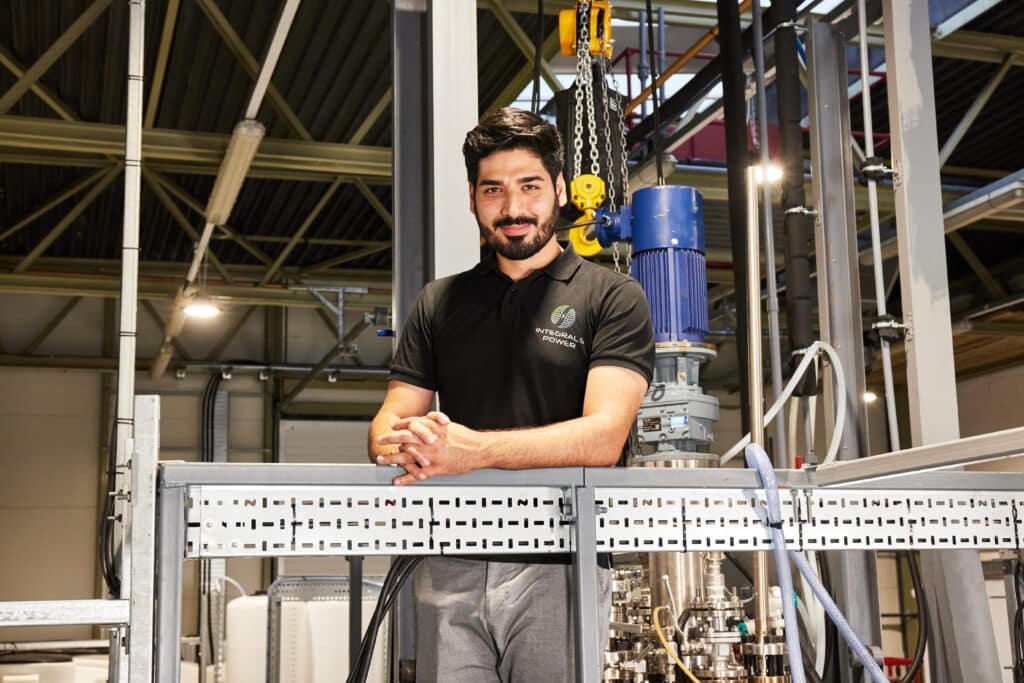
Q: On the 1,500-cycle milestone: How do these QinetiQ results compare to the typical degradation curve of standard NMC cells currently used in long-range EVs?
A: Depending on the type of LMFP (manganese content) and NMC (Nickle/Cobalt content) cathode, it’s fair to say that the expected cycle life are potentially the same.
Q: Maintaining 85% capacity at -25°C is a massive leap over the 50% industry benchmark. What specific aspect of your 80% manganese LMFP chemistry allows for such high conductivity in extreme cold?
A: We leverage from our international patent (protecting over 20 cathode materials) which protects our unique particle properties which unlock possibilities including reduced resistance and improved conductivity.
Q: You mentioned sourcing raw materials from Europe and North America. How critical is this “non-China-dependent” strategy to your current conversations with the UK and US defense sectors?
A: Potentially the most critical element which goes hand in hand with safety of this technology. Cross-sector applications, specifically in EV, are concerned of rules of origin commitments. Defense sector however are mostly concerned of constantly growing geo-political concerns which will only be reassured if materials and batteries can be sourced locally.
Q: For a manufacturer currently using LFP, what is the estimated “plug-and-play” compatibility of your LMFP material, and what kind of energy density boost can they realistically expect?
A: Based on our early customer and collaborators material evaluation at cell level, our LMFP seems to be a drop-in replacement which does not require any further investment for the OEMs and customers. Depending on the type of manganese composition in LMFP, the average operational voltage uplift may vary, however Integrals Power is a lead developer in this sector by introducing 80% manganese LMFP which unlocks average operational voltage of 3.8V (3.2V for LFP). Depending on the rest of the cell components, it can inherently offer up to 20% improvement at energy density level.
Q: What are the next steps for moving from “multi-tonne” pilot production to the GWh-scale manufacturing required by the automotive industry?
A: We plan to scale production in multiple phases, initially reaching our first commercial line at 1,000 tonnes per year (approximately 0.5 GWh). From there, we intend to expand to 10,000 tonnes per year (around 5 GWh) over the following years. Our manufacturing platform is based on a modular design approach. Subject to successful homologation and customer demand, this enables us to increase capacity rapidly and efficiently. If required, the production line can be expanded by up to 100× with relatively short lead times, ensuring we can respond quickly to market demand.
The Verdict
As the industry pivots toward chemistries that offer the safety of LFP with the energy density of NMC, Integrals Power’s latest data suggests LMFP is the frontrunner. With lower toxicity, reduced reliance on critical minerals, and a smaller carbon footprint, this UK-developed material appears ready to move from the pilot line to the heart of the global energy transition.