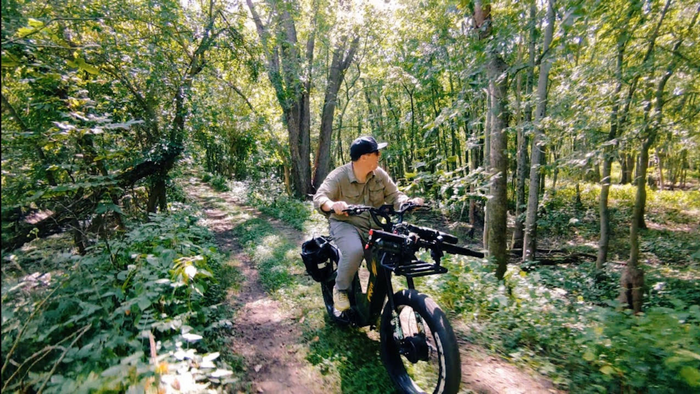
When you first decide to swap your car keys for an e-bike commuter, the initial 5-mile rides feel like a victory lap. You’re flying past gridlocked traffic, you aren’t burning cash at the gas pump, and you arrive at the office with a shot of pure morning adrenaline.
But when your daily route pushes past the 15- or 20-mile mark, reality starts to chip away at the romance.
A long-distance e-bike commute is a completely different animal than a casual weekend cruise. At 28 mph, an unexpected rain shower doesn’t just get you damp—it turns into a high-speed pressure washer forcing road grit into your shins. A poorly padded saddle or stiff grips will turn your wrists and lower back into a localized ache by mile twelve. And if you’re carrying a laptop and a change of clothes in a heavy backpack, your spine will be screaming before Tuesday afternoon.
After logging a few hundred miles on long, grueling blacktop routes, I learned that a good hunting bike is only half the equation. The other half is the infrastructure you bolt onto it. Here is the honest, field-tested breakdown of the long-distance commuter gear that actually makes the distance feel a lot shorter.
Frame-Mounted Cargo: Free Your Spine
If you take only one piece of advice from this guide, let it be this: Take the weight off your back.
❌ Bad: 20-lb Backpack —> Raises center of gravity, creates massive lower back fatigue.
✅ Better: Waterproof Panniers —> Low center of gravity, completely unweights your spine.
When you carry a heavy backpack on a 45-minute e-bike commute, you are forcing your core to stabilize that extra mass at high speeds. It causes your back to sweat through your clothes and puts immense pressure on your tailbone.
The single best upgrade you can make is a set of premium, waterproof pannier bags that latch directly to your rear rack, like the Birch eBikes.
- The Stability Factor: Shifting your laptop, lunch, and spare clothes into side-mounted panniers drops your bike’s center of gravity drastically. The bike instantly feels more planted, stable, and predictable when leaning into sharp corners at Class 3 speeds.
- The Quick-Release Standard: Look for bags featuring quick-lock mounting infrastructure. When you roll into your office bike locker, you pull a single handle, the bags unclip instantly, and you walk into your meeting looking like a human being rather than a sweaty pack mule.
Vibration Isolation: Suspension Posts and Ergonomic Touchpoints
At 12 mph on a traditional bicycle, you have plenty of time to spot a pothole, stand up on your pedals, and absorb the shock with your knees. At 25 to 28 mph on a commuter e-bike, you hit road hazards before your brain even registers them. Because e-bike commuters tend to stay seated to maintain high pedaling cadence, your spine takes a relentless pounding from bridge expansion joints and broken city asphalt.
What surprised me after my first month of long-distance riding was how much energy I was wasting just fighting road buzz. I fixed it with two specific upgrades:
- Linkage Suspension Seatposts: Swapping the stock rigid seatpost for a parallel-linkage post completely transforms the chassis. Instead of compressing straight down, a parallel-linkage pivots down and slightly backward, absorbing the horizontal slam of sharp asphalt edges. It isolates your lower back, extending your comfortable riding time by hours.
- Winged Ergonomic Grips: Standard round handlebar grips force your hands to hold all your upper-body weight on a narrow strip of bone. Upgrading to a flanged, rubberized wing grip flattens out the contact patch. It supports the heel of your palm, preventing your fingers from going numb fifteen miles into the ride.
Puncture Insurance: The Tannus Armour Real-World Check
There is nothing quite like the crushing defeat of feeling a tire go soft when you are still seven miles away from the office, watching the minutes tick down toward your morning meeting. Because e-bikes are heavy and structurally complex, changing a flat rear tire on a hub-drive motor on the side of a busy commuter corridor is an absolute nightmare involving wrenches, motor cables, and zip ties.
[Standard Inner Tube] —> Sharp glass/wire punctures easily.
[Tannus Armour Insert] —> 15mm of high-density foam protects tube from debris.
To prevent this, long-range commuters treat tire protection like an insurance policy.
- The Tech: Install a high-density foam tire liner, specifically Tannus Armour, between your tire tread and your inner tube.
- The Reality: It adds a thick, 15mm barrier of micro-cellular foam directly under the tread. If a sharp piece of road wire or glass slices through your commuter tire, it gets stuck in the foam before it ever reaches the air tube.
- The Bonus: The foam dampens the high-frequency vibration of the road, making the tire feel significantly more supple and smooth on rough surfaces.
Electronics: Dedicated GPS vs. The Smartphone Battery Drain
Most new commuters start out by clamping their smartphone to the handlebars using a cheap plastic mount. Within a week, they realize why this doesn’t work for long-distance routes. Running active mapping apps with the screen brightness turned all the way up to compete with daylight will completely drain a modern smartphone battery in about two and a half hours. If you have an emergency or a mechanical breakdown on the way home, a dead phone is a massive safety hazard.
Furthermore, the continuous 25–50Hz vibration produced by high-speed hub motors has a nasty habit of shattering the delicate optical image stabilization (OIS) systems inside modern phone cameras.
For serious daily commuters, the pro move is to outsource your data to a dedicated cycling computer with native electric-vehicle integration.
Through ANT+ LEV wireless protocols, these head units connect directly to your bike’s motor brain. Instead of just showing a generic map, they display your real-time battery percentage, your current assist level, and—most importantly—they cross-reference your remaining battery capacity with the upcoming hills on your route. It takes away the “range anxiety” of a long ride, letting you know exactly how much throttle or turbo mode you can safely use to get home on time.
All-Weather Infrastructure: Full-Wrap Aluminum Fenders
If you live in a climate where it rains, cheap clip-on plastic mudguards are useless. They twist out of alignment, rattle against your tires when you hit bumps, and only protect a tiny fraction of your back.
A long-distance rig requires full-wrap, bolted-aluminum fenders that curve all the way down past the midline of both wheels.
- The Defense: A proper front fender needs a flexible mud flap that extends nearly to the asphalt. This catches the dirty road water spinning off the front tire before it gets thrown straight onto your shoes and the bike’s bottom bracket electronics.
- The Mechanical Guard: It keeps the corrosive road salt and grime out of your chain and motor housing, cutting your weekly drivetrain cleaning and maintenance time in half.
A long commute shouldn’t feel like an endurance test or an athletic chore. When you strip the heavy load off your spine with a solid quick-release pannier system, isolate your joints from road harshness with linkage suspension, and secure your tires against punctures, the miles disappear. You stop focusing on the logistics of the commute and get to enjoy the ride for exactly what it is: the best part of your workday.
What does the asphalt quality look like on your daily route? Whether you’re dealing with flat urban concrete or rough country highways, I can help you find the exact rack dimensions or visibility setup to keep your long ride smooth!