A whole-portfolio warranty move reshapes the fleet TCO calculation — and closes a long-standing coverage gap for commercial EVs
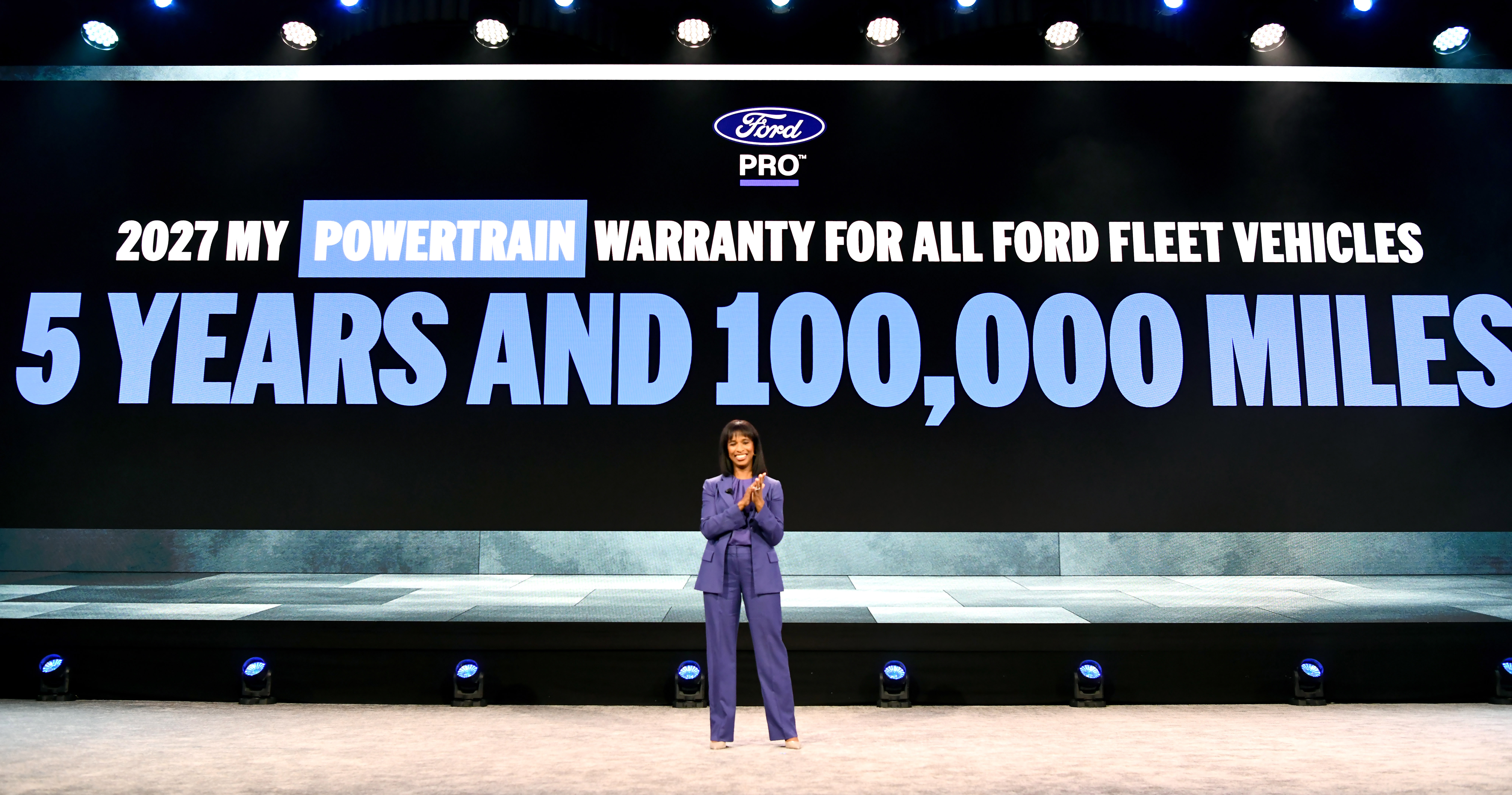
At Ford Pro’s Fleet Preview event in Las Vegas, Ford Pro President Alicia Boler Davis announced a stronger reliability and value commitment to American businesses. Starting with the 2027 Model Year (27MY), Ford is expanding its 5-year/100,000-mile limited powertrain warranty across its commercial portfolio, bringing additional 2027 models under coverage that Ford’s core commercial trucks and vans already carry.
For commercial EV buyers, the most notable part of the expansion is what it captures: the warranty now reaches Ford’s core commercial electric platforms, including the 2027 E-Transit and the 2027 Mustang Mach-E.
For business operators, the change feeds directly into the Total Cost of Ownership (TCO) calculation. Because the warranty is transferable and stays with the vehicle even when it is sold to a non-fleet or retail buyer, Ford Pro is addressing one of the most stubborn hurdles in commercial electrification: residual-value predictability.
To qualify, commercial accounts register for a Fleet Identification Number (FIN Code) and purchase under a “fleet” sales type — a benefit Ford Pro describes as exclusive to FIN Code customers.
What the 2027 expansion covers
Beginning with the 2027 model year, the 5-year/100,000-mile limited powertrain warranty extends to:
- 2027 MY Explorer
- 2027 MY Maverick
- 2027 MY Ranger
- 2027 MY Mustang (excluding GTD)
- 2027 MY Bronco (excluding Raptor)
- 2027 MY Bronco Sport
- 2027 MY Mustang Mach-E
- 2027 MY Expedition
- 2027 MY E-Transit
These join Ford commercial products already covered by the warranty: 2022-and-newer F-150, Super Duty (F-250 through F-600), Transit, F-53/F-59 stripped chassis, and E-Series (23MY+).
Ford Pro frames the benefit around three points: lower TCO through fewer unexpected repair costs, a higher resale value because the coverage transfers with the vehicle, and continued commercial leadership — building on what the company calls 41 years of commercial truck and van leadership.
To unpack how the expansion aligns mechanical coverage with Ford’s existing high-voltage EV battery coverage, EV Charging Magazine spoke with Maureen Murphy, Ford Pro EV Brand Manager.
Exclusive Q&A with Maureen Murphy, Ford Pro EV Brand Manager

1. Accelerating EV adoption via TCO confidence
Battery and powertrain longevity are primary concerns for fleet managers. How does extending the 5‑year/100,000‑mile powertrain warranty to models like the E‑Transit and Mustang Mach‑E directly address residual value concerns and accelerate adoption among hesitant commercial buyers?
Ford Pro knows total cost of ownership (TCO) is important to fleet customers, and maintenance is a big part of that equation. Extending the powertrain warranty to our electric vehicle lineup allows us to maximize resale value for our customers while helping them to offset costs associated with the entire lifecycle of the vehicle.
2. Battery vs. powertrain alignment
Ford already offers an 8‑year/100,000‑mile warranty on key EV components such as the battery. How does matching the powertrain warranty to 5 years/100,000 miles create a more seamless, holistic risk‑reduction strategy for fleets operating demanding duty cycles?
The two warranties work in tandem, aiming to ensure all major components of the vehicle are covered for the entire first lifecycle of the vehicle, with the 8-year/100,000-mile EV component warranty covering electrical components and the 5 year/100,000-mile warranty covering mechanical components. Previously, the powertrain warranty was capped at 60,000 miles, which created a gap between 60,000 to 100,000 miles where the EV components were covered but the mechanical components were not. This alignment helps eliminate risk and provide reassurance to fleet managers who are considering the operational and financial impacts of their vehicles across the entire duty cycle.
3. Impact on resale value and second life
This warranty remains with the vehicle if sold to a non‑fleet customer. In the growing secondary market for commercial EVs, how do you expect this transferability to affect resale value and the second-life potential of fleet‑retired E‑Transits and Mach‑Es?
This transferability addresses one of the largest concerns of the EV transition, the used vehicle market. The primary buyers benefit from a higher resale value due to more standardized value and more security/certainty around the longevity of the vehicle, improving their TCO. Given secondary buyers are usually small businesses or retail consumers, they may be more price-sensitive. This transferable warranty allows customers to operate the vehicle “worry free” until it expires by reducing anxiety around out-of-warranty repair costs and providing the same peace of mind as the first owner.
4. Role of Ford Pro Intelligence and uptime
Beyond warranty coverage, Ford Pro emphasizes uptime through telematics and data. How will Ford Pro Intelligence and remote diagnostics work alongside the expanded warranty to enable predictive maintenance and reduce warranty claims?
Ford Pro Intelligence and remote diagnostics help shift fleet operations from a reactive to proactive model, aiming to reduce warranty claims and increase uptime. By using real-time vehicle data, Ford Pro Telematics allows fleet managers to schedule preventative maintenance before a minor issue cascade, protecting the vehicle and reducing the severity of claims. Ford Pro Fleet Management Software also works alongside the warranty by logging warranty-covered parts, tracking vehicle age/mileage, and helping to schedule routine service in perfect alignment with manufacturer recommendations.
5. Future expansion of the commercial EV lineup
Including the 2027 E‑Transit and Mustang Mach‑E signals strong commitment to commercial electrification. How does a robust warranty framework like this support Ford Pro’s roadmap for future commercial EVs or specialized fleet variants?
Establishing this high-mileage standard today on the 2027 E-Transit and Mustang Mach-E shows that Ford stands-by the durability of these vehicles. We continually use data and customer feedback to inform engineering and maintenance cycles to optimize our vehicles and inform the design of future products, helping to build trust and deliver value to our customers in our next generation EVs. The warranty also de-risks specialized fleet variants and upfits by reassuring upfitters and buyers that the vehicle platform can handle heavy-duty applications and will be protected.